Castelo Rosso
Castelo Rosso, perched on the conical hill of Montofoli near Karystos in Greece, is a remarkable example of a medieval hill castle with a rich history spanning several centuries and diverse cultural influences. Constructed after 1205 by the Lombard Dalle Carceri family, the castle was strategically positioned to oversee the southern part of the island of Euboea. It stands on the site of an earlier Byzantine fortress dating back to the 11th century, illustrating the continuity of defensive needs in this historically contested region.
The historical significance of Castelo Rosso
The castle's history is marked by a series of power shifts reflecting the turbulent politics of medieval Greece. Initially established by the Lombards, it served as both a residence and an administrative center. In 1276, the fortress was briefly seized by the Byzantine commander Likarios, only to be reclaimed by the Lombards under Boniface of Verona in 1295. The death of Boniface in 1318 led to the transfer of control to the Catalans, who held sway over the castle during the early 14th century.
In 1366, the fortress entered Venetian hands when it was purchased for 6,000 ducats. However, Venice opted to lease the castle to noble families rather than administer it directly. The Justiniani family controlled the castle from 1386, followed by the barony of Nicolo Giorgi from 1406. This period saw the castle functioning as a feudal stronghold within the complex political landscape of the region.
The Ottoman conquest of Chalkida in 1470 brought Castelo Rosso under Ottoman rule, where it became known as Kizil Hisar, meaning "Red Castle" in Turkish. Despite the change in sovereignty, the local Greek population continued to inhabit the area until the uprising of 1684. During the Greek War of Independence in 1821, the castle withstood multiple sieges by Greek revolutionaries such as Androutsos, Kriezotis, and Faviero, although it ultimately remained under Ottoman control.
Architectural features and construction details
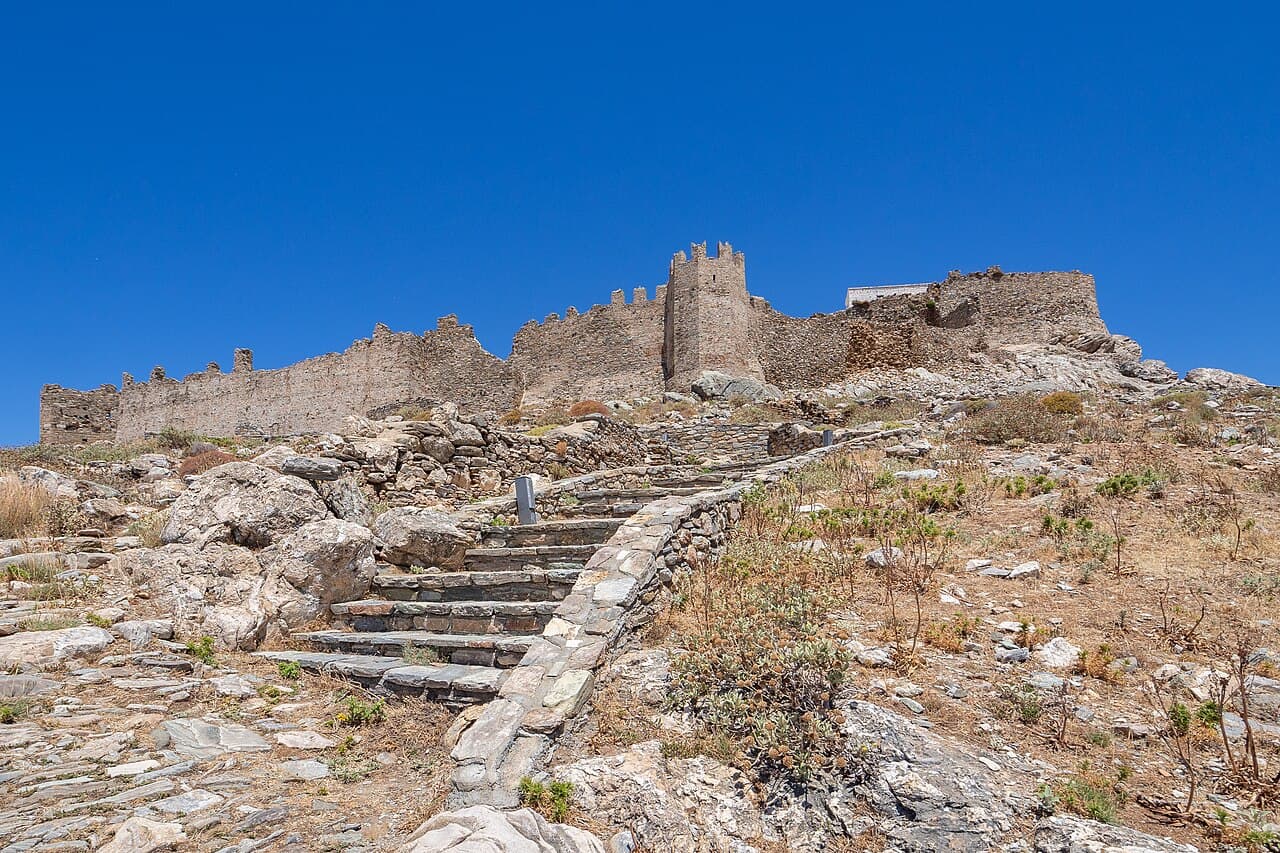
Castelo Rosso is characterized by its adaptation to the natural topography of Montofoli hill. The fortress comprises two main enclosures that follow the contours of the terrain, enclosing the medieval settlement that once flourished within. The original stronghold at the summit, serving as the keep or donjon, no longer survives, but its former presence indicates the castle's defensive depth.
The fortress walls are constructed primarily from local red schist stone, which gives the castle its distinctive name and color. These stones are bonded with a durable mixture of sand, gravel, and lime mortar, a construction technique that has preserved much of the structure up to the height of the battlements. The castle originally featured four towers, including a notable pentagonal tower on the southeast side, enhancing its defensive capabilities. The main entrance gate is located on the southwest side, strategically positioned for control and defense.
Internal structures and water management
Inside the castle walls stands a two-story rectangular building, believed to have served domestic or administrative functions. Surrounding this building are the ruins of smaller houses, indicating a once-thriving community within the fortifications. Several cisterns are scattered throughout the site, which were used to collect and store rainwater, a vital resource given the castle's hilltop location.
A church dedicated to the Prophet Elias is situated adjacent to the rectangular building, reflecting the religious significance of the site during later periods. To the north, an aqueduct channel ingeniously brings water from Mount Ochi into the castle, demonstrating advanced medieval water management and engineering skills that supported the castle's inhabitants.
Preservation and restoration efforts
Since 1967, preservation efforts have focused on maintaining the structural integrity and historical character of Castelo Rosso. Restoration work has been concentrated on the entrance gate, parts of the outer walls, and the battlements, helping to stabilize these key defensive features. These efforts have preserved the castle's silhouette and allowed visitors to appreciate its medieval architecture and strategic importance.
Today, Castelo Rosso stands as a significant cultural heritage site that embodies the layered history of Euboea, from Byzantine origins through Lombard, Catalan, Venetian, and Ottoman periods. Its well-preserved fortifications and archaeological remains offer valuable insights into medieval military architecture and the region's complex historical narrative.
Frequently asked questions (FAQ)
- How do I get to Castelo Rosso near Karystos?
- Castelo Rosso is located on Montofoli hill near Karystos in Central Greece. Visitors can reach the site by car or local transport from Karystos town, followed by a short hike up the hill to the castle ruins.
- What is the historical significance of Castelo Rosso?
- Castelo Rosso played a key role in medieval Euboea, serving as a Lombard, Catalan, Venetian, and Ottoman fortress. It witnessed numerous sieges and political changes, reflecting the turbulent history of the region.
- Can I visit the restored parts of Castelo Rosso?
- Yes, parts of Castelo Rosso, including the entrance gate, outer walls, and battlements, have been restored and are accessible to visitors. The site offers panoramic views of the surrounding landscape and insights into medieval fortification architecture.
- What architectural features make Castelo Rosso unique?
- The castle's construction with local red schist stone, the pentagonal southeast tower, and the advanced water management system including cisterns and an aqueduct channel from Mount Ochi distinguish Castelo Rosso as a notable example of medieval military architecture in Greece.
- When was Castelo Rosso built and by whom?
- Castelo Rosso was built after 1205 by the Lombard Dalle Carceri family on the site of an earlier Byzantine castle, serving as a residence and administrative center in southern Euboea.
Photo gallery

Information
Loading map...
Visitor reviews
No reviews yet. Been here? Write the first review and help other travelers!
Write the first reviewVisited this castle? Share your experience
Your review helps other travelers and adds first-hand knowledge to our encyclopedia.