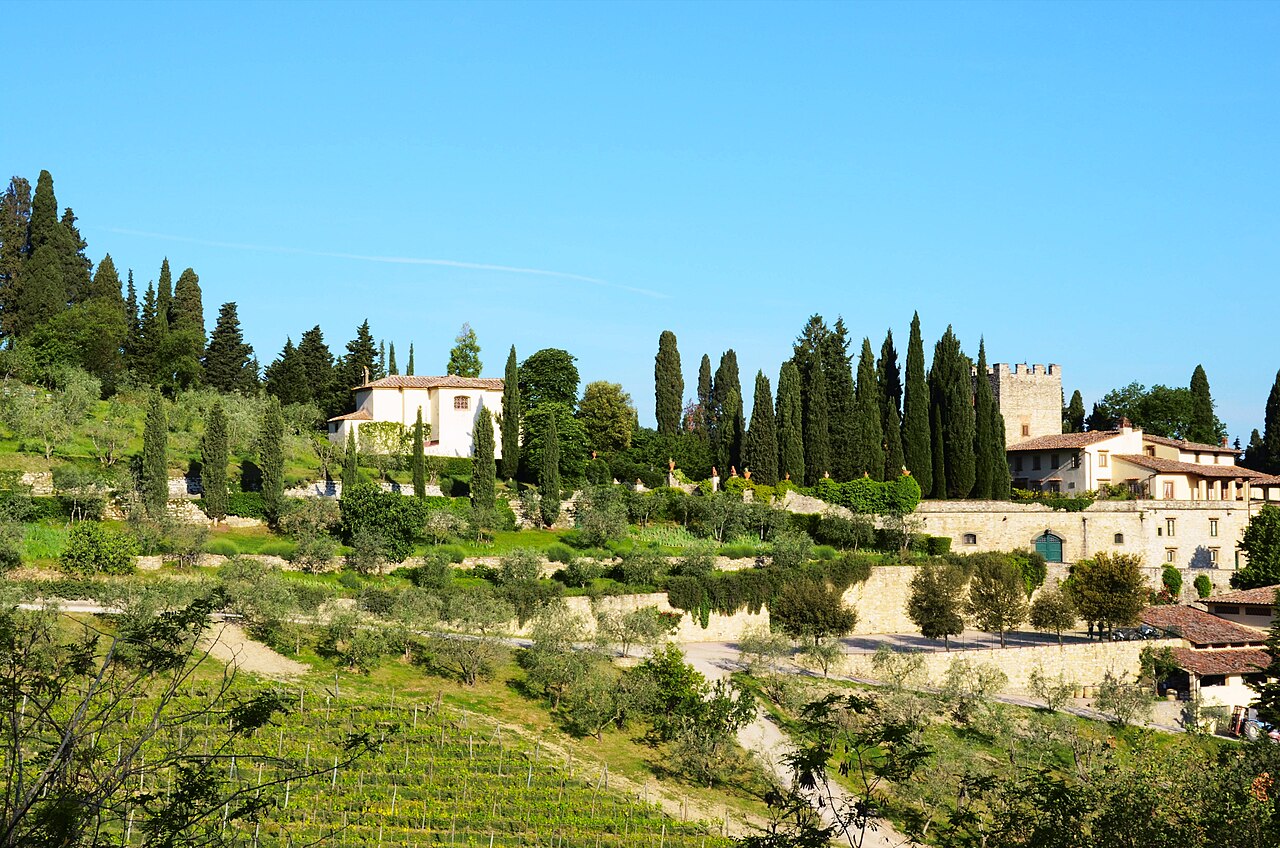
Castello di Gabbiano
Castello di Gabbiano is a remarkable Renaissance hill castle located in San Casciano in Val di Pesa, within the renowned wine region of Tuscany, Italy. Originally constructed in the early 15th century by a branch of the influential Bardi family, the castle exemplifies the architectural and cultural flourishing of noble estates during the Renaissance period in Tuscany. Its strategic position atop a hill provided both defense and commanding views of the surrounding Chianti landscape, a characteristic feature of many Tuscan castles designed to serve as both fortified residences and symbols of power.
Historical significance and ownership
The castle's history is deeply intertwined with prominent Tuscan families and the political upheavals of Florence. After its initial construction, Castello di Gabbiano came into the possession of Tommaso Soderini, father of Pier Soderini, who was an important political figure as the gonfalonier or chief magistrate of the Florentine Republic. This connection elevated the castle's status as a seat of political influence closely linked to Florence’s ruling elite during the turbulent late 15th and early 16th centuries.
However, the castle's fortunes changed dramatically with the return of the Medici family to power in Florence. The Soderini family, aligned with the Republic’s opposition to the Medici, were forced into exile, leading to the castle's abandonment and subsequent deterioration. This period of decline lasted until the early 17th century.
In 1623, a significant restoration was undertaken, and the castle was returned to the Soderini family. A commemorative plaque above the main entrance still marks this restoration, noting the poor condition of the castle at that time. Over the following centuries, ownership passed to other noble families, including the Rosselli Del Turco family in the 19th century, who added a neoclassical chapel reflecting the architectural tastes of that era.
Later, the Lemmi family carried out extensive restoration efforts to preserve and enhance the castle’s structure and interiors. In the 20th century, the estate was owned by notable individuals such as the writer Arnaldo La Cagnina, linked to the aristocracy through his marriage to Claude d’Orléans. The castle eventually came under the ownership of the Arcaini family and today functions as a winery managed by the Beringer Blass group. This continuous adaptation highlights the castle’s resilience and evolving role from noble residence to a center of viticulture.
Architectural features and layout
Fortified design and towers
Castello di Gabbiano is distinguished by its imposing quadrangular plan, a typical Renaissance noble residence layout combining defensive and residential functions. Each corner of the castle is marked by cylindrical towers added after the mid-15th century, enhancing both its fortification and aesthetic presence. These towers resemble those of the nearby Castello di Meleto, indicating regional architectural influences and shared defensive strategies during that period.
The castle’s main façade is dominated by a central square-based tower, believed to be the original core of the structure around which the later expansions were built. The masonry of this tower contrasts with the curtain walls connecting the cylindrical towers, revealing different construction phases and techniques. This juxtaposition of masonry styles provides insight into the castle’s architectural evolution from a medieval stronghold to a Renaissance noble residence.
Interior decoration and renovations
The 19th-century renovations brought significant artistic enhancements to the castle’s interiors, particularly within the corner towers. These rooms were decorated with frescoes depicting idyllic and Arcadian scenes, reflecting the romanticized pastoral themes popular in that era. The frescoes contribute to the castle’s cultural value, illustrating a vision of harmony between nature and noble life.
The main hall of the castle features a restored coffered ceiling, a hallmark of Renaissance interior design that adds depth and elegance to the space. The intricate woodwork and geometric patterns of the ceiling highlight the craftsmanship and artistic tastes of the period.
The addition of a neoclassical chapel by the Rosselli Del Turco family further diversified the castle’s architectural narrative. This chapel stands as a testament to the evolving religious and aesthetic sensibilities of the castle’s owners during the 19th century, blending classical elements with the castle’s Renaissance character.
Preservation and current use
Despite periods of neglect and decline, Castello di Gabbiano has been carefully preserved and restored over the centuries. The commemorative plaque above the main entrance serves as a historical marker of the castle’s resilience and the commitment of its owners to maintain its legacy.
Today, the castle operates as a winery under the management of the Beringer Blass group, integrating its historical and architectural heritage with contemporary agricultural practices. This adaptive reuse ensures the castle remains a vibrant part of the Tuscan landscape, attracting visitors interested in history, architecture, and wine culture.
The castle in the context of Tuscan heritage
Castello di Gabbiano exemplifies the rich tapestry of Tuscan history, where noble residences served multiple roles as defensive structures, political centers, and cultural landmarks. Its layered history, from the Bardi family origins through the Soderini and Medici conflicts to modern restoration and wine production, mirrors the broader historical currents of Tuscany.
The castle’s architectural features, including its cylindrical towers, quadrangular layout, and neoclassical chapel, provide valuable insights into the evolution of castle design from medieval fortifications to Renaissance palatial homes. Its preservation and continued use contribute to the cultural and economic vitality of the region, making it a significant site for both heritage tourism and viticulture.
Frequently asked questions (FAQ)
- When was Castello di Gabbiano originally constructed?
- Castello di Gabbiano was originally constructed in the early 15th century during the Renaissance period by the Bardi family.
- What architectural features define Castello di Gabbiano?
- The castle features a quadrangular layout with cylindrical towers at each corner and a central square-based tower, combining defensive strength and Renaissance noble residence aesthetics.
- Who were some notable owners of Castello di Gabbiano?
- Notable owners include the Bardi family, Tommaso Soderini and his son Pier Soderini, the Rosselli Del Turco family, the Lemmi family, and the current owners, the Beringer Blass group.
- What is the current use of Castello di Gabbiano?
- Today, Castello di Gabbiano operates as a winery under the management of the Beringer Blass group, integrating its historical heritage with contemporary wine production.
- What artistic features are found inside the castle?
- The interior includes 19th-century frescoes depicting Arcadian scenes in the corner towers and a restored coffered ceiling in the main hall, reflecting Renaissance and romantic artistic influences.
Information
Sources & official resources
Verify the information above using these authoritative references.
Loading map...
Visitor reviews
No reviews yet. Been here? Write the first review and help other travelers!
Write the first reviewVisited this castle? Share your experience
Your review helps other travelers and adds first-hand knowledge to our encyclopedia.