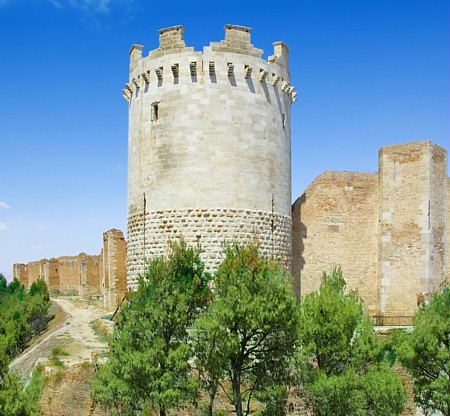
Castello di Capua
Castello di Capua stands as a remarkable testament to the layered history of southern Italy, embodying the transition from a medieval fortress to a refined Renaissance noble residence. Located on the strategic Serrone hill in the town of Gambatesa, this castle historically marked the frontier between the regions of Molise and Puglia. Its elevated position provided a commanding view of the surrounding landscape, underscoring its primary role as a defensive military outpost designed to guard the volatile borderlands.
The castle’s origins trace back to the 13th century, when it was first documented as a feudal stronghold under the lordship of Riccardo di Pietravalle. Throughout the Middle Ages, Castello di Capua served both as a military bastion and a residence for local nobility, reflecting the region’s turbulent history marked by frequent conflicts and shifting allegiances. Its robust stone walls, fortified towers, and battlements were essential features for defense against invasions and local skirmishes.
In 1484, the castle entered a new chapter under the ownership of the Di Capua family. This noble lineage initiated a significant transformation during the Renaissance period, particularly in the mid-16th century, when the fortress was remodeled into an elegant palace that combined military functionality with artistic refinement. The renovation was led by Vincenzo di Capua, who commissioned the celebrated Salento artist Donato Decumbertino in 1550 to execute an extensive cycle of frescoes. These artworks intricately blend themes from mythology, Christian iconography, and family history, aimed at glorifying the Di Capua family’s virtues across moral, civil, and military domains.
Historical significance and noble lineage
The castle’s history is closely intertwined with notable figures of the Di Capua family. Giovanni di Capua is historically recognized for his heroic act of saving the life of King Ferdinand II of Aragon during the 1495 conflicts. Another family member, Matteo di Capua, is remembered for his valiant death at the Battle of Otranto in 1480, a pivotal event in the defense against Ottoman incursions. These personal stories enrich the castle’s narrative, illustrating its role not only as a military fortress but also as a symbol of noble duty and sacrifice.
Ownership of Castello di Capua evolved over the centuries, passing through various noble titles including barons and marquises, before eventually transitioning to private ownership in more recent times. Since 2014, the castle has been under the stewardship of the Italian Ministry of Cultural Heritage as part of the Molise Museum Network, ensuring its preservation and public accessibility as a significant cultural landmark.
Architectural features and defensive design
Architecturally, Castello di Capua retains its distinctive medieval quadrangular layout, constructed predominantly from locally sourced stone. The fortress is perched prominently on the hilltop, leveraging natural topography for defense. Its massive defensive walls are crowned with characteristic Guelph battlements, noted for their square-shaped crenellations, particularly well-preserved on the southwest side. These battlements provided defenders with protective cover while allowing for effective archery and surveillance.
The castle’s corners are fortified with robust towers oriented towards the northeast, serving as critical lookout points and strongholds against potential attackers. These towers exemplify medieval military architecture, designed to maximize visibility and defensive capability.
The Renaissance renovations introduced refined architectural elements, especially along the northwest façade. A prominent rusticated portal marks the main entrance, its rough-hewn stonework conveying both strength and aesthetic elegance. This façade also features a series of windows and a loggia with three rounded arches, hallmark elements of Italian Renaissance architecture that contrast with the fortress’s earlier austere military style.
Interior decoration and fresco cycles
The castle’s interior is renowned for its extensive and well-preserved cycle of Renaissance frescoes by Donato Decumbertino, completed in 1550. These frescoes adorn the main noble floors and serve as a rich visual narrative celebrating the Di Capua family’s heritage and ideals. The artworks blend classical mythology, Christian symbolism, and historical allegory to create a comprehensive program of decoration.
The atrium features scenes from the Loves of Zeus, drawing on classical mythology to explore themes of passion and divine power. Another significant chamber is the fireplace room, which celebrates the family’s virtues through symbolic imagery centered around the hearth, a traditional symbol of home and authority.
The Sala delle Maschere is a highlight of the fresco cycle, filled with dense symbolic imagery. It prominently depicts Minerva, the Roman goddess of wisdom, accompanied by her traditional emblem, the owl. This room also contains the painter’s signature and the date of completion, alongside the coats of arms of the Di Capua and de Balzo families, signifying their alliance through marriage.
Other frescoed rooms include the Sala del Pergolato, decorated with trompe-l’oeil paintings that create the illusion of a pergola and a naval battle scene believed to represent the Battle of Otranto. The Salone delle Virtù features a richly painted polychrome ceiling and allegorical figures embodying virtues such as charity, fortitude, prudence, justice, peace, and faith.
The Sala del Canneto presents painted landscapes with rivers and medieval ruins, evoking a serene natural environment within the castle’s walls. The Studiolo, a smaller intimate room likely used as a bedroom, displays scenes of mythological love stories, further integrating classical themes into the domestic sphere.
The frescoes are rich with references to classical literature, especially Ovid’s Metamorphoses, and regional history, underscoring the cultural sophistication and intellectual aspirations of the Di Capua family. This artistic program was carefully designed to communicate the family’s prestige and moral ideals to visitors and guests.
Cultural heritage and modern preservation
Today, Castello di Capua is recognized as a significant cultural and historical monument within the Molise region. Its preservation as part of the Molise Museum Network has allowed for the protection of both its architectural integrity and its invaluable Renaissance artworks. The castle offers visitors a unique glimpse into the evolution of Italian noble residences from fortified medieval strongholds to centers of Renaissance art and culture.
The site’s management by the Italian Ministry of Cultural Heritage ensures ongoing conservation efforts and promotes public engagement through guided tours and educational programs. Castello di Capua stands not only as a symbol of regional history but also as a vibrant repository of artistic and architectural heritage, attracting scholars, tourists, and enthusiasts alike.
Its combination of military architecture and Renaissance artistry exemplifies the dynamic history of southern Italy’s borderlands, making it a compelling destination for those interested in medieval fortifications, Renaissance art, and the noble families who shaped the region’s past.
Frequently asked questions (FAQ)
- When was Castello di Capua originally built?
- Castello di Capua was originally constructed in the 13th century as a medieval fortress to defend the border between Molise and Puglia.
- What architectural styles are represented in Castello di Capua?
- The castle features a blend of medieval military architecture with Renaissance elements, including a quadrangular layout, Guelph battlements, and a rusticated portal with a loggia.
- Who was responsible for the Renaissance frescoes inside the castle?
- The extensive fresco cycle was commissioned by Vincenzo di Capua and painted by Donato Decumbertino in 1550, depicting mythology, Christian themes, and family history.
- Is Castello di Capua open to the public?
- Since 2014, the castle has been managed by the Italian Ministry of Cultural Heritage and is part of the Molise Museum Network, offering public access and guided tours.
- What historical events are associated with the castle?
- The castle is linked to notable events such as Giovanni di Capua saving King Ferdinand II of Aragon in 1495 and Matteo di Capua’s death at the Battle of Otranto in 1480.
Information
Sources & official resources
Verify the information above using these authoritative references.
Loading map...
Visitor reviews
No reviews yet. Been here? Write the first review and help other travelers!
Write the first reviewVisited this castle? Share your experience
Your review helps other travelers and adds first-hand knowledge to our encyclopedia.