Castello dei Pio
The Castello dei Pio stands as a monumental testament to the layered history of Carpi, Italy. Originating in the 11th century, this hill castle evolved over centuries from a medieval fortress into a refined Renaissance residence, reflecting the region's dynamic political, social, and artistic developments. Its enduring presence in the medieval heart of Carpi marks it as a key symbol of local heritage and architectural ingenuity.
Medieval origins and the rise of the pio family
The castle's initial construction began in the early medieval period, with fortifications designed to protect the territory and assert noble authority. Over the Middle Ages, the complex expanded through successive building campaigns, adapting to changing defensive needs and residential functions. By the 14th century, the castle became the seat of the Pio family, a noble dynasty influential in Carpi's governance and cultural life.
The Pio family's tenure, spanning the 14th to 16th centuries, was marked by significant enhancements to the castle's fortifications and living quarters. Their stewardship was pivotal in shaping the castle's identity, blending military robustness with the comforts and stylistic flourishes befitting aristocratic residence.
Renaissance transformation and architectural features
During the 16th century, under the guidance of Alberto III Pio di Savoia, the castle underwent a profound transformation. This phase introduced Renaissance architectural elements that softened the fortress's martial character, incorporating elegance and spatial harmony. The castle's layout, organized around a large central courtyard, exemplifies Renaissance ideals of proportion and symmetry.
The courtyard and facades
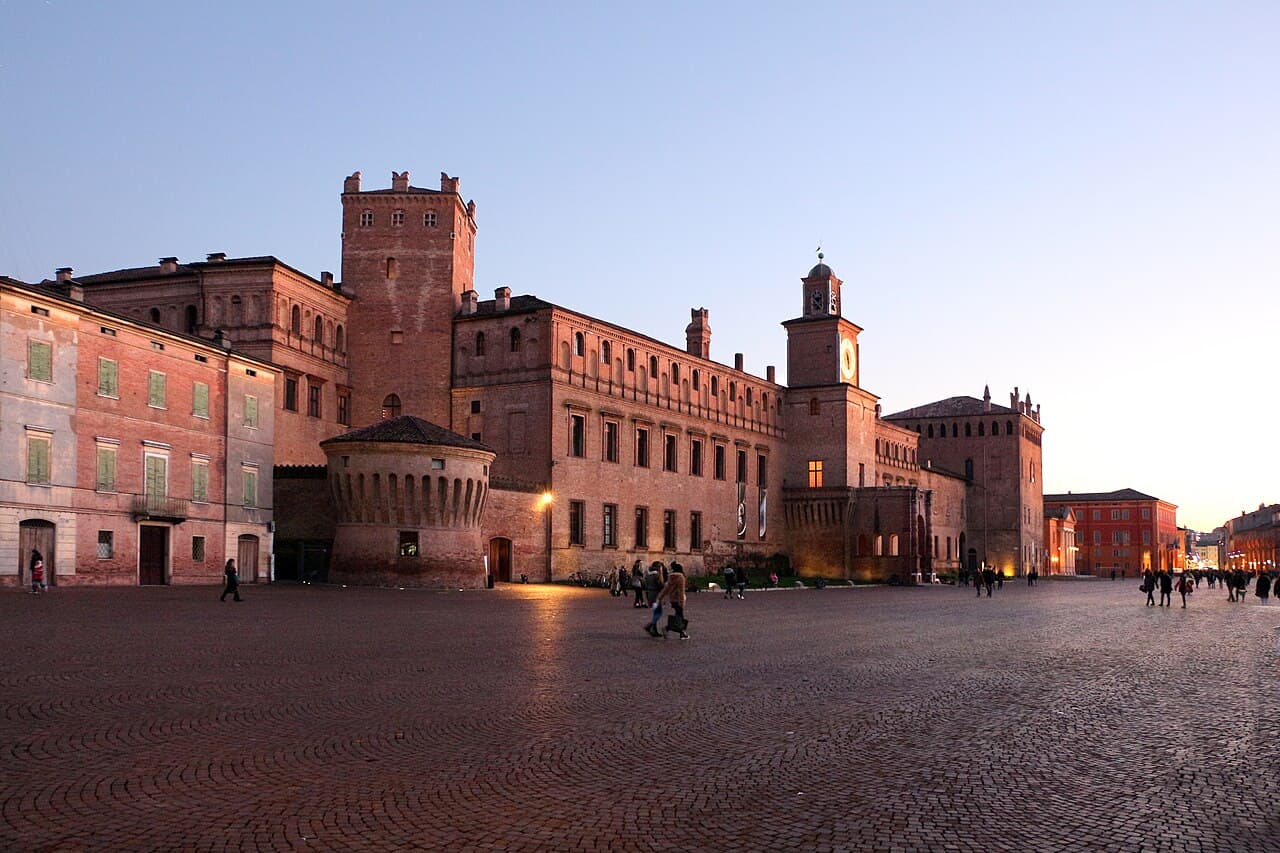
The expansive courtyard, inspired by the principles of Donato Bramante, features arcades with round arches supported by marble columns, some adorned with intricately carved capitals. The terracotta decorations, restored in the 19th century, add artistic richness to the space. The castle's main façade faces the Piazza dei Martiri, showcasing Renaissance details such as pilasters dividing windows and niches, with remnants of early 16th-century frescoes by Giovanni del Sega.
Towers and defensive structures
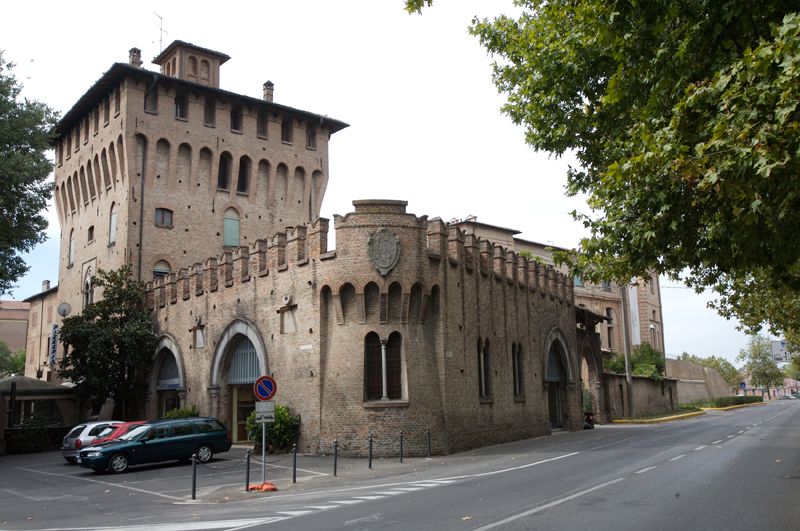
The castle retains key medieval defensive structures, including the cylindrical Torre dell’Uccelliera (1480) and the Torre del Passerino (1320), a crenellated tower exemplifying the original fortress function. The Torrione di Galasso Pio, completed by 1450, features distinctive terracotta decorations and pinnacles, blending defense with ornamental design. The 17th-century clock tower, reminiscent of Ferrara’s Castello Estense, crowns the complex and serves as a prominent visual landmark.
Interior spaces and artistic heritage
The salone dei mori and chapel
Among the castle's most remarkable interiors is the Salone dei Mori, located in the northeast wing. This grand hall is adorned with perspective paintings, classical statues, and allegorical frescoes by Giovanni del Sega from 1506, reflecting influences from Este family palaces such as Palazzo Schifanoia. Adjacent is the chapel, featuring a nave with two bays and a square choir topped by a dome on pendentives, a sophisticated architectural solution for transitioning from square to circular forms.
The chapel walls and vaults are decorated with early 16th-century frescoes by Bernardino Loschi, depicting scenes involving the Virgin Mary and the Pio family. The altar once housed Vincenzo Catena's "Annunciation," now preserved within the castle museum. Four polychrome terracotta roundels by Andrea della Robbia depict the Evangelists, enhancing the chapel’s artistic significance. The floor is covered with majolica tilework, a later addition preserving the chapel's decorative richness.
Decorative rooms and fresco cycles
The castle contains several rooms with diverse fresco programs: the Stanza Ornata displays perspective frescoes by Bernardino Loschi; the Stanza dei Trionfi contains fresco fragments inspired by Petrarch's Triumphs; the Stanza dell’Amore features a 15th-century fireplace and a painted stuccoed ceiling vault; the Sala dei Cervi presents 16th-century hunting scenes; and the Stanza degli Stemmi exhibits heraldic frescoes from the same period.
Cultural and museum functions today
Today, the Castello dei Pio serves as a vibrant cultural hub. It houses Carpi's archives, multiple museums, and exhibition venues. Since 1936, some rooms have hosted the Italian Woodcut Museum, dedicated to the art of woodcut printmaking and figures like Ugo da Carpi. This museum displays original woodcut plates, matrices, and a 19th-century printing press, illustrating the craft's history.
The second floor contains the City Museum, showcasing archaeological finds from prehistoric through medieval periods, as well as exhibits on the Pio and Este families, local crafts such as scagliola, and the textile industry's evolution, including contemporary brands like Blumarine. The castle also memorializes the victims of World War II through the Museum-Monument to Political and Racial Deportees, honoring those interned at the nearby Fossoli camp.
Architectural significance and preservation
The castle's architecture is a palimpsest of styles and functions, illustrating the transition from medieval fortification to Renaissance residence. Its well-preserved state allows visitors to appreciate the integration of defensive features with artistic and residential refinements. Restoration efforts, especially in the 19th and 20th centuries, have maintained the castle's terracotta decorations, frescoes, and structural integrity, ensuring its continued role as a cultural landmark.
The complex's layout, with interconnected buildings surrounding the central courtyard, reflects thoughtful urban integration within Carpi's historic center. The blend of medieval towers, Renaissance arcades, and decorative interiors makes the Castello dei Pio a unique example of architectural evolution in Emilia-Romagna.
Frequently asked questions (FAQ)
- When was the Castello dei Pio originally built?
- The Castello dei Pio was originally constructed beginning in the 11th century, with expansions and modifications continuing through the 17th century.
- What architectural styles are visible in the Castello dei Pio?
- The castle showcases a blend of medieval defensive architecture and Renaissance residential elegance, featuring elements such as arcaded courtyards, terracotta decorations, and frescoes.
- Can visitors explore the interior museums within the castle?
- Yes, visitors can explore several museums inside the castle, including the Italian Woodcut Museum and the City Museum, which display local history, art, and archaeology.
- What is the significance of the Salone dei Mori?
- The Salone dei Mori is a grand hall decorated with perspective paintings, classical statues, and allegorical frescoes from the early 16th century, reflecting Renaissance artistic influences.
- How does the castle commemorate World War II history?
- The castle houses the Museum-Monument to Political and Racial Deportees, established in 1973 to honor victims interned at the nearby Fossoli camp during World War II.

Information
Sources & official resources
Verify the information above using these authoritative references.
Loading map...
Visitor reviews
No reviews yet. Been here? Write the first review and help other travelers!
Write the first reviewVisited this castle? Share your experience
Your review helps other travelers and adds first-hand knowledge to our encyclopedia.