Castell y Bere is a significant Welsh hill castle located near Llanfihangel-y-pennant in Gwynedd, Wales. Constructed in the 1220s by Llywelyn the Great, it served as a strategic fortress to assert control over the southwestern region of the principality of Gwynedd. This castle is an outstanding example of early 13th-century Welsh military architecture, distinguished by its apsidal towers and natural rock defenses.
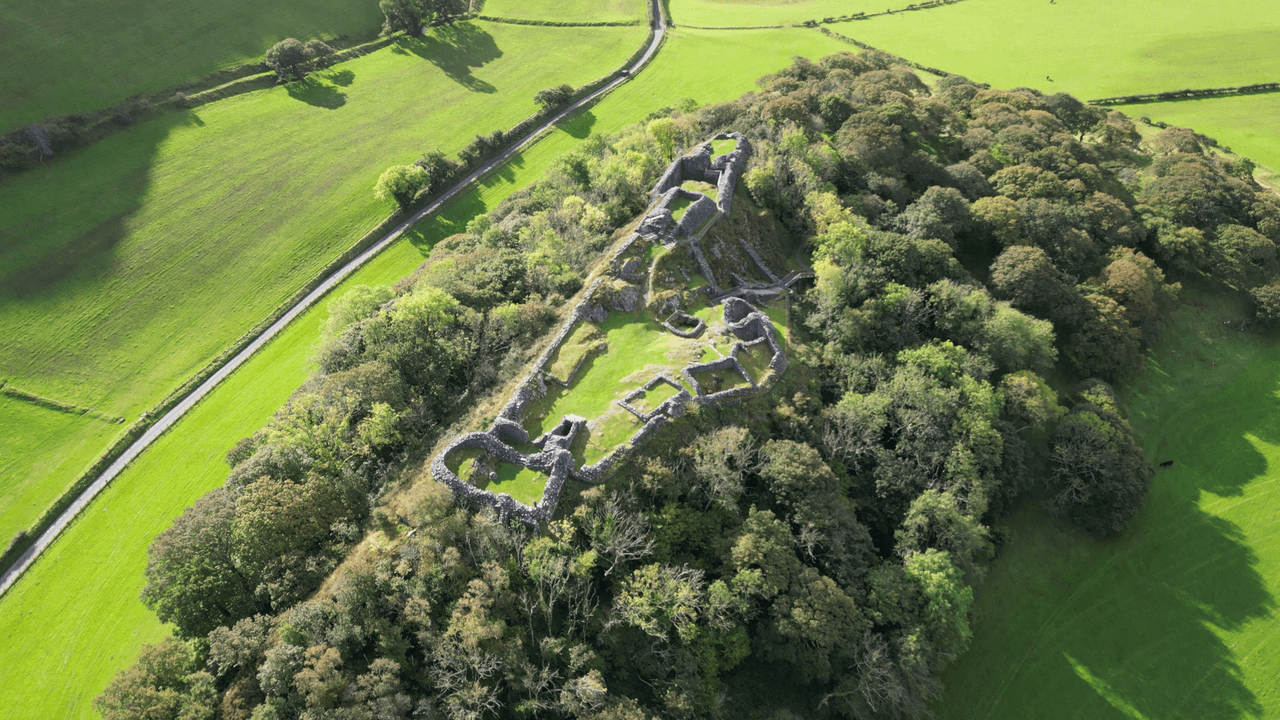
The castle's position on a rocky outcrop overlooking the Dysynni Valley allowed it to dominate key mountain trade routes and maintain authority over local Welsh populations. It was the first stone castle built by Llywelyn the Great, marking a departure from the earlier Welsh tradition of undefended royal courts known as llysoedd. Castell y Bere's construction was part of a wider effort to consolidate Gwynedd's borders and strengthen its defenses against rival Welsh principalities and encroaching English forces.
Throughout its history, Castell y Bere witnessed pivotal events in Welsh medieval history. After Llywelyn the Great's death in 1240, the principality faced territorial losses to England, but under his grandson Llywelyn ap Gruffudd, the castle was expanded and fortified during a resurgence of Welsh power in the mid-13th century. However, the castle fell to Edward I of England during his conquest of Wales in 1283. Edward undertook significant repairs and enhancements, including the addition of a barbican, gate towers, and connecting walls, reflecting the castle's ongoing military importance.
Historical context and construction
Built in the early 13th century, Castell y Bere was strategically sited to control the southwestern border of Gwynedd. Its location on a rocky hill provided natural defenses, with steep ditches cut into the stone on the south and east sides. The castle's design reflects the evolving military architecture of the period, combining natural features with robust stone fortifications.
The castle's initial construction under Llywelyn the Great was part of a broader program to establish stone castles in Wales, moving away from timber structures and undefended courts. This transition signaled a shift in Welsh defensive strategies in response to increasing threats from neighboring powers.
Expansion under Llywelyn ap Gruffudd
In the mid-13th century, Llywelyn ap Gruffudd undertook improvements to Castell y Bere, including the construction of a southern tower that likely served as residential accommodation. These enhancements were part of his efforts to reinforce Gwynedd's dominance and project power across Wales.
English conquest and Edwardian modifications
Following the death of Llywelyn ap Gruffudd in 1282 during the war with England, Castell y Bere was besieged and captured by Edward I's forces in 1283. Edward I commissioned repairs and expansions, overseen by Master Bertram the Engineer, to strengthen the castle's defenses and adapt it for English military use. Additions included a barbican with two gate towers, connecting walls, and a new chamber possibly intended for royal occupancy. These modifications exemplify the Edwardian castle-building style that characterized English fortifications in Wales during this period.
Architectural features and layout
The castle's layout centers on a courtyard surrounded by defensive walls and towers. The main entrance on the west side features the barbican, an outer defensive gateway designed to impede attackers. The barbican's two gate towers overlook stone steps leading to the inner gate, providing layered protection.
Within the courtyard lies a large well, essential for sustaining the castle's inhabitants during sieges. Remains of internal buildings suggest a complex functional space, though precise dating of these structures remains uncertain.
Towers and defensive elements
The castle is notable for its three prominent towers, each with distinctive apsidal (curved, D-shaped) ends, a hallmark of early Welsh castle architecture. The north tower may have served as a hall or chapel, combining defensive and domestic or religious functions. The south tower contains evidence of spacious living quarters, while the middle tower serves as a passageway through the Edwardian ditch yard, linking to the south tower.
Unlike many castles of the era, Castell y Bere's towers lack fireplaces in their main chambers, relying instead on central hearths for heating. This feature reflects medieval heating practices and the multifunctional use of these spaces.
Decorative stonework
Uniquely among early Welsh castles, Castell y Bere incorporates decorative stone sculptures, including carved statues of soldiers and ornamental floor tiles. These artistic elements demonstrate a high level of craftsmanship and embellishment unusual for military fortifications of the 13th century. Alongside Criccieth Castle, it stands out in Wales for such decorative stonework, with historian Lawrence Butler praising it as containing some of the finest stone carving produced in medieval Wales.
Decline and preservation
During the Welsh revolt of 1294 led by Madog ap Llywelyn, Castell y Bere was besieged and likely burned. Following this, the castle was abandoned and fell into ruin. By the 16th century, it was recorded as destroyed by the Welsh poet Gruffydd Hiraethog.
In the 19th century, archaeological interest in the site grew. The 1850s saw the clearing of undergrowth and initial investigations led by William Wynne. Later, in 1949, the castle was placed under state protection by Charles Corbett, recognizing its cultural and historic importance.
Today, Castell y Bere is managed by Cadw as a scheduled monument and tourist attraction. Visitors can explore the well-preserved ruins, including the distinctive apsidal towers, barbican, and curtain walls, gaining insight into Welsh medieval military architecture and the turbulent history of Gwynedd.
Visiting Castell y Bere
The castle's remote location offers scenic views of the Dysynni Valley and surrounding mountains, enhancing its appeal to tourists interested in history and nature. While the ruins are largely roofless, the substantial stone walls and towers provide a vivid sense of the castle's original grandeur and defensive capabilities.
Interpretive signage and guided tours help visitors understand the castle's historical context, architectural features, and significance within Welsh heritage. The site is accessible by footpaths from nearby Llanfihangel-y-pennant, and its tranquil setting makes it a rewarding destination for those exploring medieval Welsh history.
Frequently asked questions (FAQ)
- How do I get to Castell y Bere?
- Castell y Bere is located in Gwynedd, Wales, and is accessible by car via the A487 road. There are also public transport options available, including bus services from nearby towns. Parking is available near the castle for visitors.
- What is the historical significance of Castell y Bere?
- Castell y Bere was built in the 13th century by the Welsh prince Llywelyn the Great as a strategic stronghold. It played a crucial role during the conflicts between the Welsh and the English, particularly during the Middle Ages. Today, it stands as a testament to Welsh heritage and medieval architecture.
- When was Castell y Bere built?
- Construction of Castell y Bere began around 1221 and was completed in the 1230s. The castle was part of a series of fortifications built by Llywelyn the Great to assert Welsh independence. Its ruins reflect the architectural styles of that era.
- Can I enter Castell y Bere with my pet?
- Yes, pets are allowed at Castell y Bere, but they must be kept on a lead at all times. This policy ensures the safety of both your pet and the wildlife in the surrounding area. However, it is advisable to check specific guidelines before your visit.
- Is it possible to explore the castle grounds freely?
- Visitors can freely explore the castle grounds, although certain areas may have restricted access for safety reasons. Informational signage is available to guide you through the historical features of the site. Guided tours may also be offered during peak season for an enhanced experience.
- What are the opening hours of Castell y Bere?
- Castell y Bere is typically open from 10 AM to 5 PM, but hours may vary seasonally. It is best to check the official website or contact local tourist information for the most current opening hours before your visit. Extended hours may be available during the summer months.
- What are the ticket prices for Castell y Bere?
- Admission to Castell y Bere is usually free, as it is maintained by Cadw, the Welsh Government's historic environment service. However, donations are appreciated to support the preservation of this historical site. Check for any special events that may have associated fees.
- When is the best time to visit Castell y Bere?
- The best time to visit Castell y Bere is during the spring and summer months when the weather is milder and the landscape is lush. This is also when the site is most active with visitors and events. Autumn can also be a beautiful time to visit, with changing foliage adding to the scenery.
- Are there any nearby attractions to visit?
- Yes, there are several attractions near Castell y Bere, including the picturesque village of Tywyn and the stunning coastline of Cardigan Bay. Visitors can also explore other historical sites such as the ruins of Dolwyddelan Castle and the Snowdonia National Park. These locations offer a great mix of natural beauty and historical exploration.
Photo gallery

Information
Website
Visit websiteSources & official resources
Verify the information above using these authoritative references.
Loading map...
Visitor reviews
No reviews yet. Been here? Write the first review and help other travelers!
Write the first reviewVisited this castle? Share your experience
Your review helps other travelers and adds first-hand knowledge to our encyclopedia.