Aberystwyth Castle
Aberystwyth Castle stands as a significant medieval fortress on the coast of Wales, embodying centuries of military, political, and architectural history. Constructed initially in response to the turbulent conflicts of the late 13th century, this hill castle was strategically positioned on a rocky promontory overlooking Cardigan Bay. Its location provided natural defenses with steep cliffs on three sides and marshland to the north, making it a formidable stronghold in the region.
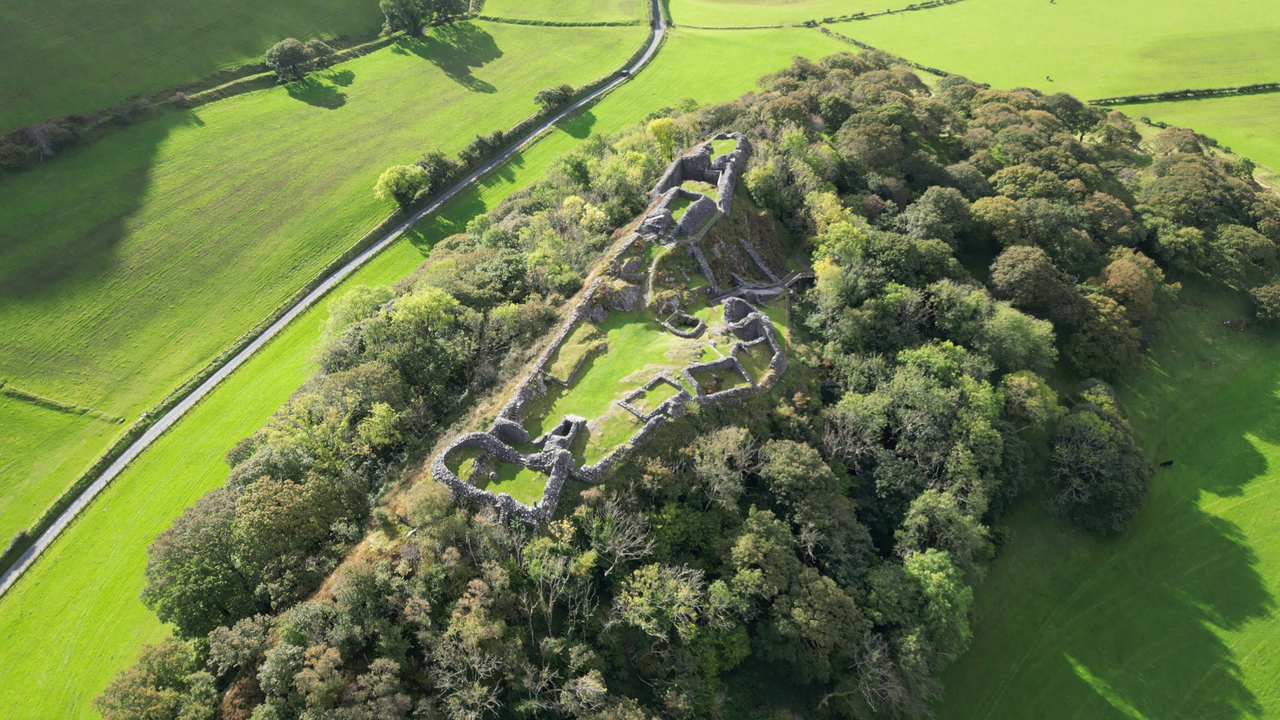
The castle's origins trace back to an earlier motte-and-bailey structure built around 1110 by the Norman lord Gilbert de Clare at a site known as Tan-y-Castell, approximately 1.5 kilometers south of the current ruins. This early fortification played a pivotal role during the 12th and early 13th centuries as a contested frontier between Norman and Welsh forces, undergoing multiple cycles of destruction and rebuilding. However, the castle known today was commissioned by King Edward I of England in 1277 after the First Welsh War, replacing the earlier site with a more durable stone fortress designed to assert English dominance over the region.
Construction and architectural design
The castle was constructed under challenging coastal conditions, employing over 1,300 workers and overseen by the renowned master mason James of St George, who was instrumental in Edward I's Welsh castle-building campaign. Completed around 1289, the fortress is an early example of a concentric castle in North Wales, featuring two rings of defensive walls adapted to the irregular diamond shape of the promontory.
Defensive features
The outer and inner walls are punctuated by multiple round and semicircular towers at the corners, enhancing the castle's defensive capabilities. The approach from the east was heavily fortified with a sequence of gatehouses, including an outer tower, a double-towered gatehouse, and a distinctive double D-shaped inner gatehouse. A dry moat protected the south, east, and north sides, while a zwinger or outer ward on the northwest end added an extra layer of defense.
Access to the castle by sea was facilitated by a gatehouse with twin towers opening toward a harbor landing, allowing resupply during sieges. This feature proved crucial during the 1294–95 Welsh revolt when the castle withstood extensive siege due in part to maritime support.
Domestic and administrative buildings
Inside the inner walls, the main domestic structures were concentrated along the southeastern side near the main gate. The great hall, or palas, served as the administrative heart and residence, likely containing royal apartments. Foundations of this hall and adjoining rectangular buildings remain visible, offering insights into the castle's internal layout and functions.
Historical significance and conflicts
Aberystwyth Castle played a pivotal role in the military and political struggles between the English crown and Welsh princes. After its initial construction, the castle was captured and burned by Welsh forces in 1282 during a widespread uprising. It was soon retaken and fortified further under James of St George's supervision.
The castle endured the Madog ap Llywelyn revolt of 1294–95, successfully resisting siege due to its strong defenses and access to sea supplies. However, by the mid-14th century, the castle showed signs of deterioration, with important structures falling into disrepair by 1343.
In the early 15th century, during the Owain Glyndŵr uprising, the castle was captured by Welsh forces in 1404 and became a principal stronghold and center of governance. A notable event was the signing of a treaty with the King of France in 1405, underscoring its strategic importance. The English recaptured the castle in 1408 after two sieges, one involving the use of a large bronze cannon, an early example of artillery in Welsh warfare.
Later uses and decline
In 1637, the castle was repurposed as a Royal mint by King Charles I, producing silver shillings from locally mined silver. This mint operated until the upheaval of the English Civil War, during which the castle was occupied by Royalist forces and later captured by Parliamentarians in 1646.
Following the war, Oliver Cromwell ordered the castle to be slighted in 1649, intentionally damaging the fortress to prevent its future military use. Over subsequent centuries, the castle fell into ruin, with much of its stone quarried for other building projects and further damage caused by coastal erosion and 19th-20th century developments like seaside promenades.
Current condition and preservation
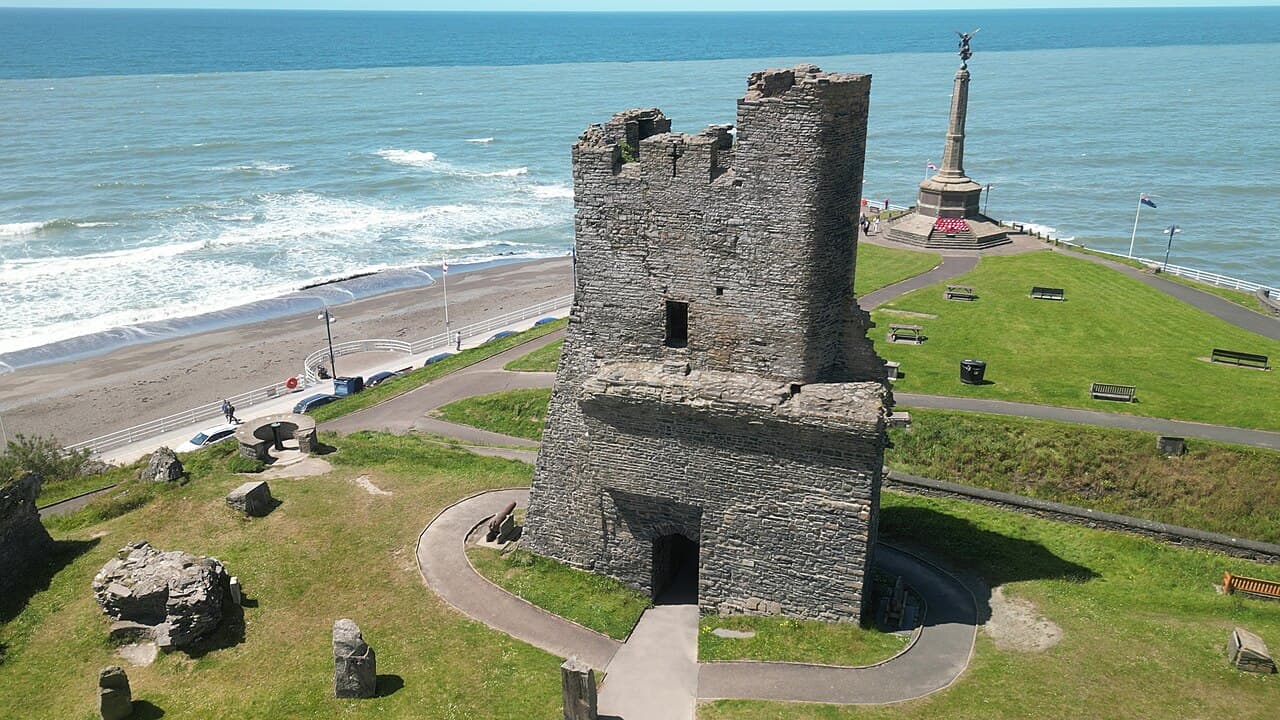
Today, the ruins of Aberystwyth Castle are protected and maintained by local authorities. The most prominent surviving feature is the tall inner gatehouse tower on the northwest side, which historically served as a navigational landmark. Other remnants include wall fragments, tower bases, and foundations of key buildings, providing valuable insights into medieval castle architecture and military strategy.
The site also contains commemorative monuments such as a stone circle erected in 1916 honoring the thirteen historic Welsh counties and a World War I memorial sculpture by Mario Rutelli from 1923. The surrounding area has been developed into a public park with recreational amenities, blending heritage preservation with community use.
Visitor information and cultural significance
Aberystwyth Castle remains a symbol of Welsh resilience and medieval military architecture. Its rich history, from Norman frontier fortification through Edwardian military innovation to its role in Welsh revolts and English civil conflict, makes it a compelling destination for history enthusiasts and scholars alike. The castle's dramatic coastal setting and well-preserved ruins offer a tangible connection to the past and an evocative glimpse into the complexities of medieval power struggles in Wales.
Frequently asked questions (FAQ)
- When was Aberystwyth Castle built and by whom?
- Aberystwyth Castle was built in 1277 by King Edward I of England following the First Welsh War, replacing an earlier motte-and-bailey castle nearby.
- What architectural style characterizes Aberystwyth Castle?
- The castle features a mixed architectural style, primarily reflecting early concentric castle design with adaptations to the rocky promontory it occupies.
- Can visitors access Aberystwyth Castle year-round?
- Yes, Aberystwyth Castle ruins are accessible year-round as an outdoor historic site, though there are no formal visitor facilities or guided tours on site.
- What significant historical events took place at Aberystwyth Castle?
- The castle was involved in key events such as the Welsh uprisings of 1282 and 1404, the Madog ap Llywelyn revolt, and served as a Royal mint during the 17th century.
- Is Aberystwyth Castle suitable for family visits?
- Yes, the castle ruins and surrounding park provide an educational and scenic environment suitable for families, with open spaces for exploration.
Photo gallery

Information
Website
Visit websiteSources & official resources
Verify the information above using these authoritative references.
Loading map...
Visitor reviews
No reviews yet. Been here? Write the first review and help other travelers!
Write the first reviewVisited this castle? Share your experience
Your review helps other travelers and adds first-hand knowledge to our encyclopedia.