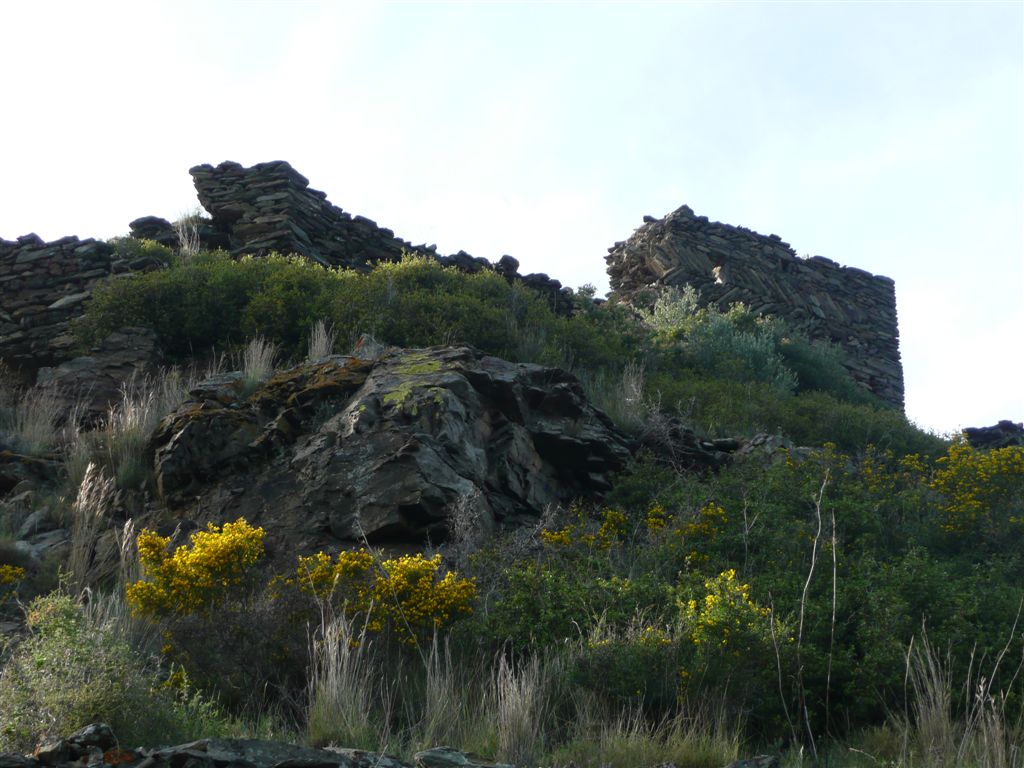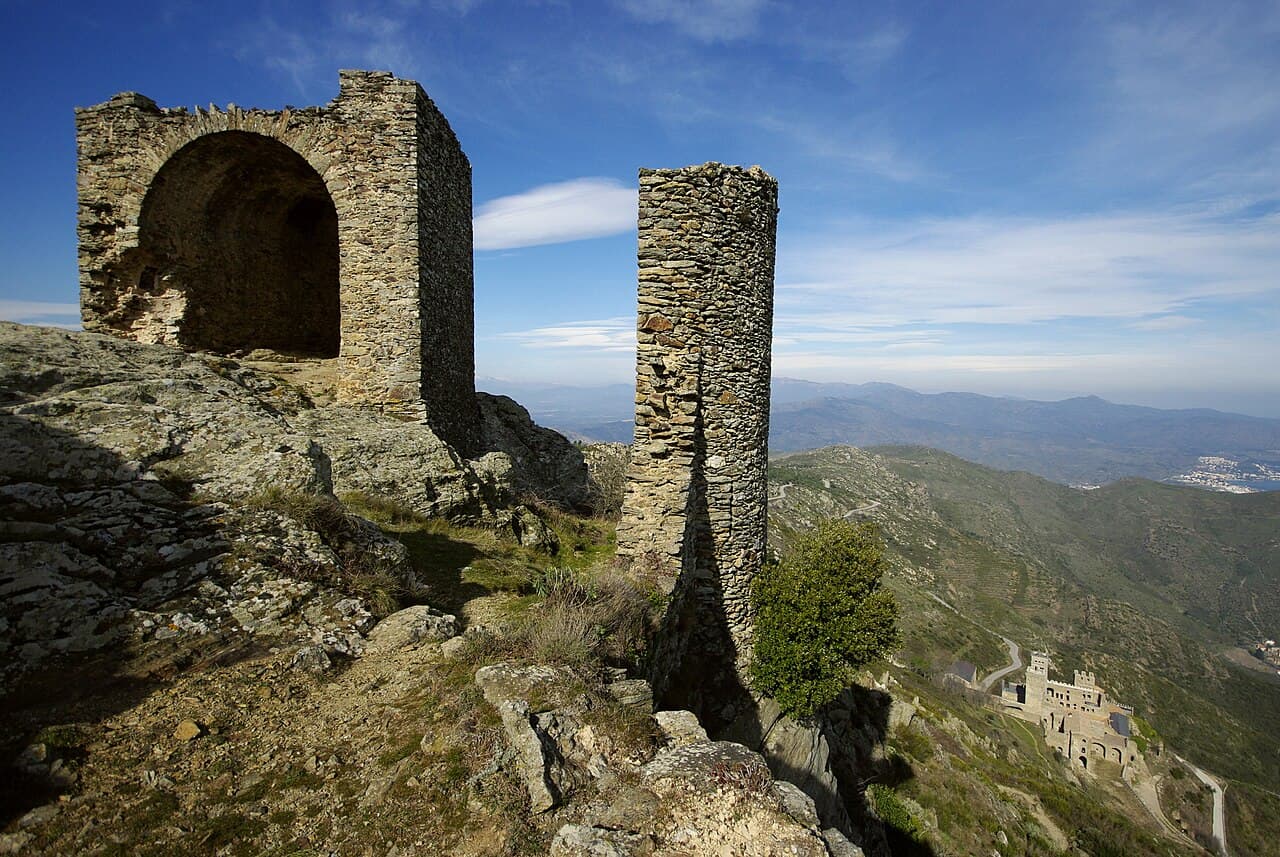
Castell de Verdera is a significant medieval hill castle located within the municipality of Roses, Spain, perched atop the Serra de Rodes mountain range. This fortress, with origins dating back to the 9th century, stands as a testament to the complex feudal and monastic power struggles that shaped the northeastern Iberian Peninsula during the Middle Ages. Its strategic position at 670 meters above sea level allowed it to dominate the surrounding landscape, overseeing the Alt Empordà plain, the Gulf of Roses, and distant natural landmarks such as the Montgrí massif and the Cap de Creus peninsula.
The castle's earliest documentary mention is from the year 904, under the name "castrum verdaria," confirming its existence as a comital stronghold belonging to the influential Counts of Empúries. This noble family played a pivotal role in the governance and defense of the Catalan counties during the Early and High Middle Ages. In 974, Count Gausfred I transferred ownership of the castle to the Benedictine monastery of Sant Pere de Rodes, a move ratified by papal bulls and royal decree, reflecting the intertwined secular and ecclesiastical interests of the period. The transfer sparked a dispute with Gausfred's successor, Count Hug I, who temporarily occupied the fortress until papal intervention restored it to monastic control by 1022.
Historical significance and ownership disputes
Throughout the early medieval period, Castell de Verdera functioned as both a defensive bastion and a symbol of monastic autonomy. The castle's dual role is exemplified by the construction of the church of Sant Salvador within its walls in the first half of the 11th century. This basilica-plan church, with its three parallel naves ending in semicircular apses, served spiritual and protective purposes, highlighting the fortress’s role as a sanctuary under monastic authority.
The late 13th century witnessed renewed tensions between the secular counts and the monastic community over control of the castle. The 1283 agreement allowed the counts to occupy the fortress during wartime while recognizing the monastery's jurisdiction at other times. That same year, Count Ponç Hug IV initiated extensive reconstruction and fortification efforts, including the erection of a new defensive enclosure and a keep tower. These enhancements incorporated architectural influences from the Crusades, reflecting contemporary advances in military design.
The castle was a focal point during the 1285 French crusade against the Crown of Aragon, when French forces held it for six months before it was reclaimed by the count. Subsequent legal disputes throughout the early 14th century resulted in an informal joint control arrangement, balancing secular occupation with ecclesiastical authority.
Later medieval and early modern period
In the later medieval era, the castle's administrative domain, or castellany, was ceded to the Satrilla family until 1374, when Count Joan I of Empúries reasserted full control and enhanced the keep tower with a private chamber. Following the extinction of the Empúries lineage in 1402, the fortress passed to the Crown of Aragon and subsequently to the regional governing body, the Diputació del General. Evidence suggests a return to monastic possession by 1474.
By the 17th century, the castle was under the control of the Dukes of Medinaceli, who repurposed it as a lookout to defend against Barbary pirate incursions. During the War of Spanish Succession in 1708, the fortress was deliberately disabled and partially demolished by order of the Duke of Noailles to prevent its military use. After the monastery's exclaustration in 1835, ownership reverted briefly to ecclesiastical hands before returning to the Medinaceli family following confiscations. Since the mid-20th century, the site has been protected as a cultural monument of national interest under Spanish and Catalan heritage laws.
Architectural features and layout
Castell de Verdera crowns the summit of Sant Salvador Saverdera, occupying a narrow rocky peak that shapes its roughly rectangular layout aligned northwest to southeast. The fortress is naturally defended on the southwest by the steep cliff known as the "Salt de la Reina". Its walls and towers adapt to the uneven terrain, creating a formidable defensive position.
Church of Sant Salvador
One of the castle's oldest and most remarkable structures is the church of Sant Salvador, dating from the early 11th century. Situated at the highest southern point within the enclosure, the church features a basilica floor plan with three parallel naves, each terminating in semicircular apses. Access is gained through a vaulted porch that also connects to the adjacent keep tower. The church's lateral walls, main façade, and porch remain largely intact, showcasing the masonry techniques of the time, characterized by small rectangular ashlar stones with finely finished cornerstones for structural stability.
Defensive structures
The fortress's main gate is located on the northern side, recessed within the curtain wall and guarded by a large square tower flanked by semicircular and triangular towers that follow the slope of the land. The gate features a distinctive double-arched opening designed to accommodate a portcullis, a heavy grille used to secure the entrance. Historically, a heraldic plaque bearing the coats of arms of Rodes and Empúries adorned the gate, though only historical records preserve its image today.
The eastern curtain wall is reinforced by alternating semicircular and rectangular towers, with a rectangular tower anchoring the southeast corner. Narrow arrow slits punctuate the walls and towers, providing protected firing positions for defenders. The consistent height of the eastern wall suggests some sections may have been lowered over time.
A connecting wall once linked the eastern defenses to the keep tower on the southwest cliff edge, where the church façade also abuts the rock. Presently, only low remnants of this wall survive. The interior courtyard is irregular and shaped by the rocky summit, with few remaining traces of ancillary buildings due to centuries of decay.
Additional defensive and utility features
Below and outside the main enclosure, northeast of the entrance, lie the vaulted ruins of a large cistern used for water collection and storage. Nearby are remnants of defensive works, possibly a wooden palisade, extending the castle's protective perimeter beyond the stone walls. To the south, on the adjacent Puig de Sant Genís or de l’Àliga, stand the remains of a round watchtower, part of a broader surveillance network guarding the region.
The 1283 reconstruction introduced architectural elements influenced by Eastern military design, brought to Europe through the Crusades, enhancing the castle's defensive capabilities in response to evolving warfare tactics. A historical water conduit linked the cistern near the castle to the monastery at Sant Pere de Rodes, illustrating the integrated relationship between fortress and monastic community.
Strategic location and cultural significance
Perched atop the Serra de Rodes, Castell de Verdera commands panoramic views across the Alt Empordà plain, the Gulf of Roses, and notable natural landmarks including the Montgrí massif, the Medes Islands, the Cap de Creus peninsula, the Albera mountains, and the eastern Pyrenees. This vantage point underscores the fortress’s enduring role in regional defense, surveillance, and control throughout the medieval and early modern periods.
Today, the castle remains a protected cultural monument, valued for its rich history, architectural heritage, and commanding presence in the Catalan landscape. Its ruins continue to attract historians, archaeologists, and visitors interested in medieval military architecture and the complex interplay of secular and ecclesiastical powers in medieval Spain.
Frequently asked questions (FAQ)
- What is the historical significance of Castell de Verdera?
- Castell de Verdera is a historic castle that dates back to the 11th century, serving as a strategic lookout point in the region of Catalonia, Spain. It played a crucial role in the defense against various invaders throughout the medieval period, making it an important landmark in the area’s history.
- When was Castell de Verdera built?
- The construction of Castell de Verdera began in the early 11th century, with its strategic positioning designed to oversee the surrounding lands. Over the centuries, it has undergone various renovations, reflecting the architectural styles and defensive needs of different eras.
- Can I visit Castell de Verdera?
- Yes, Castell de Verdera is open to visitors who wish to explore its rich history and stunning views. Visitors can roam the castle grounds and enjoy the breathtaking scenery of the surrounding landscape.
- What are the opening hours for Castell de Verdera?
- Castell de Verdera is typically open to visitors from 10:00 AM to 6:00 PM, though hours may vary seasonally. It is advisable to check the official website or local tourist information for the most current opening times before planning your visit.
- Is it possible to access Castell de Verdera by public transport?
- While public transport options may be limited, visitors can reach Castell de Verdera by taking a bus or train to the nearest town and then walking or arranging for local transport. It's recommended to plan your trip in advance to ensure a smooth visit.
- What is the best time to visit Castell de Verdera?
- The best time to visit Castell de Verdera is during the spring and fall months when the weather is mild and the surrounding nature is at its most vibrant. This allows for a comfortable experience while exploring the castle and enjoying its scenic views.
- Are there any nearby attractions to Castell de Verdera?
- Yes, nearby attractions include the beautiful beaches of the Costa Brava and the charming town of Cadaqués, known for its artistic heritage and picturesque landscapes. Exploring these sites can enhance your visit to Castell de Verdera and provide a full day of activities.
- What are the ticket prices for visiting Castell de Verdera?
- Admission to Castell de Verdera is generally free, but donations are welcomed to support the preservation of the site. Special guided tours may incur a fee, so it's advisable to check in advance for any costs associated with specific activities.
Photo gallery

Information
Loading map...
Visitor reviews
No reviews yet. Been here? Write the first review and help other travelers!
Write the first reviewVisited this castle? Share your experience
Your review helps other travelers and adds first-hand knowledge to our encyclopedia.