Castell de Solius
Castell de Solius stands as a significant medieval hill castle ruin located in the municipality of Santa Cristina d’Aro, within the Catalonia region of Spain. Its origins trace back to the early medieval period, with the earliest indirect references dating from the mid-11th century. The castle's strategic position atop a steep rocky outcrop provided commanding views over the surrounding landscape, a common defensive feature of hill castles designed to monitor and control local territories.
Early history and medieval origins
The first known indirect record related to the site of Castell de Solius appears in 1057, when Ramon Seniofred d’Olius was documented as a landowner in Solius. Notably, at this time, he was explicitly forbidden by the count from possessing any castle or tower, implying that no fortification existed on the site then. This prohibition highlights the political controls over fortifications during the early medieval period in Catalonia, where the construction of castles was often regulated by feudal lords to prevent unauthorized military power.
The earliest explicit mention of the castle itself dates from 1208, firmly placing its construction in the high medieval period. By 1210, the fortress was under the ownership of Arnau de Creixell, the Bishop of Girona, who referenced it in his 1214 will as "meum castrum integro de Ruppe," confirming his possession of the entire castle. This ecclesiastical ownership reflects the common practice of the church holding strategic fortifications during the Middle Ages, often to exert both spiritual and temporal influence.
Ownership disputes and regional control
Following its acquisition by the church, Castell de Solius became the subject of prolonged economic and legal disputes, reflecting the turbulent feudal dynamics of the region. These conflicts lasted until 1394, when the sacristy finally secured authority over the territory extending from the Ridaura stream to the sea. This control was maintained throughout the 15th and 16th centuries, underscoring the castle's role as a center of regional power and administration.
Role in 15th-century conflicts
During the Catalan Civil War (1462–1467), Castell de Solius played a notable role in the socio-political upheavals affecting the region. The castle's lords imposed taxes on livestock herders supplying the city of Barcelona, a practice that heightened tensions with local peasants, particularly the remensa peasants. These peasants were serfs burdened by feudal obligations and were central figures in the peasant revolts known as the remensa wars.
In 1485, amidst these revolts, the castle was captured by Miquel Safont from Cassà de la Selva, marking a significant event in the struggle against feudal oppression. This episode highlights the castle's strategic and symbolic importance during periods of social conflict in late medieval Catalonia.
Architectural features and defensive elements
Although primarily a residential dwelling, Castell de Solius was designed to be fortified during times of conflict. The castle's defensive system included fortified walls with a distinctive lowered arch doorway, which leads to a remarkable set of stairs carved directly into the rock face. These rock-hewn stairs are an impressive example of medieval engineering, allowing access within the fortress despite the challenging terrain.
Additional defensive features include numerous rounded holes along the walls, which once held wooden bars or beams to secure entrance points and control access. The castle also contained a stone cistern midway up the hillside, essential for collecting and storing water during sieges or droughts. This cistern remains partially overgrown but is a key element that illustrates the castle's self-sufficiency in times of isolation.
Later history and 19th-century restorations
The strategic importance of Castell de Solius declined over the centuries, partly due to the difficulties in maintaining the structure and changing military technologies. However, the castle saw modest reconstruction efforts in 1830 during the Carlist Wars. These 19th-century repairs, undertaken by the owner of the nearby estate Can Dalmau, are still visible today and represent the castle's prolonged historical use beyond the medieval period.
Current condition and archaeological significance
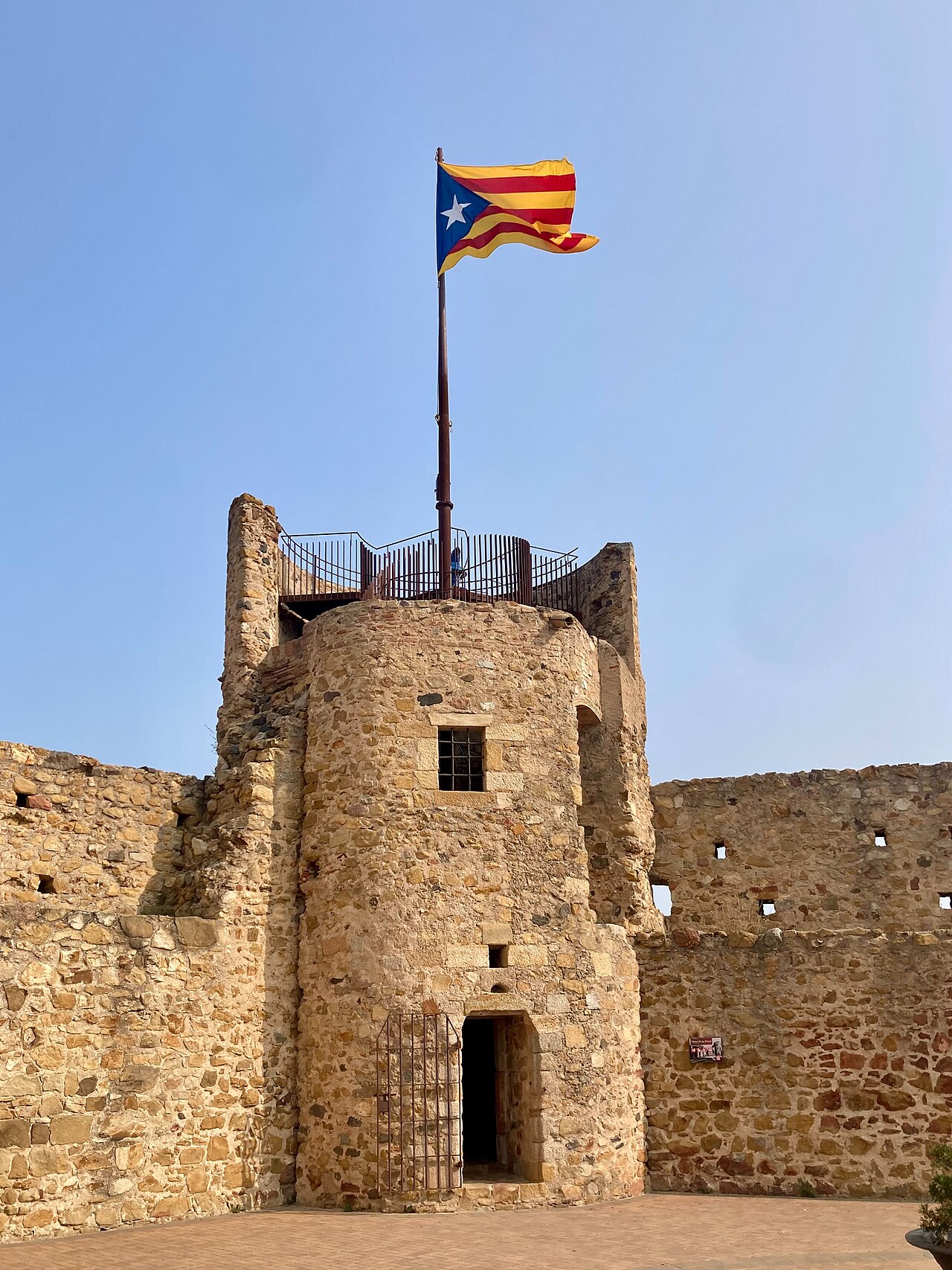
Today, the ruins of Castell de Solius are a poignant reminder of Catalonia's medieval past. The site preserves a combination of original medieval construction techniques and traces of 19th-century restoration. The remains include artificial cuttings carved into the rock, the fortified wall with its distinctive doorway, rock-hewn stairs, and the stone cistern, all set within a rugged landscape that emphasizes the castle's defensive advantages.
Despite its fragmentary state, Castell de Solius offers valuable insights into medieval castle architecture, feudal history, and the socio-political dynamics of Catalonia. It stands as an important cultural and heritage site, attracting historians, archaeologists, and visitors interested in the region's rich medieval legacy.
Frequently asked questions (FAQ)
- When was Castell de Solius originally built?
- The earliest indirect record related to the site dates back to 1057, but the castle itself is first explicitly mentioned in 1208, indicating construction during the high medieval period.
- What architectural features are notable at Castell de Solius?
- Notable features include a fortified wall with a lowered arch doorway, rock-hewn stairs carved into the cliff, rounded holes for wooden bars, and a stone cistern for water storage.
- What role did Castell de Solius play in regional conflicts?
- The castle was involved in the Catalan Civil War and the remensa wars, serving as a fortified residence and a center of feudal authority that was contested during peasant revolts.
- Is Castell de Solius accessible to visitors today?
- As a ruin, Castell de Solius can be visited, but facilities and access may be limited due to its condition and location on a steep rocky outcrop.
- What remains can be seen at the site today?
- Visitors can see remnants of medieval walls, rock-carved stairs, artificial cuttings in the rock, and the partially overgrown stone cistern from the medieval period.
Information
Website
Visit websiteSources & official resources
Verify the information above using these authoritative references.
Loading map...
Visitor reviews
No reviews yet. Been here? Write the first review and help other travelers!
Write the first reviewVisited this castle? Share your experience
Your review helps other travelers and adds first-hand knowledge to our encyclopedia.