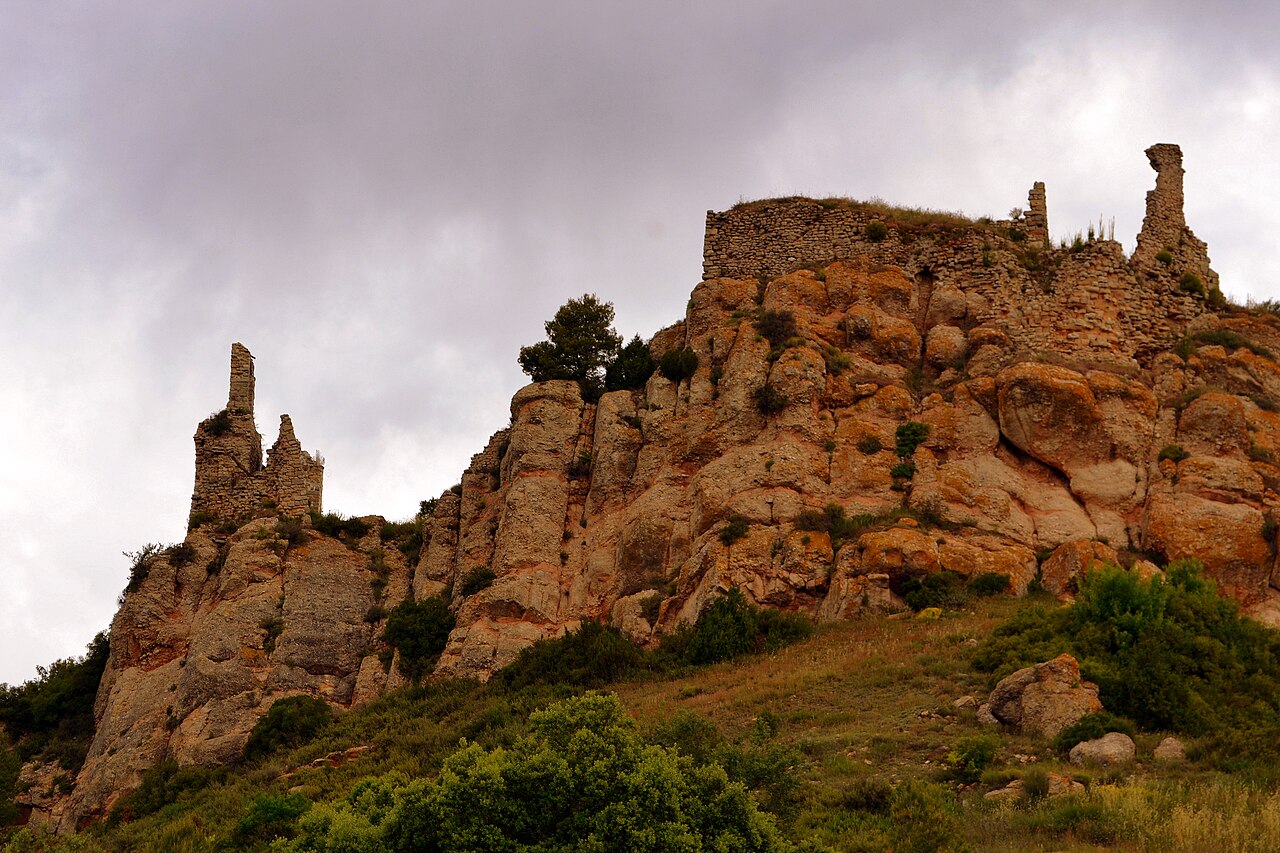
Castell de Santa Coloma de Queralt
The Castell de Santa Coloma de Queralt stands as a significant historical monument in the town of Santa Coloma de Queralt, Spain. This hill castle embodies centuries of Catalan history, showcasing a remarkable evolution from a medieval fortress to a Renaissance noble residence. Its strategic location and architectural features reflect its dual role as a military stronghold and an aristocratic seat.
Dating back to the late 9th century, the territory was initially under the control of Count Guifré el Pilós, a foundational figure in Catalan history. The first documented mention of the castle itself appears in 1018, when Hug de Cervelló transferred half ownership to his son, marking the castle's early association with the influential Cervelló family. Subsequently, the castle came under the influence of the Gurb family, who were also lords of the nearby Queralt castle. By the early 12th century, the castle had established its own identity separate from Queralt, signaling a shift in ownership and regional importance.
Medieval origins and architectural features
The castle's most prominent medieval architectural element is its circular main tower or keep, dating from the late 11th or early 12th century. This imposing tower rises to 23.5 meters with a base diameter of 12 meters tapering to 9 meters at the top. Built from large ashlar stone blocks, some measuring approximately 30 by 40 centimeters, the tower's thick walls emphasize its defensive purpose. Originally, access was via an external staircase leading to the first floor, a common defensive feature to impede attackers. Inside, the tower contains four floors culminating in a terrace surrounded by battlements, providing a vantage point for surveillance and defense. The ground floor served as storage, reflecting the practical needs of a medieval fortress.
Surrounding the tower were medieval defensive walls that enclosed the castle. Over time, these walls were dismantled, with many stones repurposed to construct a later, lower medieval castle. This newer structure, built on a rectangular plan, functioned primarily as a noble residence. Its four stories featured wooden beams supported by pointed Gothic arches, blending structural strength with aesthetic elegance. The northern façade of this residence was incorporated into the town's defensive walls, illustrating the integration of military and urban architecture.
The barony of queralt and noble transformations
By around 1230, the castle became the center of the Barony of Queralt, encompassing several villages and territories under the Queralt family's control. This period marked the castle's rise as an administrative and noble seat, with ownership passing through prominent families including the Timor and Queralt lineages. The Queralt family maintained their influence for centuries, underscoring the castle's enduring regional significance.
A pivotal moment came in 1599 when Pere de Queralt i d’Icard was granted the title of Count of Santa Coloma by King Philip II of Spain. This noble elevation coincided with a substantial transformation of the castle, shifting its function from a purely defensive fortress to a grand residence reflective of Renaissance tastes. The remodeled castle featured a striking Baroque façade while preserving the medieval keep, symbolizing a blend of historical continuity and contemporary elegance.
Artistic heritage and interior decoration
The castle's interior boasts remarkable artistic features, notably the grand staircase vault adorned with secular and pagan frescoes dating from the mid-16th century. These frescoes, attributed to Lluís Martínez and painted between 1576 and 1577 using glue tempera on wood and plaster, depict a rich iconography. Central to the decoration is the image of the river god Tiber, inspired by a Roman sculpture discovered in 1512 and popularized through a 1550 engraving by Nicola Béatrizet.
Surrounding the river god are figures of Romulus and Remus, the legendary founders of Rome, alongside symbols such as the cornucopia representing abundance. The frescoes also include portraits linked to the historic Battle of Lepanto, featuring possible depictions of Lluís de Queralt i d’Icart, the Ottoman leader Uluj Alí, Admiral John of Austria, and King Philip I of Aragon. This artistic program connects the castle's decoration to broader historical and military narratives of the 16th century, highlighting its cultural significance.
Role during the catalan revolt and later history
During the mid-17th century Catalan Revolt, also known as the Guerra dels Segadors, the castle was repurposed as a military hospital, serving the needs of the conflict. This period reflects the castle's ongoing strategic and social importance beyond its noble functions.
In 1689, ownership passed to the Reard family, who adopted the Queralt name to continue the lineage. The castle retained its feudal lordship status until the abolition of noble privileges, adapting to changing political and social contexts. By the 19th century, the castle also housed the town prison while remaining under the counts' ownership, illustrating its multifunctional role within the community.
Preservation and current condition
Today, the Castell de Santa Coloma de Queralt is recognized for its well-preserved medieval keep and the Renaissance elements that characterize its noble residence phase. Restoration efforts focus on maintaining the structural integrity and historical fabric of the castle, particularly the main tower and the frescoed interiors.
While the original medieval walls have largely disappeared, the castle's layout and surviving architectural features offer valuable insights into its evolution. The integration of defensive and residential elements within the castle exemplifies the complex history of Catalan fortifications and noble estates.
Architectural significance and cultural heritage
The castle represents an important example of medieval military architecture transitioning into a Renaissance noble residence. Its circular keep is a notable defensive structure from the early 12th century, while the later additions reflect the changing tastes and functions of the aristocracy in Catalonia. The frescoes provide a rare glimpse into 16th-century secular art within a castle context, enriching the cultural heritage of the region.
As a monument, the Castell de Santa Coloma de Queralt embodies the layered history of Catalonia, from feudal lordship and military conflict to Renaissance artistry and civic adaptation. It remains a valuable site for understanding the architectural and historical developments in this part of Spain.
Frequently asked questions (FAQ)
- How do I get to Castell de Santa Coloma de Queralt?
- Castell de Santa Coloma de Queralt is located in the town of Santa Coloma de Queralt, Spain. You can reach it by car via the C-241 road or by taking public transportation to the nearby town and walking to the castle. Parking is available near the site for visitors coming by car.
- What is the historical significance of Castell de Santa Coloma de Queralt?
- Castell de Santa Coloma de Queralt dates back to the 10th century and played a vital role in the defense of the region during the Middle Ages. It served as a residence for the Counts of Queralt and has witnessed numerous historical events throughout its existence. Today, it stands as a testament to medieval architecture and the rich history of Catalonia.
- When was Castell de Santa Coloma de Queralt built?
- The castle was originally constructed in the 10th century, with various modifications and expansions occurring over the centuries. Its strategic location and fortifications were essential for protecting the surrounding area during times of conflict. The castle has undergone restoration to preserve its historical integrity for future generations.
- Can I visit Castell de Santa Coloma de Queralt year-round?
- Yes, the castle is open to visitors throughout the year, although the opening hours may vary by season. It is advisable to check the official website or local tourist information for the most accurate hours before your visit. Guided tours may also be available to enhance your experience.
- Why is the architecture of Castell de Santa Coloma de Queralt noteworthy?
- The architecture of the castle reflects a blend of different styles that have evolved over its long history, including Romanesque and Gothic influences. Key features include thick stone walls, a central keep, and picturesque views of the surrounding landscape. The castle's design illustrates the fortification techniques used during its time and its adaptation to the changing needs of its inhabitants.
- Is it possible to explore the interior of the castle?
- Yes, visitors can explore the interior of Castell de Santa Coloma de Queralt, where various rooms and passages have been preserved. Guided tours are often available, providing insights into the castle's history and architecture. Be sure to check the availability of guided tours upon your arrival.
- What are the ticket prices for visiting the castle?
- Ticket prices for Castell de Santa Coloma de Queralt are generally affordable, with discounts available for children, students, and seniors. Prices may vary based on guided tours or special events, so it’s best to confirm the current rates on the official website or at the entrance before your visit. Group rates may also be available for larger parties.
- When is the best time to visit Castell de Santa Coloma de Queralt?
- The best time to visit the castle is during the spring and early autumn months when the weather is mild and pleasant for outdoor exploration. Summer can be hot, and winter may present chilly conditions, affecting your visit. Additionally, consider timing your visit with local festivals or events to enhance your experience.
- Are there any nearby attractions to visit?
- Yes, there are several attractions near Castell de Santa Coloma de Queralt, including the picturesque village of Santa Coloma de Queralt itself. Visitors can also explore nearby natural parks, hiking trails, and other historical sites that showcase the region's rich cultural heritage. These attractions make it easy to plan a full day of exploration in the area.
Information
Website
Visit websiteSources & official resources
Verify the information above using these authoritative references.
Loading map...
Visitor reviews
No reviews yet. Been here? Write the first review and help other travelers!
Write the first reviewVisited this castle? Share your experience
Your review helps other travelers and adds first-hand knowledge to our encyclopedia.