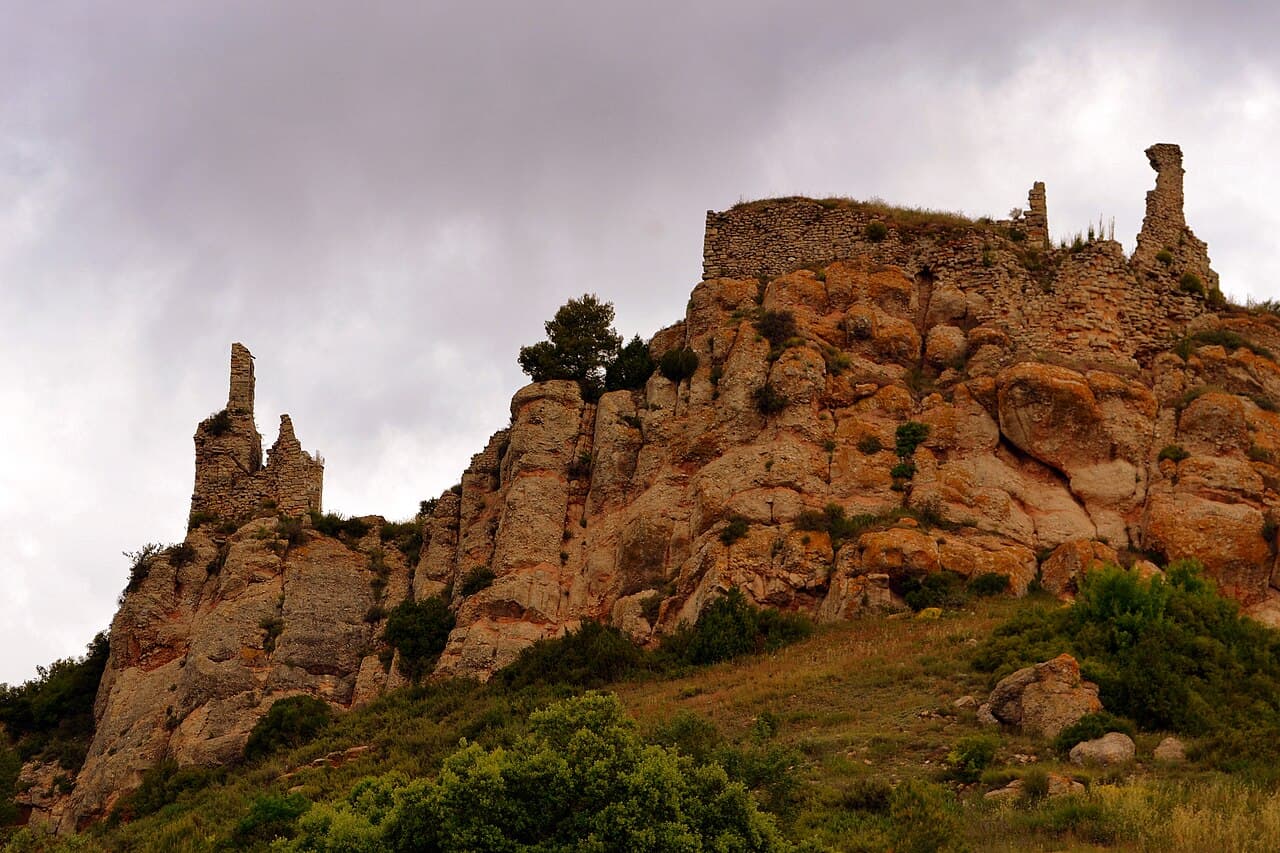
Castell de Queralt
Castell de Queralt stands as a remarkable example of a medieval hill castle in the Catalan region of Spain. Perched atop a rocky ridge in the municipality of Bellprat, this fortress played a pivotal role in the defense and administration of the frontier territories during the early Middle Ages. Its strategic location on the western boundary of the Marca Hispánica made it a key stronghold in the complex historical landscape of Christian-Muslim relations on the Iberian Peninsula.
The castle's origins trace back to the 10th century, a period marked by territorial consolidation and repopulation efforts led by the Catalan Counts. Though no direct records pinpoint its exact foundation, its association with Count Wifred the Hairy (880–897) is significant, as he was instrumental in repopulating the County of Osona. Castell de Queralt symbolized the outer limit of this resettlement, embodying its function as a frontier fortress in a contested borderland.
Throughout the centuries, the castle witnessed a complex history of ownership and territorial disputes. In 976, it was sold by Count Borrell II and his wife Ledgarda to Guitard, Viscount of Barcelona. Later, the Viscounts of Osona, particularly the family of Trasoar, took control. Disputes in the early 11th century involved prominent figures such as Bishop Sal·la of Urgell and Sendred de Gurb, culminating in a 1002 judgment by Counts Ramon Borrell and Ermessenda, which likely favored the bishop. Despite this, the Gurb-Queralt family maintained control, either through purchase or force.
The queralt family and their legacy
Under Bernat Sendred de Gurb, the castle became a center for repopulating the surrounding lands and founding settlements like Montargull, Rauric, and Figuerola. His son, Guillem Bernat de Queralt, who died in 1084, was the first to adopt the Queralt name, establishing a familial legacy closely tied to the fortress.
By the late 12th and early 13th centuries, the Queralt estates were divided between holdings under eminent domain and feudal fiefs. The primary branch of the family faded, while the secondary branch resided at Castell de Queralt. In 1212, Arnau de Timor purchased the castle, and his descendants adopted the Queralt surname, later consolidating the barony of Santa Coloma and expanding their influence.
The Queralt family produced notable figures such as Pere IV de Queralt (d. 1408) and Pere VI de Queralt, a soldier, diplomat, and scholar serving under three Aragonese monarchs: Pere IV, Joan I, and Martí l’Humà. In 1599, Pere VIII was granted the title of Count of Santa Coloma by Philip III of Castile, elevating the family's noble status.
During the 17th century Reapers’ War, Dalmau III de Queralt served as viceroy of Catalonia and was killed during the 1640 Corpus de Sang uprising. His son later became a Grandee of Spain in 1647, granted by Philip IV, underscoring the family's enduring prominence.
Architectural features and castle remains
The castle occupies the highest point of a rocky hill, with its remains enclosed by imposing walls that have partially collapsed or sunk into the earth. The surviving structures showcase medieval construction techniques, combining roughly built exterior walls with finely cut internal ashlar stones laid in horizontal layers. This contrast highlights the fortress’s dual purpose of robust defense and internal refinement.
At the summit stands the main residential building, a rectangular Gothic-style edifice aligned northward. It rises vertically with three levels: ground floor, first floor, and a terrace. Architectural features include a prominent main entrance, two mid-height arrow slits for defense, and two upper windows for light and observation.
Near the northwest corner, archaeologists uncovered a narrow channel made of carefully joined rectangular sandstone blocks, likely serving as a water drainage or supply system. Adjacent lies the remains of a small rectangular stone cistern, crucial for water collection and storage.
West of the castle, near the cliff edge, rubble indicates the former presence of the castle’s church and auxiliary structures such as stables, corrals, or barns, reflecting the site’s role as a fortified residence and rural estate.
Only one wall of the Church of Sant Miquel remains standing today, specifically its west façade with a bell gable featuring a semicircular voussoir arch. A partial interior stone staircase also endures. The nave and apse walls have been lost, indicating significant decay.
Church of Sant Jaume de Queralt
At the hill’s base lies the Church of Sant Jaume de Queralt, a Romanesque single-nave building with late medieval modifications. Its bell gable has been reconstructed, and the lateral exterior walls are decorated with Lombard bands and blind arcades. The original semicircular apse was replaced by a rectangular extension. The older walls consist of dark stone contrasting with newer additions. Though no longer active, the church is stabilized for preservation.
Historical significance and later history
Castell de Queralt’s role evolved over the centuries from a frontier fortress to a noble residence and administrative center. By the 19th century, its military importance waned. In 1842, the estate was sold to merchant Josep Safont, by which time the castle had fallen into serious disrepair and was surrounded by agricultural land.
The last recorded military use occurred during the Carlist Wars in the mid-1800s. Despite this decline, the castle’s religious connections persisted through its internal chapel dedicated to Sant Miquel and the nearby parish church.
In July 2021, a wildfire affected the area including the castle and surrounding churches. Fortunately, damage to the ruins was minimal and largely superficial, allowing continued preservation efforts.
Visiting and cultural heritage
Today, Castell de Queralt stands as a testament to Catalonia’s medieval history and architectural heritage. Its ruins offer insight into the region’s complex feudal and military past, as well as the evolution of castle construction techniques from the early to late medieval periods.
The site is of interest to historians, architects, and visitors fascinated by medieval fortifications, Gothic architecture, and Catalan noble history. Preservation efforts focus on stabilizing the ruins, including the castle walls and associated religious buildings, to maintain their cultural significance for future generations.
Frequently asked questions (FAQ)
- What is the historical significance of Castell de Queralt?
- Castell de Queralt was a strategic frontier fortress marking the western boundary of the Marca Hispánica in the 10th century, playing a key role in the defense and repopulation of Catalonia during the early Middle Ages.
- Can I visit Castell de Queralt and its surrounding churches?
- Yes, the castle ruins and the nearby Church of Sant Jaume de Queralt are accessible to visitors. While the castle is in ruins, the site offers a fascinating glimpse into medieval architecture and history.
- When was Castell de Queralt built?
- Although the exact construction date is unknown, the castle's origins date back to the 10th century during the early medieval period associated with Count Wifred the Hairy.
- What architectural styles are present at Castell de Queralt?
- The castle features medieval construction with Gothic architectural elements, particularly visible in the main residential building and defensive structures.
- Is Castell de Queralt wheelchair accessible?
- Due to its hilltop location and ruined condition, Castell de Queralt is not fully wheelchair accessible. Visitors should be prepared for uneven terrain and limited facilities.
Photo gallery

Information
Current owner
Private owner
Loading map...
Visitor reviews
No reviews yet. Been here? Write the first review and help other travelers!
Write the first reviewVisited this castle? Share your experience
Your review helps other travelers and adds first-hand knowledge to our encyclopedia.


