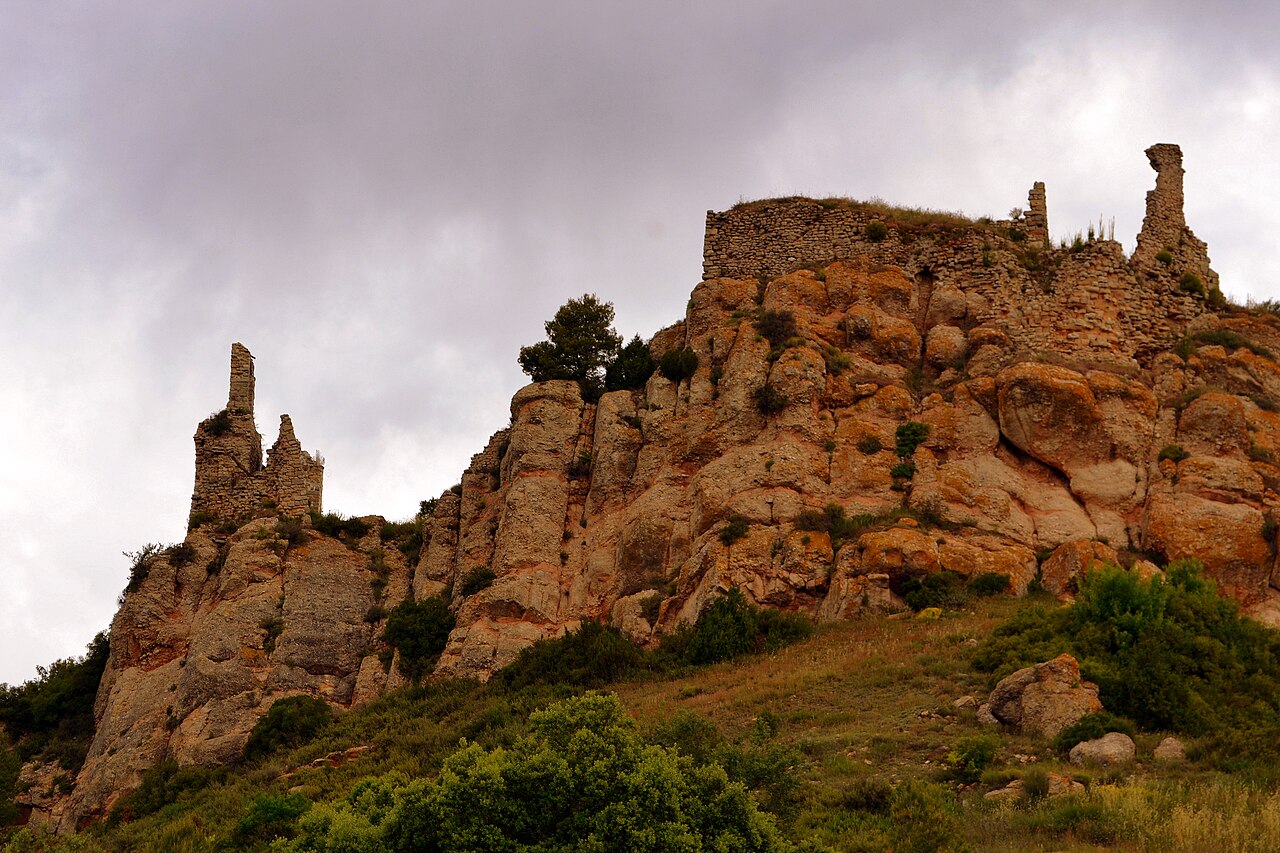
Castell de la Roqueta
The Castell de la Roqueta stands as a testament to the turbulent history of the early Middle Ages in Catalonia, Spain. Perched strategically atop a rocky hill in the municipality of Sant Martí de Tous, this hill castle was constructed by Christian forces as a defensive stronghold against the incursions of Saracen forces along the volatile frontier known as la Marca. Its commanding position provided a vantage point over the surrounding landscape, crucial for monitoring and controlling movement across this contested border region.
The earliest known mention of the castle dates back to 960 AD, where it is referred to as "Ipsa Rocheta," highlighting its distinctive location on a rocky outcrop. This reference underscores the castle's role not only as a military fortification but also as a territorial marker delineating control between rival powers. By 976 AD, the castle was integral in defining boundaries with neighboring fortifications such as the Castell de Queralt, emphasizing its importance in the network of medieval defensive sites.
Medieval ownership and historical significance
Throughout the 11th and 12th centuries, the Castell de la Roqueta witnessed a succession of noble custodianship, reflecting the shifting political landscape of the region. Around 1018, the castle was held by a noble named Hug, son of Ansulf, who passed it to his son Alamany. Although records do not clarify whether the castle changed hands through conflict or inheritance, its control was evidently significant for local power dynamics.
In 1029, lordship passed to a knight named Humbert, succeeded by Bernat Sendred, who notably engaged in territorial disputes with the influential Church of Vic in the early 11th century. By 1043, governance was under Alemany de Cervelló, during whose tenure the castle's chapel, dedicated to Saint Michael, was consecrated by the renowned Abbot Oliba. This event marked the castle as not only a military installation but also a site of religious significance.
The latter half of the 12th century saw the role of castellan occupied by Guillem de Montagut, while the broader lordship remained with the Alamany family. In 1193, ownership transferred within the family to Guillem de Cervelló, indicating the castle's continued importance in noble lineage and territorial governance.
By the early 13th century, specifically in 1226, the castle entered ecclesiastical hands under the monastery of Santes Creus. This transition from secular to religious authority reflects broader medieval trends of monastic expansion and land acquisition. A formal agreement in 1311 further clarified property boundaries between the monastery and local nobility, illustrating the complex feudal relationships of the period.
Administrative shifts occurred in 1358 when King Peter IV of Aragon reassigned the castle's jurisdiction from the district of Cervera to Vilafranca del Penedès. Census records from the 14th century reveal a decline in the castle's resident population, from ten households in the 1360s to just five by 1381, all remaining under monastic authority. This demographic change suggests a gradual decline in the castle's military and administrative prominence.
Architectural features and surviving remains
The Castell de la Roqueta is situated on a hill between the local church of Santa Maria and the Savinosa mountain pass, oriented towards the Queralt mountain range. The remnants of the castle are modest but revealing, consisting primarily of foundational stonework embedded directly on the rocky hilltop and fragments of the castle chapel walls.
One of the most prominent surviving structures is a south-facing wall segment measuring approximately 3.3 meters in height, 8.2 meters in length, and nearly a meter thick. This wall features a secondary internal wall with two small rounded arch openings framed by voussoirs, a hallmark of early medieval masonry. This segment likely belonged to the castle's main hall or the chapel dedicated to Saint Michael. The hall extended along this wall, with an estimated width of about four meters, and was probably covered by a now-collapsed stone vault. Defensive architecture is evident in the two narrow arrow slits on the southern facade, positioned at different heights to provide coverage against attackers.
At the hill's summit lie the ruins of a tower, considered the oldest part of the fortress. The tower's masonry is composed of small rectangular stones approximately 12 by 25 centimeters, laid in even horizontal courses and bonded with a sand and lime mortar mixture. This construction technique reflects typical medieval practices aimed at durability and defense.
Today, dense vegetation conceals much of the site, complicating detailed archaeological examination. Nonetheless, the visible vestiges of walls and tower outlines provide valuable insights into the castle's original layout and its role as a fortified medieval stronghold controlling a critical frontier zone.
Historical context and strategic importance
The Castell de la Roqueta played a crucial role in the defense system of la Marca, the borderland between Christian and Muslim territories during the early Middle Ages. Its position atop a rocky hill offered both natural fortification and a commanding view of the surrounding valleys and passes, essential for early warning and defense against raids.
The castle's proximity to other fortifications, such as the Castell de Queralt, formed a network of strongholds that secured the region and facilitated control over trade routes and military movements. The repeated changes in ownership among noble families and religious institutions reflect the contested nature of this frontier and the importance of the castle in asserting territorial claims.
Preservation and current status
By the 19th century, the Castell de la Roqueta had fallen into ruin, with only fragments of walls and traces of nearby mining activity remaining visible. The site is now heavily overgrown, with thick vegetation obscuring many of the stone remains, making preservation and archaeological study challenging.
Despite its ruinous state, the castle remains an important cultural and historical landmark, offering insights into medieval military architecture and the complex feudal and religious dynamics of Catalonia during the early and high medieval periods. Efforts to document and study the site continue to contribute to our understanding of the region's medieval heritage.
Frequently asked questions (FAQ)
- How do I get to Castell de la Roqueta?
- The Castell de la Roqueta is located in Sant Martí de Tous, Spain. Visitors can reach the site by local roads leading to the municipality, followed by a hike up the hill where the castle ruins are situated.
- What is the historical significance of Castell de la Roqueta?
- Castell de la Roqueta served as a strategic defensive fortress during the early Middle Ages, guarding the frontier known as la Marca against Saracen incursions and marking territorial boundaries.
- Can I visit the ruins of Castell de la Roqueta?
- Yes, the ruins of Castell de la Roqueta are accessible to the public. However, the site is largely overgrown and in a state of ruin, so visitors should be prepared for uneven terrain and limited facilities.
- When was the castle chapel consecrated?
- The castle chapel dedicated to Saint Michael was consecrated in 1043 by Abbot Oliba, a significant religious figure of the time.
- Why is the castle located on a rocky hill?
- The castle's location on a rocky hill provided a natural defensive advantage, offering a commanding view of the surrounding area and making it difficult for attackers to approach unnoticed.
Information
Loading map...
Visitor reviews
No reviews yet. Been here? Write the first review and help other travelers!
Write the first reviewVisited this castle? Share your experience
Your review helps other travelers and adds first-hand knowledge to our encyclopedia.