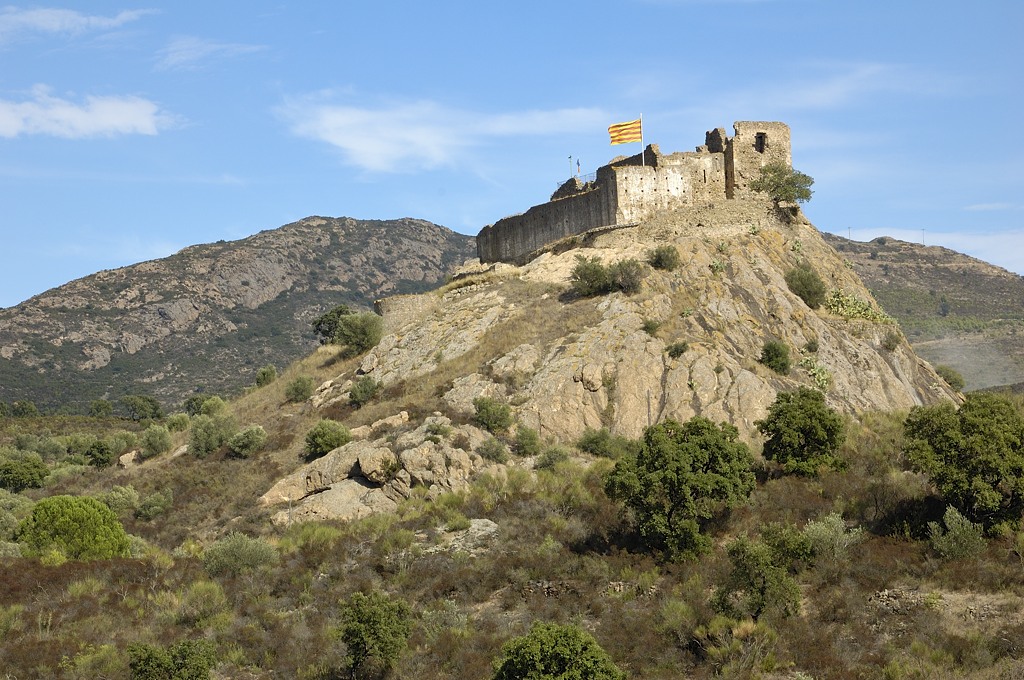
Castell de Molinàs
The Castell de Molinàs is a notable example of a medieval hill castle located near the village of Colera in the municipality of Colera, within the historic region of Catalonia, Spain. This fortress stands as a testament to the strategic importance of the Colera valley during the turbulent medieval period marked by shifting control between Christian and Muslim powers. Its origins are linked to the defensive networks established in the region, serving as a watchpoint and stronghold to guard the frontier.
Historical context and significance
The history of Castell de Molinàs is intertwined with the broader military and feudal developments of the medieval Christian kingdoms in northeastern Spain. Although direct documentation about the castle's initial construction is sparse, historical records from the 10th and 11th centuries mention a "tower of Moors" in the Colera valley, suggesting the presence of early frontier defenses. These references, particularly from the years 935 and 1123, coincide with the consecration of the Sant Quirc de Colera monastery basilica and imply a network of watchtowers protecting the region.
By the late 11th century, the site had gained feudal significance, as evidenced by records naming Dalmau Berenguer, a noble who held lands and a tower in Colera as a fief from the monastery. This highlights the castle's role not only in military defense but also within the local feudal and ecclesiastical hierarchy. Further evidence from the early 13th century, including a formal agreement in 1223 by the abbot of Sant Quirc, acknowledges multiple castles and towers in the valley, confirming Castell de Molinàs as part of a coordinated defensive system guarding the frontier against incursions.
Architectural features and construction
The castle is primarily characterized by its rectangular tower layout, constructed on a natural rock outcrop that was carefully carved to form a stable foundation. This practical adaptation to the terrain is a hallmark of many hill castles, leveraging natural defenses. The walls are built using a traditional local technique involving long, narrow slabs of slate arranged irregularly and bonded with clay, a method that reflects regional building practices of the late medieval period, likely dating from the 12th or 13th century.
The southern doorway of the tower is notable for its reinforcement with later-added mortar bricks, indicating ongoing maintenance and modifications over the centuries. The northern wall is the most intact, rising approximately ten meters and featuring three horizontal rows of arrow slits. These narrow vertical openings allowed defenders to launch arrows while remaining protected. Above these defensive apertures is a machicolation, a projecting parapet with openings through which defenders could drop stones or boiling liquids on attackers below. Adjacent to this is a now-blocked semicircular arched window, which likely served for observation or lighting.
The eastern wall has suffered significant damage, partly due to the later addition of a farmhouse that altered the original castle silhouette. In contrast, the western wall stands at about five meters tall and contains four low-positioned arrow slits, maintaining the defensive emphasis. The southern wall houses the main entrance and features eight arrow slits, reinforcing the tower's protective capabilities.
Interior layout and structural details
Inside, the tower is divided by a north-south wall containing a blocked semicircular arch at the lower level. The flooring includes slate slabs arranged in a distinctive herringbone pattern, combining durability with aesthetic appeal. A rectangular door provides access to the upper floor, while a rectangular space to the west of the dividing wall was likely open to the sky or covered with wooden boards rather than stone vaulting.
The eastern interior side retains traces of original roofing supported by semicircular diaphragm arches. These curved arches are crucial structural elements that distribute the roof's weight evenly, demonstrating the builders' knowledge of medieval construction techniques. The reuse of earlier architectural remains within the tower's fabric reflects a long history of adaptation and continuous occupation.
Strategic role and defensive elements
Castell de Molinàs functioned as part of a broader network of fortifications along the Colera valley, a frontier zone between Christian and Muslim territories during the Middle Ages. Its elevated position on a hill provided commanding views over the valley, enabling early warning of approaching forces. The combination of arrow slits, machicolations, and robust stone walls underscores the castle's primary role as a defensive stronghold.
The tower's construction, with its thick walls and limited openings, reflects the military architectural principles of the late medieval period in Catalonia. The presence of a machicolation is particularly significant, as this feature was a common defensive innovation in fortifications designed to repel attackers attempting to scale walls or breach gates.
Preservation and current condition
Today, the remains of Castell de Molinàs stand as a partially preserved medieval hill castle. The northern wall's remarkable preservation allows visitors to appreciate the original defensive design, while other sections exhibit varying degrees of ruin. The castle's integration with the natural rock and use of local materials provide valuable insights into medieval construction techniques in the region.
Although the eastern wall has been compromised by later agricultural developments, the overall structure retains enough integrity to convey its historical and architectural significance. Ongoing conservation efforts focus on stabilizing the remaining walls and preventing further deterioration, ensuring that Castell de Molinàs continues to be a cultural heritage site reflecting Catalonia's medieval past.
Cultural heritage and visitor information
Castell de Molinàs is an important cultural landmark within Catalonia's rich medieval heritage. Its connection to the Sant Quirc de Colera monastery and its role in the feudal and defensive systems of the region make it a site of interest for historians, archaeologists, and visitors fascinated by medieval military architecture.
Visitors to the site can explore the ruins and observe the distinctive architectural features such as the arrow slits, machicolation, and the slate construction techniques. The castle's location near Colera also offers opportunities to experience the surrounding natural landscape and other historical sites in the valley.
Frequently asked questions (FAQ)
- What is the historical significance of Castell de Molinàs?
- Castell de Molinàs was a strategic medieval hill castle guarding the Colera valley frontier between Christian and Muslim territories in Catalonia. It was part of a defensive network linked to the Sant Quirc de Colera monastery and feudal lords.
- What are the main architectural features of Castell de Molinàs?
- The castle features a rectangular tower built on natural rock with slate walls, arrow slits, a machicolation, semicircular arches, and a herringbone patterned slate floor, reflecting late medieval military architecture.
- Is Castell de Molinàs accessible to visitors?
- The castle remains are partially preserved and open to visitors who can explore the ruins and appreciate the medieval defensive structures. However, facilities and detailed visitor information may be limited due to its ruinous state.
- When was Castell de Molinàs constructed?
- The architectural features and documentary evidence suggest the castle was built in the late 12th or 13th century, during the late medieval period.
- Why is the northern wall of Castell de Molinàs significant?
- The northern wall is remarkably well-preserved, rising about ten meters and featuring three rows of arrow slits and a machicolation, showcasing the castle's defensive design and construction quality.
Information
Loading map...
Visitor reviews
No reviews yet. Been here? Write the first review and help other travelers!
Write the first reviewVisited this castle? Share your experience
Your review helps other travelers and adds first-hand knowledge to our encyclopedia.