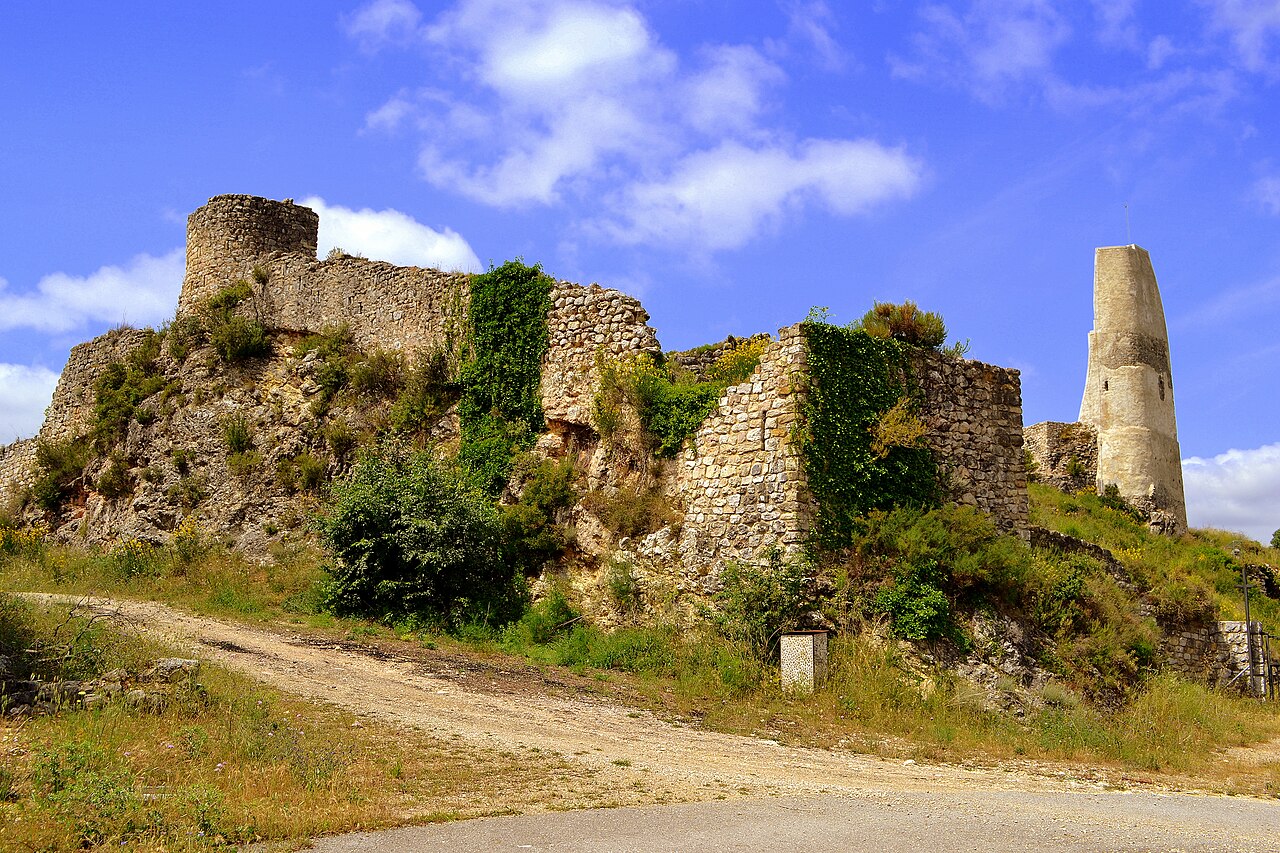
Castell de la Granada
The Castell de la Granada stands as a significant medieval fortress located in the village of La Granada, within the Catalonia region of Spain. This hill castle was originally constructed by Christian medieval builders to exert control over a strategically vital area. Its location at the crossroads of the ancient Roman Via Augusta and the important Via Mercadera contributed to its military and economic importance throughout the Middle Ages.
The earliest known reference to the site dates back to 950 AD, when Bishop Guilarà of Barcelona granted the land to Sisovald for the purpose of erecting a defensive tower. This initial fortification was destroyed in 1003 during an assault by Saracen forces led by Abd al-Màlik Yüsuf. Reconstruction efforts were undertaken starting in 1005 by Bishop Aeci, who invested considerable resources into restoring the castle until approximately 1013. Throughout these early centuries, the castle remained under the ownership and jurisdiction of the Bishopric of Barcelona.
Medieval ownership and feudal context
In the 12th century, the castle came under the control of the Cervelló family, a notable noble lineage in Catalonia. Documents from 1193 record Guerau Alemany de Cervelló as the castle's holder, although the bishopric retained overarching domain rights well into the 14th century. This dual ownership reflects the complex feudal arrangements typical of medieval Catalonia, where ecclesiastical authorities often shared power with secular nobility.
Strategic significance and economic role
The castle's position at the intersection of two major routes made it a focal point for trade and military control. The nearby market, first documented in 1080, was one of the earliest in Catalonia and flourished due to the castle's protection and the traffic along the roads. This market thrived until the establishment of the larger market at Vilafranca, which gradually overshadowed it.
Military history and conflicts
Throughout its history, Castell de la Granada witnessed several military engagements. During the 15th century Catalan civil war, the castle was besieged, demonstrating its continued strategic value. Later, in the 17th century during the Guerra dels Segadors (Catalan Revolt), Castilian troops fought near the castle and suffered defeat, underscoring the site's ongoing military relevance.
The castle's fate was sealed in the early 18th century during the War of Spanish Succession. King Philip V ordered its demolition to prevent its use by opposing forces. The fortress was extensively dismantled, with stones repurposed for other constructions. Notably, during the Spanish Civil War in 1937, materials from the ruins were used for road building, and further destruction occurred after the conflict ended in 1939. Despite this, the site remains a protected cultural heritage landmark in Catalonia.
Architectural features and current remains
The castle occupies a raised area within the village and follows a rectangular plan approximately 20 meters long by 10.5 meters wide internally. The surviving walls, primarily constructed in the 13th century, consist of slightly worked rectangular stone blocks arranged in horizontal courses. Each block measures about 20 centimeters in height and 35 centimeters in length, reflecting skilled masonry techniques of the period.
A distinctive feature was a rectangular tower attached to the southwest corner of the castle, measuring roughly 3.4 by 3.9 meters internally. The eastern wall that connected this tower to the main fortress no longer exists. The southern and western walls still stand about 7 meters tall, although earlier damage reduced their original height by approximately three meters. The northern and eastern walls suffered severe demolition, particularly in 1937.
The eastern wall features the main entrance with a large portal characterized by a single stone lintel topped by a semicircular arch, a typical medieval gateway form. The northern wall preserves remnants of three doorways, including one with a semicircular arch. Door jambs remain visible, along with functional details such as a bar hole to secure doors and pivot holes for door hinges.
Defensive elements are evident in the numerous arrow slits carved into the walls. Near ground level, about one meter above the floor, the arrow slits measure approximately 70 centimeters wide by 115 centimeters tall and are finished with angled stone slabs to optimize visibility and firing angles. The southern wall contains sixteen smaller arrow slits, while larger, vertically oriented slits measuring about 70 centimeters wide and two meters tall are positioned about two meters above these, enhancing defensive capabilities.
Construction techniques and materials
The use of slightly worked rectangular stone blocks laid in even horizontal layers is characteristic of 13th-century military architecture in Catalonia. The masonry demonstrates a balance between durability and efficiency, with the stones carefully shaped to fit tightly without excessive finishing. This technique provided robust defensive walls capable of withstanding sieges and assaults common in the medieval period.
Preservation and cultural heritage status
Although the castle suffered significant destruction and material spoliation over centuries, including deliberate demolition in the 18th century and reuse of stones in the 20th century, enough remains to convey its historical and architectural significance. The site is recognized as part of Catalonia's cultural heritage and offers valuable insights into medieval fortification design, feudal history, and regional conflicts.
Visitors to the site can observe the castle's rectangular footprint, surviving defensive walls, and architectural details such as the main gate and arrow slits. These remnants provide a tangible connection to the turbulent history of Catalonia and the strategic importance of fortifications like Castell de la Granada in controlling trade routes and regional power.
Historical context within catalonia's medieval landscape
The castle's history reflects the broader dynamics of medieval Catalonia, where ecclesiastical authorities like the Bishopric of Barcelona played a significant role in land ownership and fortification construction. The interplay between religious and noble powers shaped the region's political landscape, with castles serving as both military strongholds and symbols of authority.
Its location along vital communication and trade routes underscores the economic as well as military motivations behind castle construction during this period. The development of markets near such fortifications was common, facilitating commerce under the protection of the castle's garrison.
The castell's role in regional conflicts
The sieges and battles involving Castell de la Granada illustrate its strategic importance during periods of civil unrest and external threats. The castle's endurance through the 15th-century civil war and the 17th-century Catalan Revolt highlight its defensive capabilities and the military challenges faced by Catalan forces.
The ordered demolition in the early 18th century reflects the shifting political landscape following the War of Spanish Succession, where new centralized powers sought to neutralize regional fortresses that could support opposition forces.
Visitor information and accessibility
Today, the ruins of Castell de la Granada are accessible to visitors interested in medieval architecture and Catalan history. While the site is primarily an archaeological ruin, it offers a compelling glimpse into the construction techniques and military architecture of the High to Late Medieval periods. Visitors can explore the remains of walls, towers, and defensive features that have withstood centuries of conflict and change.
The castle's location within the village makes it an accessible destination for those exploring the cultural heritage of Catalonia. Interpretive signage and preservation efforts help contextualize the site within the broader history of the region.
Frequently asked questions (FAQ)
- How do I get to Castell de la Granada?
- Castell de la Granada is located in the village of La Granada, Catalonia, Spain. It is accessible by local roads and can be reached by car or public transport from nearby towns.
- What is the best time to visit the castle?
- The best time to visit Castell de la Granada is during spring and autumn when the weather is mild and comfortable for exploring the ruins and surrounding village.
- Is there an entrance fee to visit the castle?
- Currently, there is no entrance fee to visit the ruins of Castell de la Granada, making it an accessible destination for history enthusiasts and tourists.
- Can I explore the entire castle ruins?
- Visitors can explore the visible remains of the castle, including the walls, tower base, and gate structures. However, some areas may be restricted for safety reasons due to the ruinous condition.
- What architectural style is the castle built in?
- Castell de la Granada primarily exhibits Romanesque architectural features typical of the 13th century, including semicircular arches and robust stone masonry.
Information
Sources & official resources
Verify the information above using these authoritative references.
Loading map...
Visitor reviews
No reviews yet. Been here? Write the first review and help other travelers!
Write the first reviewVisited this castle? Share your experience
Your review helps other travelers and adds first-hand knowledge to our encyclopedia.