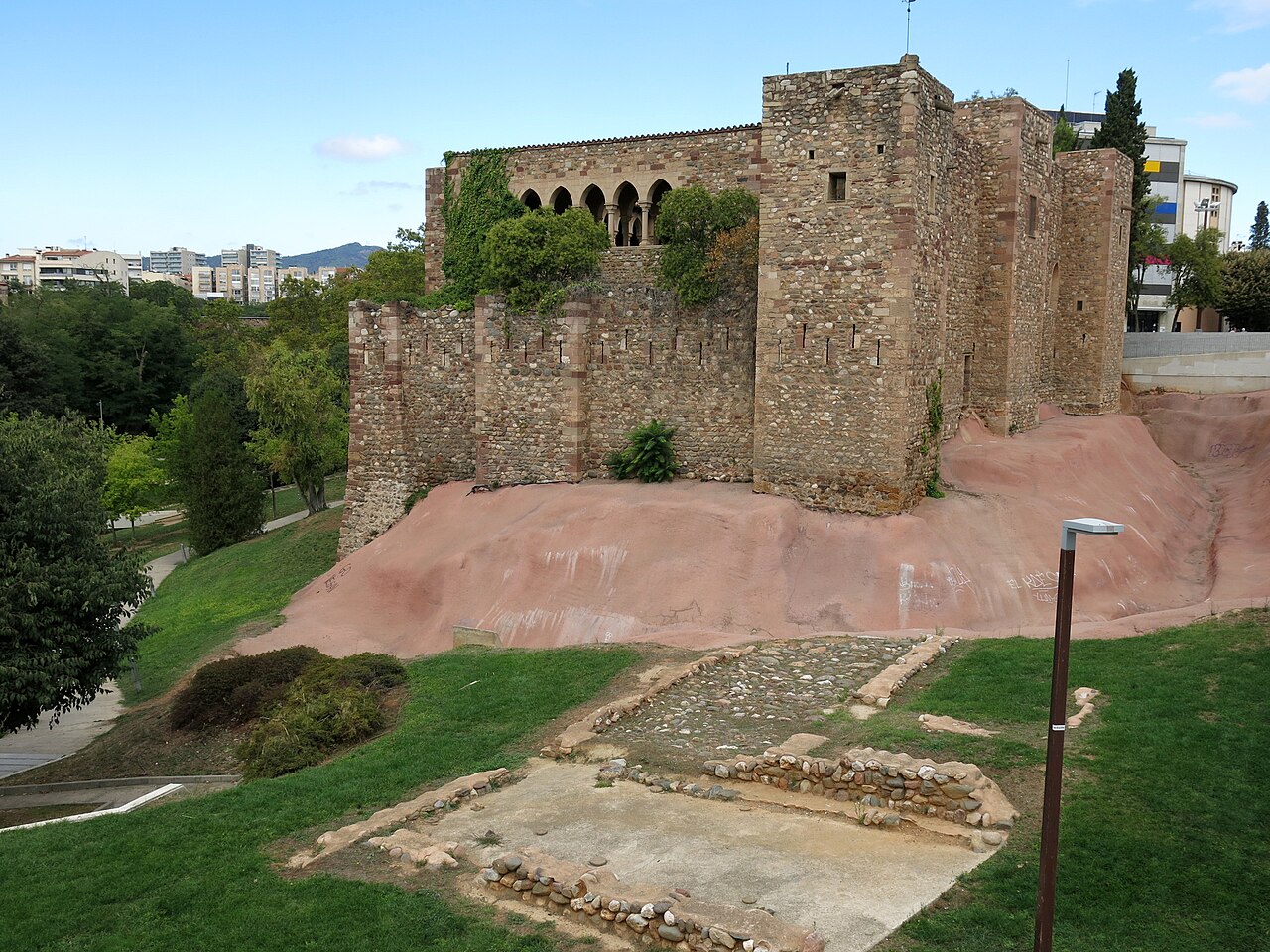
Castell de Clasquerí
Castell de Clasquerí stands as a remarkable example of a medieval hill castle nestled near the municipality of Castellar del Vallès in Catalonia, Spain. Its origins trace back to the early 10th century, a period marked by the Christian reorganization and territorial consolidation following the decline of Muslim control in the Iberian Peninsula. This fortress played a significant role in the defense and administration of the surrounding lands during the turbulent medieval era.
The earliest documentary mentions of the castle date from the years 912, 939, and 1010, where it is referred to as castrum Kastellare. These records highlight the castle's foundational role as a fortified site within the developing territory that would become known as Castellar del Vallès. Throughout the 10th century, the castle's lands were the subject of multiple land donations, notably to the Counts of Barcelona and the Monastery of Sant Cugat del Vallès. These transactions underscore the castle's strategic and economic importance in the region during the early medieval period.
Historical context and ownership transitions
Between 1020 and 1030, the castle was involved in noble marriage alliances, particularly with the influential Montcada family. Such alliances were typical of feudal consolidation strategies, where castles served not only military but also social and political functions. A pivotal moment came in 1039 when Countess Ermessenda and her grandson Ramon Berenguer I granted the castle and its estates to the Monastery of Sant Llorenç del Munt. This transfer marked a period during which ecclesiastical authorities gained control over the fortress and its surrounding lands, reflecting the intertwined nature of religious and feudal power in medieval Catalonia.
By the late 11th century, Castell de Clasquerí was integrated into the feudal domain of Castellar, though the Counts of Barcelona maintained overarching feudal supremacy throughout the 12th century. Over the subsequent centuries, ownership passed through various noble families, with a significant transition in 1310 when Gastón de Moncada donated the castle to Pedro de Clasquerí. The Clasquerí family held possession for nearly five centuries until 1788, after which the property passed to the Sentmenat family and later to the Fontcuberta family, who remain the current private owners.
Architectural features and layout
The castle is arranged on a distinctive trapezoidal ground plan, anchored by two principal towers located at opposite corners. These towers, along with additional wings and a smaller tower, enclose a central courtyard that contains a well and staircases providing access to the upper floors. The structure comprises a ground floor plus two successive upper stories, demonstrating the typical vertical stratification of medieval fortifications.
The main façade faces south and features large pseudo-Gothic windows, crenellated battlements designed for defensive purposes, and a voussoired arched portal constructed from wedge-shaped stones arranged in an arch. This façade opens onto a lookout plaza that includes a rectangular water basin, an integral component of the castle's historic water management system, and is backed by the Gothic chapel of Santa Bárbara.
The chapel of santa bárbara
The chapel is a single-nave Gothic building with a polygonal apse crowned by small stepped battlements resembling a tower rising above the roofline. Its main façade is characterized by a rounded arch doorway framed with a pointed archivolt, a small stone rose window with intricate tracery, and a double-pitched roof topped with battlements. Inside, the chapel houses a set of 16th-century paintings by Pere Serafí, a notable artist from Barcelona, created in 1548. These artworks contribute significantly to the cultural heritage value of the site.
Masonry and decorative elements
The castle's walls are constructed from carefully cut ashlar stones laid in horizontal, aligned courses, reflecting refined medieval masonry craftsmanship. The first floor of the main south façade features two pairs of Gothic windows separated by slender columns, each pair embellished with heraldic shields representing the historic lords of the castle. Above, the second floor presents windows with distinctive ogee arches, a pointed form with double curves typical of Gothic architecture.
Inside, 20th-century restorations preserved coffered ceilings—decorative sunken panels—in the noble floor's main chambers. Additionally, a mural dating to 1581 survives within the main tower, likely a fresco depicting a man holding a cross, accompanied by a skull and a sword on a nearby table, suggesting symbolic or religious themes.
Water management and ancillary structures
An important feature of Castell de Clasquerí is its hydraulic system, including an aqueduct that historically channeled water from the masoveria—a large farmhouse situated on the northeastern slope—down to the water basin within the castle's courtyard. The masoveria is a substantial building with a ground floor and two upper levels, capped by a double-pitched roof oriented perpendicularly to the main eastern façade.
A notable architectural element of the masoveria is its large south-facing porch on the second floor, whose entrance is elevated above ground level and supported by a substantial retaining wall that visually connects it to the aqueduct. This integration of residential and hydraulic architecture illustrates the castle's self-sufficiency and the importance of water management in medieval fortifications.
Restoration and preservation
The castle underwent important restoration efforts in 1335 under Guerau de Clasquerí, which helped maintain its medieval character. Further renovations between the late 19th and early 20th centuries aimed to preserve and emulate early medieval construction methods and stylistic elements, ensuring the site's historic atmosphere was retained. Today, Castell de Clasquerí is recognized for its cultural and historical significance within Catalonia, standing as a well-preserved example of medieval military architecture and noble residence.
The on-site chapel of Santa Bárbara served as a private place of worship for the castle's owners, with religious ceremonies continuing under special authorization until the mid-19th century. This continuity of use adds an important layer to the castle's historical narrative, linking its military and residential functions with spiritual life.
Frequently asked questions (FAQ)
- How do I get to Castell de Clasquerí?
- You can reach Castell de Clasquerí by car or public transport from Barcelona. The closest train station is in Castellar del Vallès, and from there, local buses or taxis can take you to the castle.
- What is the history of Castell de Clasquerí?
- Castell de Clasquerí dates back to the 10th century, serving as a strategic fortress in the region. Its historical significance lies in its role during the medieval period, particularly in defending the area from invasions.
- Can I take guided tours of the castle?
- Yes, guided tours are available at Castell de Clasquerí, providing visitors with in-depth information about its history and architecture. It is recommended to book tours in advance, especially during peak tourist seasons.
- Is Castell de Clasquerí accessible for visitors with mobility challenges?
- The castle's historic structure features some uneven terrain and stairs, which may pose challenges for visitors with mobility issues. However, efforts are made to accommodate all guests, and it's best to contact the castle management for specific accessibility options.
- When is the best time to visit Castell de Clasquerí?
- The best time to visit Castell de Clasquerí is during the spring and fall when the weather is pleasant and ideal for exploring the grounds. Summer can be quite hot, while winter may limit outdoor activities.
- What are the opening hours for Castell de Clasquerí?
- Castell de Clasquerí typically opens from 10 AM to 6 PM, with extended hours during the summer months. It's advisable to check the official website for any seasonal changes or special events that may affect visiting hours.
- How much does it cost to enter Castell de Clasquerí?
- Ticket prices for Castell de Clasquerí are generally around €5 for adults, with discounts available for children and seniors. Special rates may apply for guided tours or group bookings, so be sure to confirm upon arrival.
- Are there any nearby attractions to visit after Castell de Clasquerí?
- Yes, after exploring Castell de Clasquerí, you can visit the beautiful Montcada i Reixac or take a short trip to the Parc Natural de Sant Llorenç del Munt i l'Obac for hiking and nature walks. The area offers a variety of cultural and outdoor activities for visitors.
Information
Sources & official resources
Verify the information above using these authoritative references.
Loading map...
Visitor reviews
No reviews yet. Been here? Write the first review and help other travelers!
Write the first reviewVisited this castle? Share your experience
Your review helps other travelers and adds first-hand knowledge to our encyclopedia.