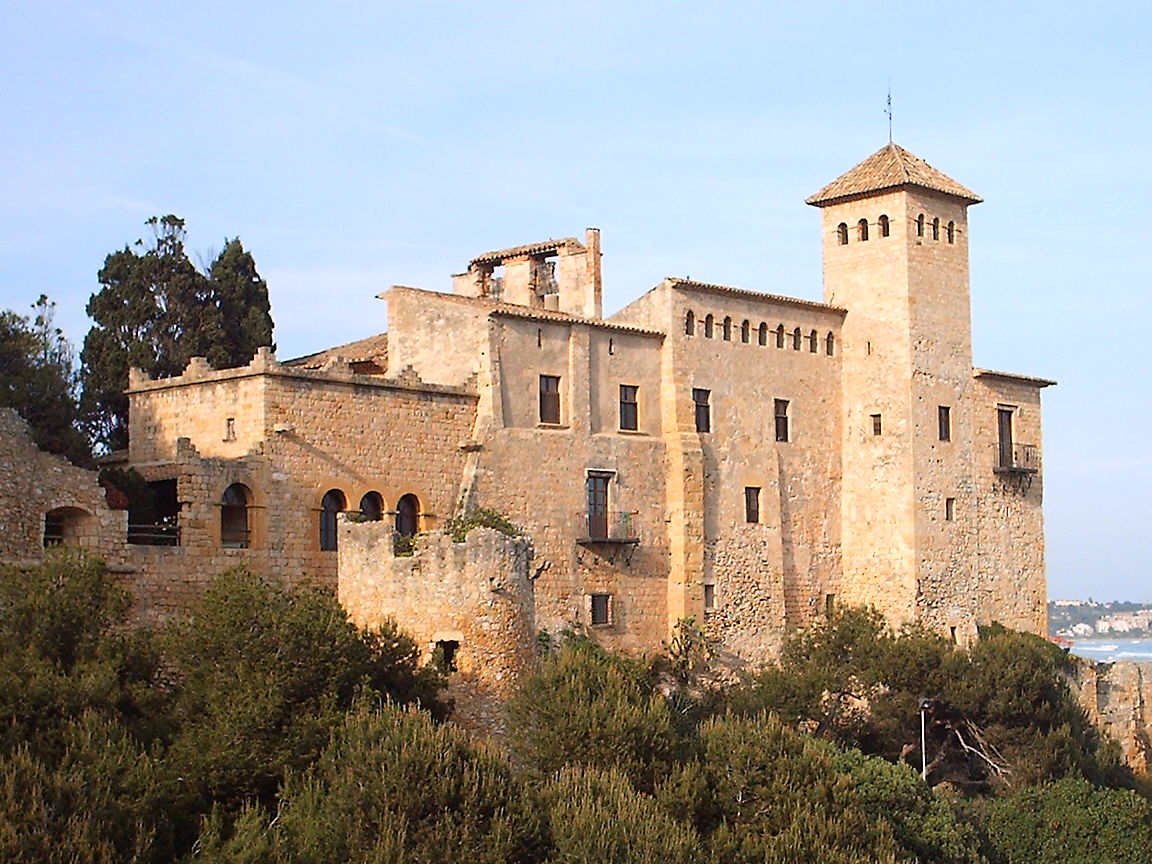
Castell d’Altafulla
Castell d’Altafulla, also known as Castell dels Montserrat, stands as a remarkable example of a medieval hill castle in the town of Altafulla, Catalonia, Spain. Its strategic location atop the highest point of the town allowed it to dominate and control the surrounding landscape, fulfilling both defensive and administrative roles throughout its long history. The castle's origins trace back to the 11th century, a period marked by the consolidation of feudal power and territorial organization in the region.
Early history and medieval significance
The site of Castell d’Altafulla initially emerged around 1057 as part of a farmstead or quadra within the larger defensive system known as the castrum of Tamarit. The castle's first documented mention appears in a 1060 record concerning a territorial boundary donation by the Counts Ramon Berenguer I and Almodis de la Marca. This early documentation highlights the castle's importance in demarcating feudal landholdings and its role within the evolving political landscape of medieval Catalonia.
Throughout the 12th century, the castle and its surrounding lands underwent a process of colonization and development, with the castle's name appearing in various forms such as Altafuya, Alta Folia, and Altafoia. These variations reflect the castle's continuous administrative and defensive functions during this period. Although documentary evidence becomes scarce during the 13th century, the castle re-emerges in records from the 14th century when King Jaume II of the Crown of Aragon granted the estate to the noble Requesens family.
Berenguer de Requesens is recorded as the lord of the castle in 1337, succeeded by Lluís de Requesens in the 15th century. In 1472, ownership passed to Pere de Castellet i de Requesens, indicating a continuity of noble possession that underscores the castle's significance as a seat of local power. These transitions reflect broader feudal dynamics and the importance of noble lineages in Catalonia during the late medieval period.
Early modern transformations and noble ownership
The 17th century brought significant changes to Castell d’Altafulla, both in terms of ownership and architectural style. The castle passed to the Corbera-Santcliment family through marriage, and shortly thereafter, between 1669 and 1673, it was sold to Francesc de Montserrat i Vives. Francesc's elevation to Marquis of Tamarit by King Charles II in 1681 marked a new chapter in the castle's history, with the Montserrat family maintaining control until the abolition of seigniories in the region.
Architecturally, this period saw the introduction of a renaissance gallery above the castle's interior courtyard, reflecting contemporary tastes and the castle's transition from purely military fortress to a more residential and prestigious noble residence. These alterations, carried out primarily in the 1600s, significantly modified the castle's fabric, obscuring many of its original Romanesque features but preserving its overall fortress character.
Architectural features and layout
Castell d’Altafulla is characterized by its large, irregular polygonal plan, designed to maximize defensive capabilities by adapting to the natural contours of the hilltop site. The castle's perimeter is punctuated by several protruding sections resembling fortified towers, each crowned with battlements that emphasize its military function.
At the heart of the castle lies an interior courtyard that remains largely intact, providing insight into the spatial organization typical of medieval fortress-palaces. The presence of the renaissance gallery above this courtyard is a distinctive feature that illustrates the castle's architectural evolution and its owners' desire to incorporate contemporary stylistic elements.
The castle's defensive structures, including its battlemented towers and thick walls, coexist with residential spaces, reflecting the dual role of the castle as both a stronghold and a noble residence. Its proximity to the parish church of Sant Martí further underscores its central role in the historical and social fabric of Altafulla.
Preservation and cultural heritage
Today, Castell d’Altafulla is recognized as an important cultural heritage site in Catalonia. Although the castle has undergone multiple alterations over the centuries, its well-preserved battlemented towers and the renaissance gallery remain prominent features that attract interest from historians, architects, and visitors alike.
The castle serves as a tangible record of the complex layering of historical periods through its diverse materials and construction techniques. Its enduring presence offers valuable insights into the feudal, medieval, and early modern history of the region, making it a significant landmark within the Catalan cultural landscape.
Frequently asked questions (FAQ)
- How do I visit Castell d’Altafulla?
- Castell d’Altafulla is privately owned and may have limited public access. Visitors should check local tourism websites or contact the Altafulla town hall for current visiting information and possible guided tours.
- What is the historical significance of Castell d’Altafulla?
- Castell d’Altafulla played a key role in the feudal organization and defense of the Altafulla region from the 11th century onward. It was a noble residence and a military stronghold that witnessed important ownership transitions among Catalan noble families.
- When was Castell d’Altafulla built?
- The castle's origins date back to around 1057, with documented mentions beginning in 1060. It was constructed during the High Medieval period as part of the feudal defensive system in Catalonia.
- Can I see original architectural features at Castell d’Altafulla?
- While many original Romanesque elements were altered during 17th-century renovations, visitors can still observe the castle’s medieval fortress layout, battlemented towers, and the Renaissance gallery added in the early modern period.
- Is Castell d’Altafulla accessible for people with mobility issues?
- Due to its hilltop location and historic structure, accessibility may be limited. Visitors with mobility concerns should inquire locally about accommodations and the extent of accessible areas within the castle.
Information
Current owner
Private owner
Loading map...
Visitor reviews
No reviews yet. Been here? Write the first review and help other travelers!
Write the first reviewVisited this castle? Share your experience
Your review helps other travelers and adds first-hand knowledge to our encyclopedia.