Castel Sant'Angelo
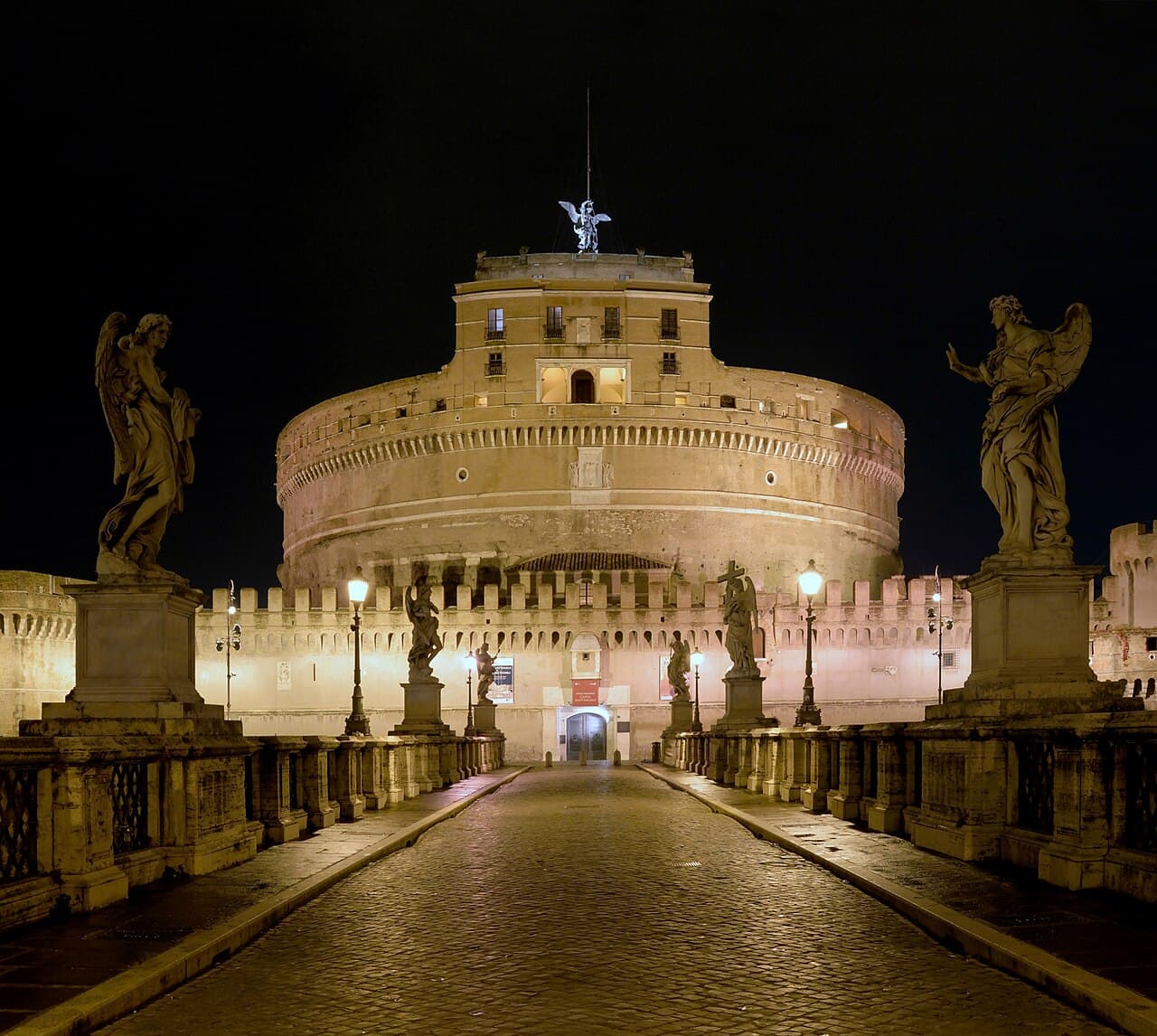
Castel Sant'Angelo, originally known as the Mausoleum of Hadrian, stands as one of Rome's most iconic and historically rich monuments. Commissioned by the Roman Emperor Hadrian between 134 and 139 AD, this towering cylindrical structure was initially designed as a mausoleum for Hadrian himself and his family. Located on the right bank of the Tiber River, it was strategically positioned near the ancient Pons Aelius, a bridge constructed by Hadrian to provide a grand approach from the city center.
The mausoleum was originally a grand, decorated cylinder crowned with a garden and a golden quadriga statue, symbolizing imperial power and eternity. It housed the ashes of Hadrian, his wife Sabina, and his adopted son Lucius Aelius, with subsequent emperors, including Caracalla, also interred there until the early 3rd century. The urns containing these ashes were likely kept in the building's inner treasury room, a testament to its funerary function.
The transformation from mausoleum to fortress
Over the centuries, Castel Sant'Angelo underwent significant transformations. By the early medieval period, the mausoleum had lost much of its original funerary purpose and was repurposed for military defense. Around 401 AD, it was converted into a fortress and incorporated into the Aurelian Walls, Rome's defensive walls, under Emperor Honorius. This marked the beginning of its long history as a military stronghold.
The building's defensive capabilities were tested during the Visigothic sack of Rome in 410 AD, when looters scattered the urns and ashes it once contained. Later, during the siege of Rome in 537 AD by the Ostrogoths, the defenders famously threw down the original bronze and stone statues from the mausoleum's heights to repel the attackers, as chronicled by the historian Procopius.
The legend of the archangel
The castle's current name derives from a famous legend dating to 590 AD, when the city was ravaged by plague. According to tradition, the Archangel Michael appeared atop the mausoleum, sheathing his sword as a sign that the plague would end. This vision inspired the renaming of the structure to Castel Sant'Angelo, or Castle of the Holy Angel, a name that has endured ever since.
Papal fortress, residence, and prison
From the 14th century onward, the popes transformed Castel Sant'Angelo into a fortified papal castle. Pope Nicholas III connected it to St. Peter's Basilica by a fortified corridor known as the Passetto di Borgo, allowing the pope a secure passage in times of danger. This corridor played a crucial role during the Sack of Rome in 1527, when Pope Clement VII sought refuge within the castle walls from the invading forces of Charles V of Spain.
The fortress was enhanced with luxurious papal apartments under Pope Paul III, ensuring a comfortable residence during sieges. Artistic contributions include a chapel built under Pope Leo X featuring a Madonna by Raffaello da Montelupo, and the statue of Saint Michael atop the castle, originally sculpted in marble by Montelupo and later replaced by a bronze statue by Peter Anton von Verschaffelt in 1753. The original marble statue remains on display in the castle's courtyard.
Besides its military and residential functions, Castel Sant'Angelo served as a notorious papal prison. Famous prisoners included the philosopher Giordano Bruno, who was held for six years, and the sculptor and goldsmith Benvenuto Cellini. Executions were carried out in the castle's small inner courtyard. The castle's prison role also inspired cultural works such as the third act of Giacomo Puccini's opera Tosca, where the heroine leaps to her death from the castle's ramparts.
Architectural features and artistic elements
The castle's architecture reflects its varied history, combining elements of Roman imperial design with medieval and Renaissance fortifications. The original cylindrical mausoleum structure remains the core, surrounded by massive defensive walls and bastions added during the medieval period. The Passetto di Borgo is a remarkable example of papal military architecture, a secret passage linking the Vatican and the castle for over 600 years.
The castle's ramparts offer commanding views over Rome and the Tiber River, underscoring its strategic importance. The interior houses richly decorated papal apartments, chapels, and the treasury room, where the ashes of emperors were once kept. The castle also contains a museum today, displaying artifacts from its long history, including Renaissance artworks and weaponry.
Modern history and museum status
Decommissioned as a fortress in 1901, Castel Sant'Angelo was converted into the Museo Nazionale di Castel Sant'Angelo. The museum preserves and exhibits the castle's extensive history, from its Roman origins through its papal military role to its cultural significance in modern times.
Visitors can explore the castle's multiple levels, including the dungeons, papal apartments, and the rooftop terrace crowned by the statue of Saint Michael. The castle remains one of Rome's most visited historic sites, celebrated for its architectural grandeur and rich layers of history.
Location and surroundings
Situated in the heart of Rome, Castel Sant'Angelo is easily accessible and lies adjacent to the Vatican City. Its proximity to both the Tiber River and the ancient city center enhances its historical and touristic appeal. The nearby Ponte Sant'Angelo, adorned with Baroque statues of angels, serves as a scenic approach to the castle, linking it visually and physically to the city.
Today, the castle is well-preserved and maintained, offering visitors a unique glimpse into Rome's imperial past, papal power, and artistic heritage.
Frequently asked questions (FAQ)
- What is the historical significance of Castel Sant'Angelo?
- Castel Sant'Angelo has served as a Roman mausoleum, papal fortress, prison, and now a museum, reflecting Rome's imperial and religious history.
- How do I get to Castel Sant'Angelo in Rome?
- Castel Sant'Angelo is centrally located near the Vatican and accessible by public transport, walking from central Rome or Vatican City.
- Can I visit the Passetto di Borgo corridor?
- The Passetto di Borgo is generally not open to the public, as it is a private papal passage, but guided tours occasionally provide limited access.
- When is the best time to visit Castel Sant'Angelo?
- Visiting early in the morning or late afternoon helps avoid crowds; the castle is open daily from 9:00 to 19:00.
- Are there any special exhibitions or events at Castel Sant'Angelo?
- The Museo Nazionale di Castel Sant'Angelo hosts temporary exhibitions and cultural events related to its history and art collections.
- Is Castel Sant'Angelo accessible for visitors with mobility issues?
- While some areas have limited accessibility due to the historic structure, the museum provides assistance and has adapted routes where possible.
- What architectural styles are represented in Castel Sant'Angelo?
- The castle features a mix of Roman imperial architecture, medieval fortifications, and Renaissance papal additions.
Photo gallery

Information
Opening hours
9:00-19:00 daily
Ticket prices
€15 adult, reduced rates available
Current owner
State museum
Website
Visit websiteSources & official resources
Verify the information above using these authoritative references.
Loading map...
Visitor reviews
No reviews yet. Been here? Write the first review and help other travelers!
Write the first reviewVisited this castle? Share your experience
Your review helps other travelers and adds first-hand knowledge to our encyclopedia.