Carisbrooke Castle
Carisbrooke Castle stands as a monumental example of Norman military architecture, perched atop a prominent hill overlooking the village of Carisbrooke near Newport on the Isle of Wight. This historic motte-and-bailey castle has witnessed centuries of English history, from its early medieval origins to its pivotal role during the English Civil War. Its commanding position and robust fortifications reflect its strategic importance in controlling the island and defending against invasions.
The site of Carisbrooke Castle reveals a rich archaeological timeline. Evidence suggests occupation since pre-Roman times, with traces of a Roman fortification likely part of the Saxon Shore defense system. The Anglo-Saxon Chronicle records that Wihtgar, a relative of King Cynric of Wessex, was buried here in AD 544, indicating the site's early significance. By the 8th century, an Anglo-Saxon stronghold was established, and around the year 1000, defensive walls were constructed to repel Viking raids, underscoring the site's long-standing military role.
The Norman foundation and medieval development
Following the Norman Conquest, William fitz Osbern, Earl of Hereford, founded the initial castle structure in the 12th century, employing the classic motte-and-bailey design. This design featured an artificial motte crowned by a stone keep, accompanied by two baileys enclosed by defensive walls. The castle passed into the hands of the Redvers family, notably Baldwin de Redvers, Earl of Devon, who enhanced the defenses by constructing a formidable stone curtain wall around the baileys. This transformation marked the castle's evolution from timber to stone fortifications, typical of the High Medieval period.
The castle quickly became entwined with national politics. In 1136, Baldwin de Redvers supported Queen Maud's claim to the English throne during the civil conflict known as The Anarchy. When King Stephen besieged Carisbrooke, the castle's water supply failed, forcing Baldwin to surrender despite its strong defenses. This episode highlights the strategic value and vulnerabilities of medieval fortifications.
Countess Isabella de Fortibus and the castle's domestic transformation
One of Carisbrooke's most influential figures was Countess Isabella de Fortibus, the last of the Redvers line and one of England's wealthiest landowners in the 13th century. She made Carisbrooke her principal residence and undertook significant modifications to improve its habitability. Isabella added a great hall, private chambers, and the chapel of St Peter, which now forms part of the castle museum. These additions reflect a shift from purely military functions to a more comfortable noble residence, blending defense with domesticity.
Upon Isabella's death in 1293, the castle reverted to royal ownership under King Edward I. From this point onward, Carisbrooke was managed by appointed wardens, often royal favourites, who maintained its defenses and governance.
Military engagements and Tudor fortifications
Carisbrooke's military relevance continued into the late medieval period. In 1377, during the reign of Richard II, the castle successfully repelled a French invasion. Local legend credits this defense to Peter de Heyno, a skilled archer who reportedly killed the French commander, securing the castle's safety.
By the Tudor era, the threat shifted from French to Spanish forces. Anticipating an attack during the Spanish Armada crisis, Sir George Carey, Governor of the Isle of Wight from 1583, commissioned the Italian engineer Federigo Giambelli to modernize Carisbrooke's defenses. Giambelli introduced a trace Italienne style fortification, featuring low, angled bastions designed to withstand artillery bombardment. Completed by 1600, these earthworks and stone bastions fully enclosed the earlier Norman baileys, marking a significant evolution in the castle's defensive architecture.
Carisbrooke Castle during the English Civil War
The castle's most famous historical association is with King Charles I, who was imprisoned at Carisbrooke from 1647 to 1648 following his defeat in the English Civil War. He was housed in the Constable's Lodging, a Tudor building adjacent to the medieval Great Hall. Despite comfortable accommodations, Charles attempted multiple escapes, including a failed attempt through a barred window that remains preserved. His confinement here ended when he was transferred to London for trial and execution in 1649.
Following the king's imprisonment, two of his youngest children were also confined at Carisbrooke. Tragically, Princess Elizabeth died at the castle, adding a somber chapter to its history.
Later history and preservation
In the late 19th and early 20th centuries, Carisbrooke Castle served as the summer residence of Princess Beatrice, Queen Victoria's youngest daughter, who was appointed Governor of the Isle of Wight in 1896. She lived at the castle until 1944, maintaining its status as a royal residence.
Today, Carisbrooke Castle is managed by English Heritage and remains a well-preserved example of a Norman hill castle with extensive Tudor fortifications. Visitors can explore the Great Hall, Great Chamber, and the castle chapel, as well as the donkey-powered well-house that historically supplied water to the keep. The castle's museum houses exhibits on its rich history and its connection to Charles I.
Architectural features and visitor experience
The keep and defensive structures
The castle's keep, built during the reign of Henry I, is a hollow stone structure supported by buttresses to counteract the unstable limestone foundation. Visitors ascend 71 steps to reach the top, which offers panoramic views of the surrounding countryside. The keep contains a deep well, historically vital for withstanding sieges, though the original well dried up in the 12th century, leading to the construction of the donkey-powered well-house.
The gatehouse and curtain walls
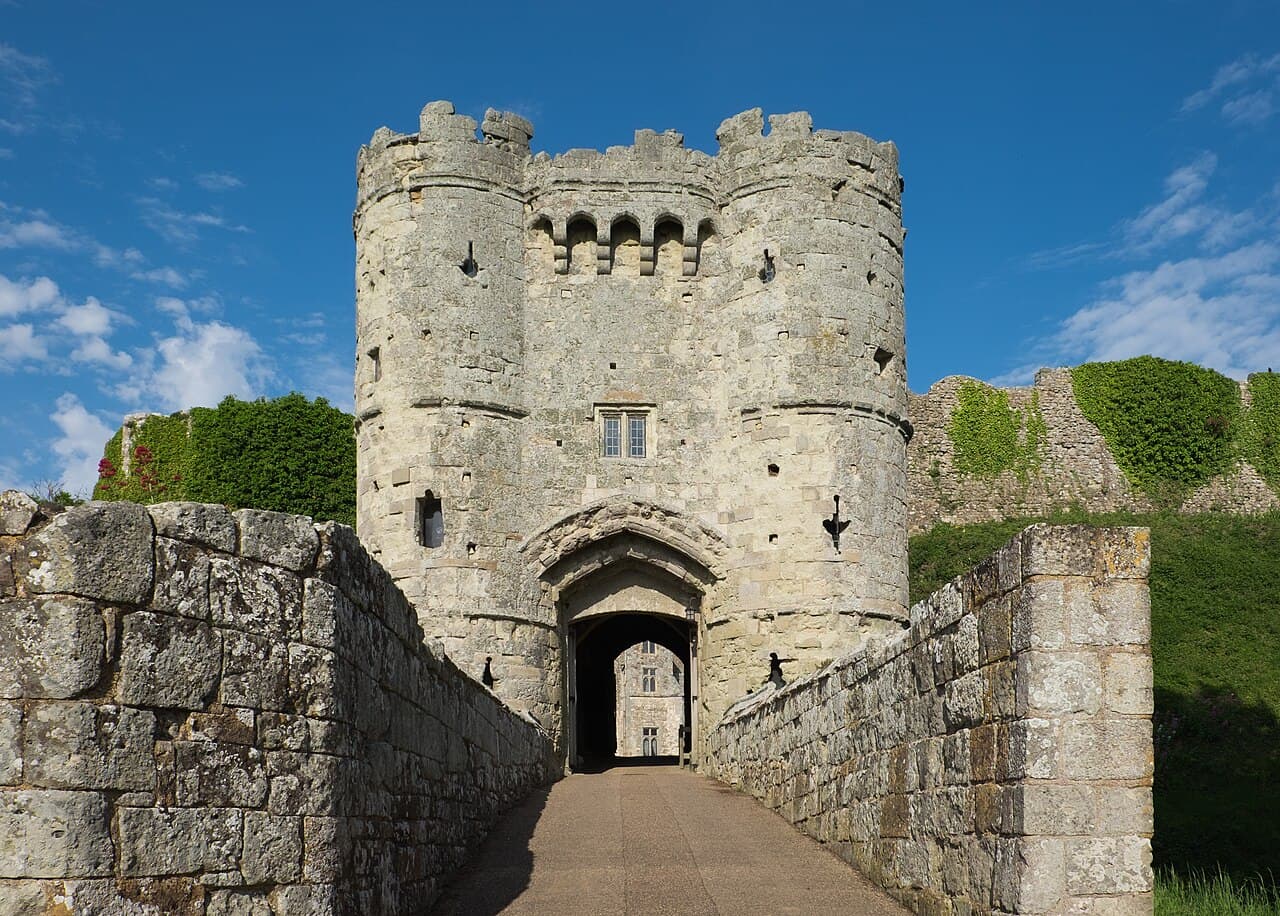
The main entrance is marked by a gatehouse flanked by two round towers constructed in the 14th century and heightened later in the century. These towers feature narrow arrow slits for archers and display the heraldic arms of Anthony Woodville, who added the gate in the 15th century. The gatehouse once housed the Isle of Wight Museum and remains a striking feature of the castle's defenses.
Domestic buildings and interiors
The castle's domestic buildings date primarily from the 13th century, with 16th-century additions. The Great Hall contains a large fireplace installed by William Montagu in the late 14th century. The Constable's Lodging preserves the prison bedroom of Charles I and was used by Princess Beatrice as a dining room. It contains Charles's bed and Beatrice's collection of stag and antelope heads, providing a tangible link to the castle's royal past.
The chapel of St Nicholas
The chapel of St Nicholas, located near the main gate, was rebuilt and re-consecrated in 1904 as a memorial to Charles I. It also honors local soldiers who died in World War I, including Princess Beatrice's son. The chapel stands as a symbol of the castle's enduring cultural and historical significance.
Defensive earthworks and bastions
The late 16th-century trace Italienne fortifications surround the castle, featuring angled bastions and ramparts designed to counter artillery attacks. These earthworks represent one of the finest examples of Renaissance military engineering in England and reflect the strategic foresight of the Tudor governors.
Visitor attractions and facilities
Visitors to Carisbrooke Castle can witness the working donkey-powered water wheel in the well-house, a unique historical feature that continues to draw crowds. The castle grounds also include a tearoom housed in converted 14th-century stone buildings and a bowling green situated on former defensive earthworks, offering a blend of historical ambiance and leisure.
Frequently asked questions (FAQ)
- How do I get to Carisbrooke Castle?
- Carisbrooke Castle is located near Newport on the Isle of Wight. It is accessible by car and public transport, with parking available nearby. The castle is well signposted from Newport.
- What are the opening hours of Carisbrooke Castle?
- The castle is open daily from 10:00 to 17:00. It is advisable to check the official website for any seasonal changes or special closures.
- Can I see the prison bedroom of King Charles I?
- Yes, visitors can tour the Constable's Lodging where King Charles I was imprisoned. The room contains his bed and other historical artifacts related to his captivity.
- Is Carisbrooke Castle suitable for children?
- Yes, the castle offers engaging exhibits and demonstrations such as the donkey-powered water wheel, making it an educational and enjoyable visit for families.
- Are there guided tours available at the castle?
- Guided tours are occasionally offered, providing detailed insights into the castle's history and architecture. Visitors should check the schedule in advance.
- What is the significance of the trace Italienne fortifications?
- The trace Italienne fortifications at Carisbrooke are a rare example of Renaissance military engineering in England, designed to defend against artillery during the Tudor period.
Photo gallery

Information
Opening hours
10:00-17:00, daily
Ticket prices
£10 adult, £5 child
Current owner
English Heritage
Website
Visit websiteSources & official resources
Verify the information above using these authoritative references.
Loading map...
Visitor reviews
No reviews yet. Been here? Write the first review and help other travelers!
Write the first reviewVisited this castle? Share your experience
Your review helps other travelers and adds first-hand knowledge to our encyclopedia.