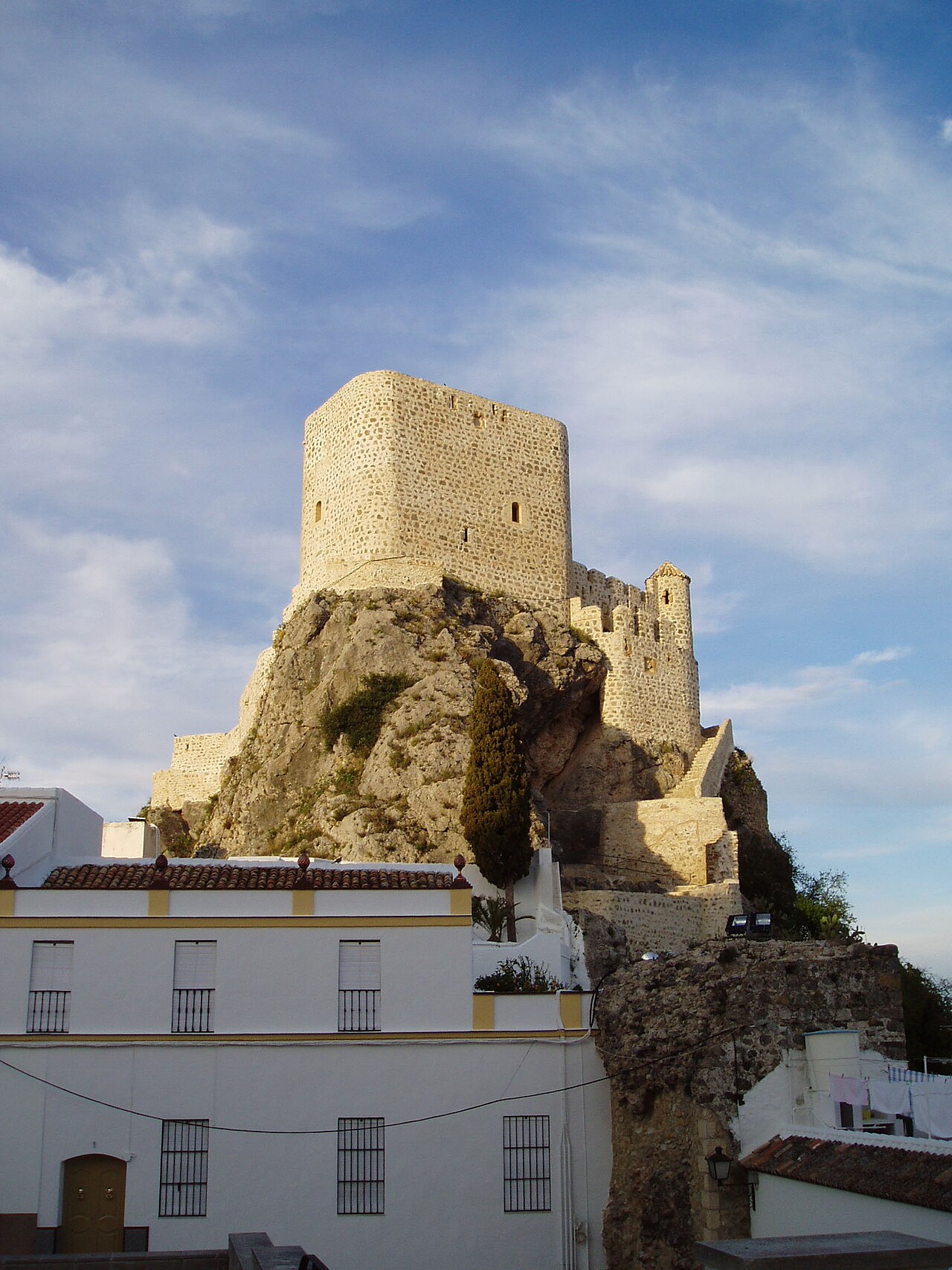
Carastas Castle, also known as Castillo de Carastas, Castillo de Ayamonte, or Castillo de Vallehermoso, is a small but historically significant fortress located northeast of the town of Olvera in the province of Cádiz, Andalucía, Spain. This hill castle stands on a distinctive tuff outcrop, a volcanic ash rock formation that provided a natural defensive advantage. Though modest in scale, the castle's strategic position allowed it to control and monitor the surrounding landscape, including views toward the nearby Hierro Castle to the west.
The origins of Carastas Castle trace back to the Nasrid Kingdom of Granada, the last Muslim dynasty on the Iberian Peninsula. Constructed during the late medieval period, the fortress served as a border defense point, guarding the northern frontiers of the Nasrid realm. Its compact design and limited access routes reflect its primary function as a military outpost rather than a royal residence.
Historical context and military significance
The castle's most notable historical moment came in the early 14th century during the expansionist campaigns of Alfonso XI of Castile. In 1327, Alfonso XI captured Carastas Castle along with the nearby towns of Olvera and Pruna. These operations were part of a broader effort to diminish Nasrid power and extend Christian control in southern Spain. The campaign culminated with Alfonso's decisive victory at the Battle of Teba in 1330, after which the castle remained under Castilian rule.
Following its capture, Castillo de Vallehermoso was integrated into the Castilian defensive network, serving as a frontier stronghold overseeing border security in this part of Andalucía. Over subsequent centuries, as the political landscape stabilized and the frontier moved southward, the castle's military importance waned. It gradually fell into disuse and became ruinous, reflecting the broader decline of many such fortifications after the Reconquista.
In 1985, the castle was officially recognized as a site of cultural interest, highlighting its historical and architectural value. Since then, local heritage organizations have proposed preservation and restoration efforts to stabilize the remains and promote awareness of its legacy.
Architectural features and layout
Location and defensive design
Perched on a porous tuff ridge, the castle's position exploits the natural terrain to limit access primarily to one approach. This approach is marked by a winding ramp leading to the main entrance, which is framed by a rectangular brick gate. The gate was historically protected by a small keep, known as the torre del Homenaje, serving as the castle's last line of defense.
Gate and keep
The entrance gate features remnants of an alfiz, a decorative framed arch typical of Islamic architecture, though today only fragments of this detail survive. Above the keep, traces of a machicolation remain visible. This defensive architectural element allowed defenders to drop projectiles or boiling liquids on attackers below, enhancing the castle's protective capabilities.
Interior structures and water management
Inside the castle walls stands a rectangular multi-story building resembling a tower. This structure, accessible only from the upper floor, likely dates from the original Nasrid construction phase. It may have housed a small garrison responsible for guarding the fortress. In later times, this building was repurposed as a livestock pen, reflecting a shift from military to agricultural use.
Beneath the keep lies a cistern, or aljibe, an underground water reservoir essential for sustaining the castle's occupants during sieges. While now almost completely sealed, this feature underscores the castle's preparedness for prolonged defensive situations.
Current condition and preservation efforts
Today, Carastas Castle remains in a ruinous state but retains key architectural elements that provide valuable insights into its medieval military function. The thin defensive walls probably supported a wooden adarve, or walkway, allowing defenders to patrol the perimeter. Despite its dilapidation, the castle's compact layout and surviving features make it an important cultural landmark.
The castle is situated on private agricultural land and is not open to public visitation. Occasionally, the ruins are used as a cattle pen, which has contributed to some deterioration. Local heritage groups have expressed interest in restoration projects aimed at stabilizing the structure and enhancing its historical visibility.
Regional significance and related sites
Carastas Castle is part of a network of medieval fortifications in the province of Cádiz that reflect the turbulent history of the Reconquista and the shifting borders between Muslim and Christian realms. Its proximity to other castles like Hierro Castle highlights the strategic importance of this region during the late medieval period.
Although less well-known than larger Andalusian fortresses, Carastas Castle offers a unique glimpse into the military architecture and frontier life of the Nasrid period and early Castilian rule. Its preservation contributes to understanding the complex cultural and historical landscape of southern Spain.
Frequently asked questions (FAQ)
- How do I visit Carastas Castle?
- Carastas Castle is located on private agricultural property near Olvera and is not open to the public. Visitors can view the castle ruins from a distance but cannot enter the site.
- What is the historical significance of Carastas Castle?
- Carastas Castle was originally built by the Nasrid Kingdom of Granada as a border defense fortress. It was captured by Alfonso XI of Castile in 1327 and served as a Castilian frontier stronghold during the late medieval period.
- What architectural features does Carastas Castle have?
- The castle features a small keep with a machicolation, a rectangular brick-framed gate with an alfiz arch, thin defensive walls likely topped by a wooden adarve, a multi-story rectangular building inside, and an underground cistern (aljibe).
- Is Carastas Castle accessible for visitors with mobility issues?
- Due to its location on private land and the ruinous condition of the castle, Carastas Castle is not accessible to visitors, including those with mobility issues.
- When was Carastas Castle built?
- Carastas Castle dates back to the late medieval period, originally constructed by the Nasrid Kingdom of Granada before its capture in 1327 by Castilian forces.
- Are there any nearby castles to visit?
- Nearby castles include Hierro Castle, which can be seen from Carastas Castle. Visitors interested in medieval fortifications in the region may explore other sites in the province of Cádiz.
Information
Website
Visit websiteSources & official resources
Verify the information above using these authoritative references.
Loading map...
Visitor reviews
No reviews yet. Been here? Write the first review and help other travelers!
Write the first reviewVisited this castle? Share your experience
Your review helps other travelers and adds first-hand knowledge to our encyclopedia.