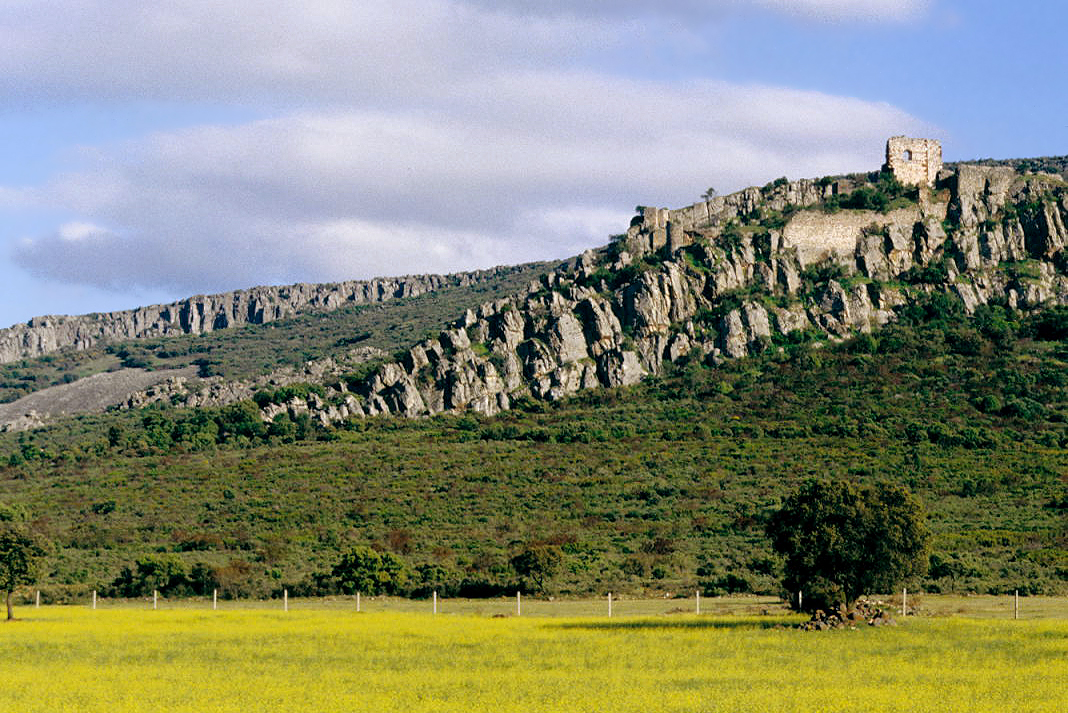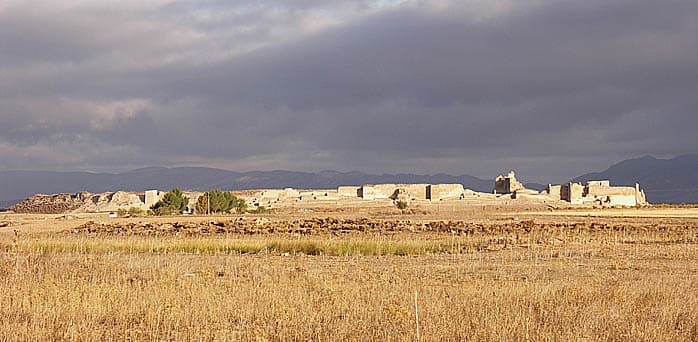
Calatrava la Vieja stands as a monumental hill castle near Carrión de Calatrava in Spain, embodying centuries of military, religious, and administrative history that shaped the medieval Iberian Peninsula. Originally established by the Umayyads in the late 8th century, this fortress was strategically positioned to control the vital route between Córdoba and Toledo within the territory of al-Andalus. Its location on an oval plateau overlooking the Guadiana River provided natural defense, which was further enhanced by a deep, rock-carved dry moat and formidable walls, transforming the site into a near-island fortress.
For approximately four centuries, Calatrava la Vieja was a key stronghold within the Emirate and later the Caliphate of Córdoba. It served as the capital of a large administrative region from 853 to 1147, undergoing significant reconstruction under the patronage of al-Hakam, brother of Emir Muhammad I. The fortress's importance grew as it became the main Muslim bastion facing the advancing Christian Kingdom of Castile, especially after the Christian capture of Toledo in 1085 and the arrival of the Almoravid dynasty in 1086.
Historical significance and medieval conflicts
Following the collapse of the Caliphate of Córdoba in the early 11th century, Calatrava la Vieja was fiercely contested among the Taifa kingdoms of Seville, Córdoba, and Toledo. The fortress's strategic value made it a focal point in the regional power struggles. In 1147, Alfonso VII of León and Castile captured the castle, initially granting it to the Knights Templar. However, the Templars soon abandoned the site, and in 1158, control was transferred to Abbot Raymond of Fitero, who founded the Order of Calatrava at this fortress. This order was the first major military-religious order in Iberia dedicated to defending Christian territories and managing frontier lands.
The fortress's fortunes fluctuated with the tides of war. It fell to the Almohads in 1195 after their victory at the Battle of Alarcos and remained under their control for 17 years. The castle was recaptured by Castilian forces in 1212 during the campaign culminating in the Battle of Las Navas de Tolosa, a decisive moment in the Reconquista. Shortly thereafter, in 1217, the Order of Calatrava relocated its headquarters to the Castle of Dueñas (Calatrava la Nueva), initiating the gradual decline of Calatrava la Vieja. By the early 15th century, it was abandoned as the military commander settled nearby in Carrión de Calatrava.
Architectural and defensive features
Site layout and fortifications
Calatrava la Vieja occupies an oval-shaped plateau covering about five hectares. The northern side is naturally defended by the Guadiana River, while the remaining perimeter is protected by a deep dry moat carved primarily from solid rock. This moat extends over 750 meters and reaches depths of approximately 10 meters, effectively isolating the fortress. Surrounding the moat is a robust wall system measuring roughly 1,500 meters in length, dating mainly to the Umayyad period. The walls are reinforced by at least 44 flanking towers, predominantly hollow and quadrangular, with two distinctive pentagonal towers on the eastern side of the central fortress or alcázar.
The fortress is divided into two main sectors by a large dividing wall. The alcázar to the east is a triangular enclosure of about one hectare, serving as the seat of power and the strongest defensive position. The larger western sector, the almedina or medina, contains the urban area surrounded by a wall with over 40 towers. Beyond these walls lie the arrabales or suburbs, featuring industrial and artisanal spaces, a cemetery, scattered dwellings, and a mosque near the modern Ermita de la Encarnación.
Hydraulic defense system
One of the most remarkable features of Calatrava la Vieja is its sophisticated hydraulic defense system, which reflects the advanced military engineering of the Umayyad period. This system included four waterworks called corachas that lifted water from the moat into the fortress. A portion of this water was directed to a pentagonal tower known as the castellum aquae, where it was forced through ceramic pipes back into the moat under pressure. This unique mechanism was both a practical defense measure and a symbol of technological prowess and authority.
The two hollow pentagonal towers at the eastern alcázar, dating to 854, were integral to this system. One functioned as a water castle without direct internal access, while the other served as a control tower accessible from the alcázar. Additionally, a third tower originally constructed as an albarrana—a detached defensive tower connected by a bridge—was later reshaped into a pentagonal form, possibly to support heavy siege equipment.
Gates and access points
The southern city gate exemplifies a 9th-century bent gate design known as in recodo, which enhanced defense by forcing attackers to navigate a sharp turn. Access to this gate is via a bridge over the moat, preceded by a smaller postern gate used for secondary entry. The alcázar also contains a bent gate that controlled access to the river through an external ramp, further emphasizing the fortress's layered defensive strategy.
Residential and urban elements
Within the almedina, archaeological excavations have uncovered remains of residential homes and an Almohad-period paved street. The urban layout reflects typical Islamic city planning, including mosques, baths, shops, and pottery workshops. These elements highlight the dual military and civilian functions of the site, serving as both a fortress and a thriving settlement.
The alcázar itself reveals multiple construction phases. Early walls made of adobe, brick, and rammed earth predate 853. Later expansions under Muhammad I introduced monumental entrance towers, a triumphal arch, and the distinctive pentagonal towers. During the brief Templar occupation (1147-1158), an unfinished dodecagonal apse of a church was constructed. Subsequent centuries saw additions including a church and vaulted annexes used by the Order of Calatrava, such as a smithy built over earlier foundations.
Archaeological significance and preservation
Since the late 20th century, archaeological excavations and restoration efforts have illuminated Calatrava la Vieja's importance as one of the most significant Islamic-origin sites in Spain. Excavations have revealed layers of occupation, including prehistoric settlements beneath the fortress. Notably, no Roman or Visigothic remains have been found, likely due to the area's historically poor health conditions.
Despite partial coverage by debris and earth, the moat and defensive walls remain largely visible, and their impressive scale continues to impress visitors and scholars alike. The site's enduring structures from the Templar period and the era of the Order of Calatrava provide a tangible link to pivotal chapters in medieval military and religious history.
Today, Calatrava la Vieja stands as a testament to the complex cultural and military history of medieval Spain, showcasing the ingenuity of Umayyad military architecture, the turbulent frontier conflicts of the Reconquista, and the legacy of the early military orders that shaped Iberian history.
Frequently asked questions (FAQ)
- What is the historical significance of Calatrava la Vieja?
- Calatrava la Vieja is a medieval castle located in Spain, renowned for its role in the Reconquista. Built in the 12th century, it served as a strategic military fortress for the Knights of Calatrava, showcasing the importance of religious and military orders in medieval Spain.
- When was Calatrava la Vieja constructed?
- Calatrava la Vieja was constructed in the early 12th century, around the year 1147. Its establishment marked a crucial point in the efforts to reclaim territory from the Moors during the Reconquista, making it a significant historical site.
- What are the opening hours for visiting Calatrava la Vieja?
- Calatrava la Vieja is generally open to visitors from 10 AM to 6 PM during the peak season, which runs from April to October. In the off-season, the hours may vary, so it is advisable to check the official website or contact local tourism offices before planning your visit.
- Can I access Calatrava la Vieja by public transportation?
- Yes, Calatrava la Vieja is accessible via public transportation, though options may be limited. Visitors can take a bus or train to nearby towns and then use local taxis or arrange for a shuttle service to reach the castle.
- Is it possible to take guided tours of Calatrava la Vieja?
- Yes, guided tours of Calatrava la Vieja are available and highly recommended for a more in-depth experience. Knowledgeable guides can provide insights into the castle's history, architecture, and significance, enhancing your visit.
- What is the best time to visit Calatrava la Vieja?
- The best time to visit Calatrava la Vieja is during the spring and fall months when the weather is mild and pleasant for exploring the grounds. Additionally, these seasons typically see fewer crowds, allowing for a more enjoyable experience.
- Are there any nearby attractions to visit after Calatrava la Vieja?
- Yes, there are several nearby attractions, including the historic town of Almagro, known for its well-preserved architecture and cultural events. Additionally, the natural landscapes surrounding the castle offer opportunities for hiking and exploration.
- What are the ticket prices for visiting Calatrava la Vieja?
- Ticket prices for Calatrava la Vieja are quite reasonable, typically ranging from €3 to €5 for adults, with discounts available for students and seniors. Children under a certain age may enter for free, making it an affordable outing for families.
- How do I get more information about events at Calatrava la Vieja?
- For more information about events at Calatrava la Vieja, it is best to visit the official website or contact the local tourist information center. They often provide details on special events, exhibitions, and guided tours that may be taking place during your visit.
Photo gallery

Photo by No machine-readable author provided. Mareve assumed (based on copyright claims).•Public domain
Information
Website
Visit websiteSources & official resources
Verify the information above using these authoritative references.
Loading map...
Visitor reviews
No reviews yet. Been here? Write the first review and help other travelers!
Write the first reviewVisited this castle? Share your experience
Your review helps other travelers and adds first-hand knowledge to our encyclopedia.