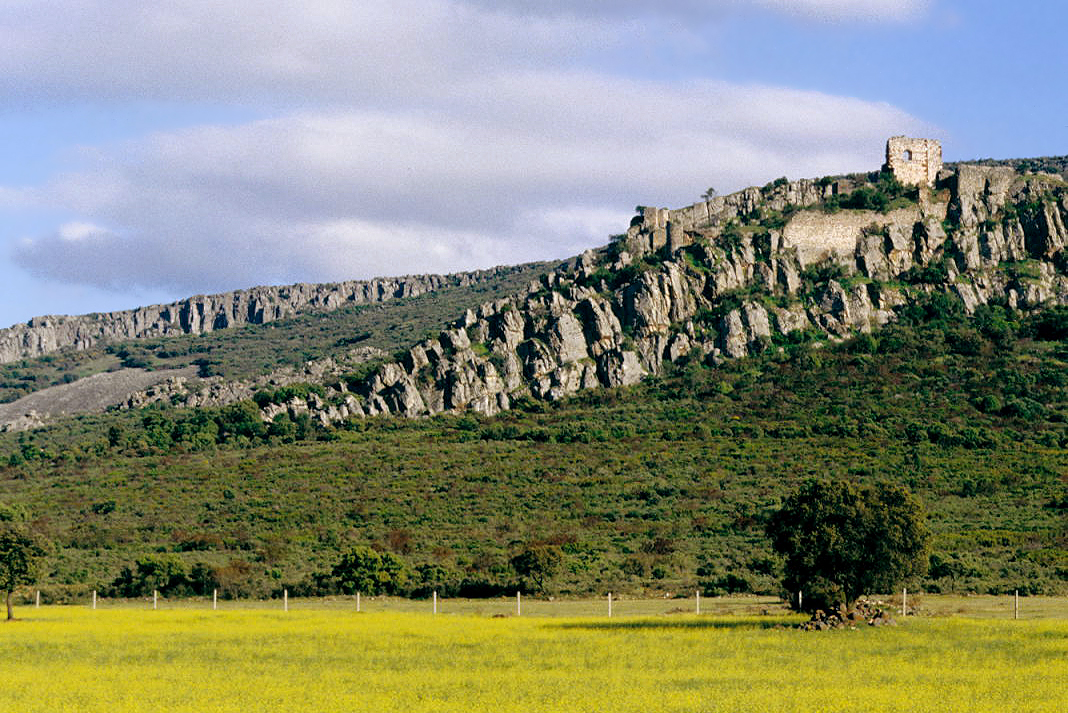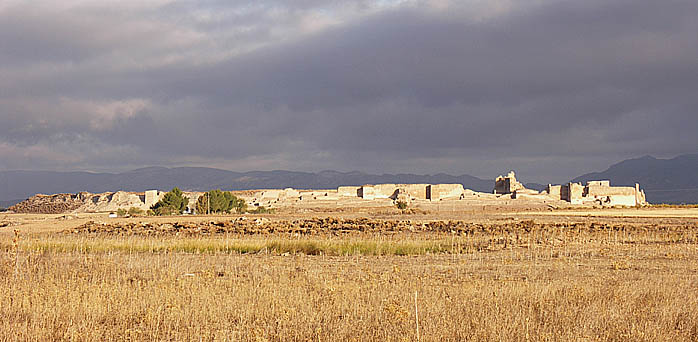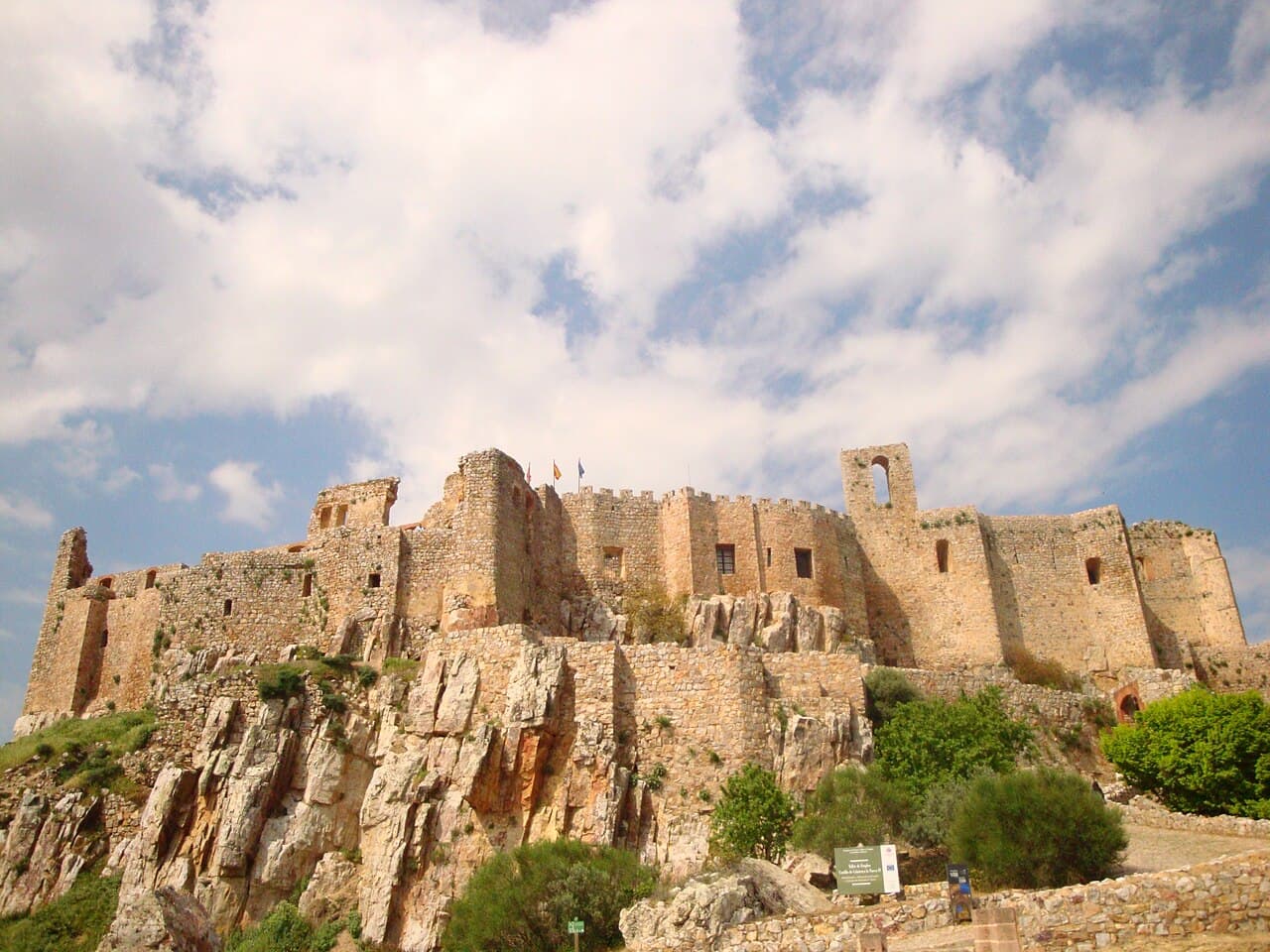
Calatrava la Nueva is a remarkable hill castle perched atop the volcanic Cerro Alacranejo in Aldea del Rey, Spain. Established in the early 13th century by the Order of Calatrava, this fortress holds a rich history that spans several millennia, reflecting its strategic and religious significance during the medieval period and beyond.
The site of Calatrava la Nueva has been a focal point of human activity since the Bronze Age, as evidenced by archaeological finds such as pottery shards. Before the current castle's construction, a Visigothic fortress stood here, which came under Christian control in 1129. In the late 12th century, the Manrique de Lara family took possession of the site, before the Order of Calatrava acquired it in 1191 through donation and purchase, with royal confirmation by King Alfonso VIII in 1201.
The Order of Calatrava initially controlled another fortress, Calatrava la Vieja, but lost it to Muslim forces. Following the pivotal Battle of Las Navas de Tolosa in 1212, a decisive Christian victory in the Reconquista, the order shifted its headquarters to this new location. Construction of the present castle began between 1213 and 1217, utilizing prisoners from the battle as laborers. This move was strategic, as Calatrava la Nueva allowed control over access to the Sierra Morena mountains and served as a critical defensive stronghold after the fall of nearby Salvatierra castle in 1211.
Historical significance and role of the order
Throughout the Middle Ages and into the early modern period, Calatrava la Nueva functioned as the main residence and administrative center for the Order of Calatrava. This military-religious order was instrumental in defending Christian territories and expanding their reach during the Reconquista. The castle was not only a fortress but also a religious and administrative hub, reflecting the dual nature of the order as both knights and monks.
The castle remained a significant symbol of Castilian power until the 19th century. The ecclesiastical confiscations (desamortizaciones) initiated by Minister Juan Álvarez Mendizábal in 1835 led to the abandonment of the fortress. Subsequently, the Order of Calatrava was officially dissolved by Queen Isabella II, and the castle fell into private hands, gradually deteriorating.
In the 20th century, the castle gained recognition as a historic-artistic monument in 1931 during Spain's Second Republic. It has since become a cultural landmark, associated with historical memory and literary events, such as the honorary doctorate awarded to writer Umberto Eco in 1997.
Architectural layout and defensive features
Calatrava la Nueva covers an extensive fortified complex of approximately 46,000 square meters, strategically built on a steep volcanic hill. The castle's design integrates natural rock formations into its defensive walls, which rise directly from the rocky foundation, enhancing its impregnability.
Outer enclosure and defensive perimeter
The fortress is surrounded by a large outer enclosure defined by two closely parallel walls. This area served multiple purposes: as a livestock pen, accommodation for soldiers, and a refuge for local peasants during attacks. The walls are reinforced with towers that provided vantage points for surveillance and defense, maintaining security over a broad perimeter.
Access to the inner parts of the castle begins through a semi-subterranean chamber adjacent to the outer wall, originally used for guards and stables. Above this chamber was the guesthouse (hospedería), though much of it has not survived. Beyond lies the convent complex, which reflects the religious aspect of the Order, with remaining floors and partial walls still visible.
Inner castle and puebla
The castle proper is fortified with high walls set upon rocky outcrops. To the left of the main path are former storage rooms built partly below ground level, later converted partially into a guardhouse over the remains of the guesthouse. Attached to the castle walls is the fortified puebla—a rectangular settlement with streets and houses for servants connected to the castle and convent. The puebla's walls and battlements are well preserved and accessible for visitors.
Religious structures and features
The castle's church is a prime example of Cistercian architectural style, featuring a large rose window from the era of the Catholic Monarchs. It has three spacious naves with brick vaults and three apses with pointed arches, characteristic of Gothic influence. The church originally included funerary chapels on its left side, which were later sealed and destroyed, with restoration efforts still pending.
On the church's left facade stood a dovecote and an ice or snow well, used historically for food preservation. To the right lies the Field of the Martyrs cemetery and the Chapel of Our Lady of the Martyrs. Nearby are large underground cisterns essential for water storage, ensuring the castle's self-sufficiency during sieges.
The church's main chapel houses the tomb of Alfonso de Molina, son of King Alfonso IX. The tomb is notable for its ornate design beneath an arch. Access to the convent cloister is through a door in the right nave of the church, where remnants of arcade supports mark the cloister's original galleries. A narrow passage between the cloister walls and castle foundations leads to the castle's first fortified gate.
Central fortress and defensive architecture
The hilltop fortress features a complex gate system designed for robust defense. The initial entrance is a pointed-arch gate serving as a barbican, a fortified outwork protecting a second gate accessed via a narrow, bent passage exposed to the open air. Beyond this gate is a spacious vaulted stable separated from the main courtyard by rows of pillars.
The main courtyard includes a modern stone spiral staircase on the right side leading to the former archive of the Order. The left wall features the entrance to the Master's chambers, marked by the Cross of Calatrava above a pointed arch. Beneath the courtyard lies another underground cistern for water collection.
A grand staircase ascends from the courtyard to four successive levels. The first level contains a vaulted chamber with a hatch to the floor above and access to an underground cistern. The second level has a long, narrow room once divided by a wooden floor into two stories. The third level, about 20 meters above ground, includes the main floor with surviving walls and window openings, and a vaulted archive room overlooking the nearby Salvatierra castle. The fourth and highest level offers panoramic views of the entire complex, the Sierra Morena mountains to the south, and Salvatierra castle to the east.
Preservation and cultural importance
Today, Calatrava la Nueva stands as a well-preserved testament to medieval military and religious architecture. Its extensive remains illustrate the multifaceted role of the Order of Calatrava as defenders, administrators, and monks. The castle is a significant cultural and historical landmark in Spain, attracting visitors interested in the Reconquista, medieval fortifications, and religious military orders.
The site offers a unique glimpse into the architectural ingenuity of the 13th century, combining natural topography with formidable construction techniques. Its preservation allows for educational tours and cultural events that celebrate Spain's rich medieval heritage.
Frequently asked questions (FAQ)
- How do I get to Calatrava la Nueva?
- Calatrava la Nueva is located in the province of Ciudad Real, Spain. You can reach the castle by car, and it's approximately a 2-hour drive from Madrid. Public transportation options are limited, so driving or taking a taxi is recommended.
- What is the historical significance of Calatrava la Nueva?
- Calatrava la Nueva was established in the 12th century as a fortress by the Knights of Calatrava. It played a crucial role during the Reconquista, serving as a stronghold in the fight against the Moors. The castle is an excellent example of medieval military architecture and offers insights into the region's history.
- When was Calatrava la Nueva constructed?
- Construction of Calatrava la Nueva began in 1217 and continued over several centuries. The castle was completed in the late 13th century, reflecting the architectural styles and military needs of that period. Its well-preserved structures provide a glimpse into the past.
- Can I enter the castle grounds?
- Yes, visitors can explore the castle grounds and its various structures. There are guided tours available that provide detailed information about the history and architecture of Calatrava la Nueva. It's advisable to check in advance for any special events or restrictions.
- Why is Calatrava la Nueva popular among tourists?
- Calatrava la Nueva attracts tourists due to its stunning architecture and breathtaking views of the surrounding countryside. The castle's rich history and well-maintained ruins offer a unique experience for history enthusiasts and photographers alike. It's also a peaceful location for those looking to escape the hustle and bustle of city life.
- Is it possible to visit Calatrava la Nueva year-round?
- Yes, Calatrava la Nueva is open for visitors throughout the year, although hours may vary by season. It is advisable to check the official website for the most current opening hours and any seasonal events. Visiting during spring or autumn can provide a pleasant climate for exploration.
- What are the ticket prices for Calatrava la Nueva?
- Ticket prices for Calatrava la Nueva are generally affordable, with discounts available for students, seniors, and groups. Children under a certain age may enter for free. It is recommended to purchase tickets on-site or through the official website to avoid any inconvenience.
- What are the opening hours for Calatrava la Nueva?
- Calatrava la Nueva typically opens at 10 AM and closes at 6 PM, but these hours can change depending on the season. It is best to check the castle's official website for the most accurate and up-to-date information regarding hours of operation. Planning your visit in advance will ensure you have ample time to explore.
- Are there nearby attractions to visit along with Calatrava la Nueva?
- Yes, there are several nearby attractions worth visiting, including the historic town of Almagro and the beautiful natural parks in the region. The area is rich in cultural heritage, offering additional sites that complement your visit to Calatrava la Nueva. Consider taking a day to explore the surrounding attractions for a fuller experience.
Photo gallery

Information
Website
Visit websiteSources & official resources
Verify the information above using these authoritative references.
Loading map...
Visitor reviews
No reviews yet. Been here? Write the first review and help other travelers!
Write the first reviewVisited this castle? Share your experience
Your review helps other travelers and adds first-hand knowledge to our encyclopedia.