Cahercommaun
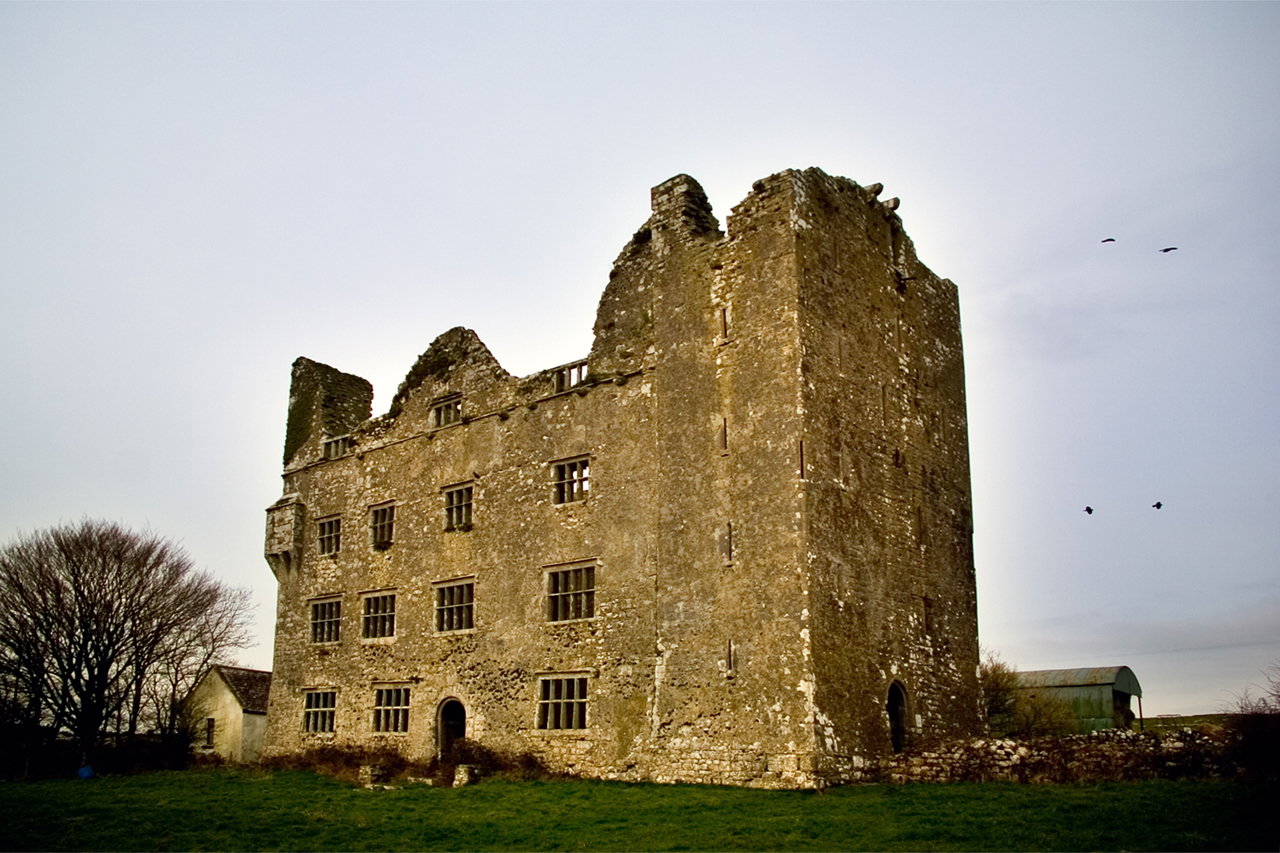
Cahercommaun (Irish: Cathair Chomáin), also known as Cahercommane, is a remarkable example of an early medieval triple stone ringfort situated on the south-east edge of the Burren region in County Clare, Ireland. This ancient fortification dates back to the 9th century and is located near the rural village of Carran and the townland of Kilnaboy. Its strategic position on a limestone outcrop offers commanding views over the surrounding landscape, which was essential for defense and surveillance during its time.
Architectural features and layout
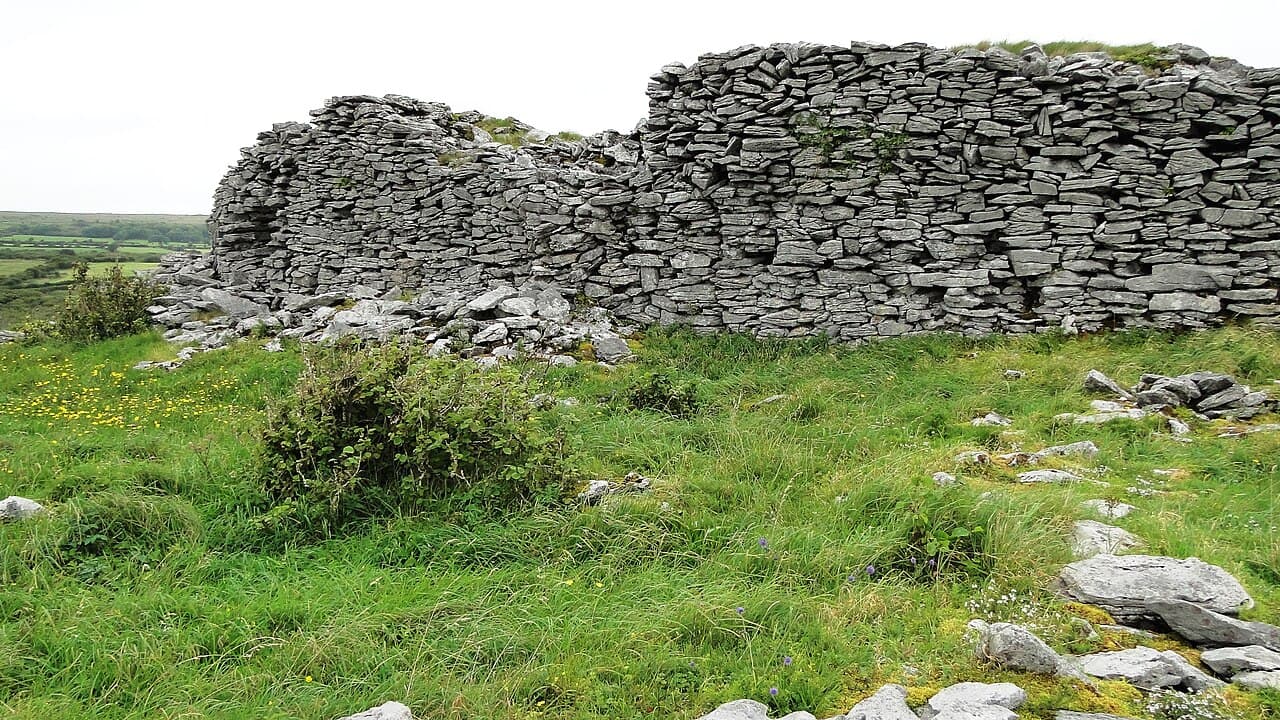
Cahercommaun is notable for its distinctive construction as a triple stone ringfort, a rare and sophisticated form of fortification in early medieval Ireland. The site consists of three concentric stone walls or ramparts, each enclosing a separate courtyard. These walls were built using dry stone masonry techniques typical of the period, employing large limestone blocks sourced locally from the Burren's karst landscape.
The outermost wall is the largest and highest, designed to provide the first line of defense. It encloses an area roughly circular in shape, with a diameter of approximately 100 meters. The middle wall adds a second layer of protection, while the innermost wall encloses the central living and communal spaces. The walls vary in thickness and height but can reach up to several meters, with some sections preserved up to 3 meters high.
Access to the fort was controlled by narrow gateways with carefully constructed lintels and jambs, designed to be easily defensible. The triple ring structure allowed inhabitants to retreat inward in case of attack, a feature that demonstrates advanced defensive planning.
Historical context and significance
The construction of Cahercommaun in the 9th century places it within the early medieval period of Irish history, a time marked by frequent local conflicts and the need for fortified settlements. Ringforts, or cathairs, were common in this era as farmsteads and defensive homesteads for Gaelic chieftains and their communities.
Unlike simpler single-ring forts, the triple ring design of Cahercommaun suggests it was a site of considerable importance, possibly serving as a stronghold for a local ruler or clan. Its robust construction and commanding location would have made it a formidable defensive site against rival groups or raiders.
Construction techniques and materials
The builders of Cahercommaun utilized the abundant limestone of the Burren, shaping and stacking stones without mortar to create thick, stable walls. This dry stone technique was well-suited to the local environment and has contributed to the fort's preservation over more than a millennium.
Inside the fort, archaeological investigations have revealed traces of domestic structures, hearths, and storage pits, indicating that the site was a self-sufficient settlement supporting a small community. The layered defensive walls and internal arrangements reflect a well-planned settlement designed for both habitation and protection.
Preservation and current condition
Today, Cahercommaun is classified as partially preserved, with significant portions of its stone walls still standing, offering valuable insights into early medieval Irish fortification architecture. Its location within the Burren National Park and proximity to other archaeological sites makes it an important destination for visitors interested in Ireland's ancient heritage.
Efforts to maintain and protect the site have ensured that Cahercommaun remains accessible to the public, with interpretive signage helping visitors understand its historical and architectural significance.
Visiting Cahercommaun
Visitors to Cahercommaun can explore the extensive stone walls and imagine the lives of its early medieval inhabitants. The site is open year-round and is accessible via walking trails from nearby Kilnaboy and Carran. The rugged landscape of the Burren adds to the experience, offering a unique combination of natural beauty and historical depth.
Nearby attractions include other ringforts, megalithic tombs, and the Burren's distinctive flora and fauna, making the area a rich destination for cultural and natural exploration.
Frequently asked questions
- What is Cahercommaun? Cahercommaun is a 9th-century triple stone ringfort located in County Clare, Ireland, known for its concentric defensive walls.
- When was Cahercommaun built? It was constructed in the 9th century during the early medieval period.
- Can I visit Cahercommaun? Yes, the site is open to the public year-round and can be accessed by walking trails from nearby villages.
- What materials were used to build Cahercommaun? The fort was built using local limestone blocks with dry stone masonry techniques.
- Why is Cahercommaun significant? Its triple ring structure and strategic location reflect advanced early medieval fortification design in Ireland.
- Is Cahercommaun well preserved? The site is partially preserved with substantial portions of its walls still standing.
- Are there other attractions near Cahercommaun? Yes, the Burren region offers numerous archaeological sites and natural landmarks to explore.
Frequently asked questions (FAQ)
- What is Cahercommaun?
- Cahercommaun is a 9th-century triple stone ringfort located in County Clare, Ireland, known for its concentric defensive walls.
- When was Cahercommaun built?
- It was constructed in the 9th century during the early medieval period.
- Can I visit Cahercommaun?
- Yes, the site is open to the public year-round and can be accessed by walking trails from nearby villages.
- What materials were used to build Cahercommaun?
- The fort was built using local limestone blocks with dry stone masonry techniques.
- Why is Cahercommaun significant?
- Its triple ring structure and strategic location reflect advanced early medieval fortification design in Ireland.
- Is Cahercommaun well preserved?
- The site is partially preserved with substantial portions of its walls still standing.
- Are there other attractions near Cahercommaun?
- Yes, the Burren region offers numerous archaeological sites and natural landmarks to explore.
Photo gallery

Information
Current owner
State
Loading map...
Visitor reviews
No reviews yet. Been here? Write the first review and help other travelers!
Write the first reviewVisited this castle? Share your experience
Your review helps other travelers and adds first-hand knowledge to our encyclopedia.