Caerlaverock Castle
Caerlaverock Castle stands as one of Scotland's most architecturally unique and historically rich medieval fortresses. Constructed in the 13th century, this moated triangular castle is located on the southern coast of Scotland, approximately 11 kilometres south of Dumfries, on the edge of the Caerlaverock National Nature Reserve. Its unusual triangular layout and robust defensive features make it a standout example of High Medieval military architecture, reflecting the turbulent history of the Anglo-Scottish borderlands.
The castle was the ancestral stronghold of the powerful Maxwell family from the 13th century until its abandonment in the 17th century. Throughout its history, Caerlaverock was a focal point of conflict, enduring multiple sieges, including a famous 1300 siege led by King Edward I of England during the Wars of Scottish Independence. Despite repeated damage and partial demolitions, the castle's distinctive triangular plan has been preserved, alongside significant architectural remnants such as the two-towered gatehouse, curtain walls, and the Renaissance Nithsdale Lodging, a rare example of early classical domestic architecture in Scotland.
Historical background and strategic importance
The site of Caerlaverock Castle has a long history of fortification predating the current stone structure. Archaeological evidence points to earlier defensive works, including a Roman fort on Ward Law Hill and a British hill fort dating back to around 950 AD. The name "Caerlaverock" itself derives from Brittonic origins, meaning an enclosed or defensible site, highlighting its longstanding military significance.
The castle's first stone fortification was commissioned around 1220 by Sir John Maxwell, who was granted the lands by Alexander II of Scotland. This initial castle was square in shape and surrounded by a moat but was later abandoned for the current triangular fortress built in the 1270s by Sir John's brother, Sir Aymer Maxwell. This new castle was constructed on an artificially raised clay platform within a floodplain beside the River Nith, an unusual choice compared to the typical hilltop locations of many Scottish castles, but one that allowed effective control over trade and movement in the region.
The Wars of Scottish Independence and sieges
Caerlaverock's location near the volatile Anglo-Scottish border made it a strategic target during the Wars of Scottish Independence. In 1300, King Edward I led a large English army to besiege the castle. Despite being defended by only about 60 men under Sir Eustace Maxwell, the castle resisted for several days before surrendering. This siege was famously chronicled in a heraldic poem, the Siege of Caerlaverock, which detailed the arms and deeds of the English nobility present.
After periods of English occupation and Scottish control, the castle was deliberately dismantled by Sir Eustace Maxwell to prevent its capture by the English. It was rebuilt and changed hands multiple times during the 14th and 15th centuries, reflecting the ongoing border conflicts. Notably, Robert Maxwell undertook significant rebuilding between 1373 and 1410, and further enhancements were made in the mid-15th century, including reconstruction of the gatehouse.
Architectural features and layout
Caerlaverock Castle is renowned for its rare triangular plan, measuring approximately 52 meters along the south base and about 46 meters on each side. This design is unique within the United Kingdom and was likely intended to maximize defensive capabilities while adapting to the site's topography.
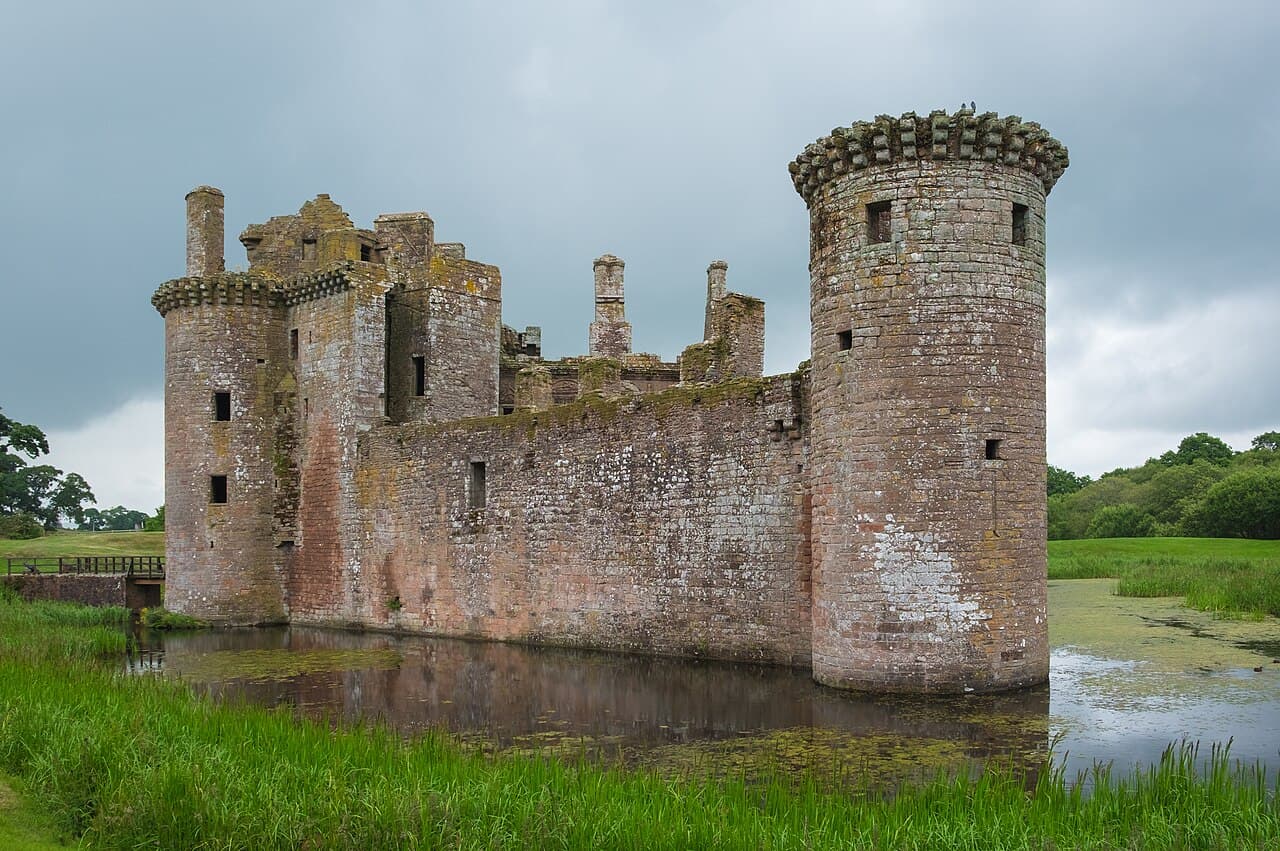
The castle is surrounded by a broad moat roughly 20 meters wide, fed by the nearby River Nith, with earth ramparts formed from the excavated clay creating raised defensive embankments. The outer curtain walls, built primarily of locally quarried red sandstone, survive mostly at lower levels but remain impressive in scale.
Gatehouse and towers
The main northern entrance is fortified by a massive gatehouse flanked by two large drum towers. The west tower is largely original from the medieval period, standing about 15.5 meters tall up to its machicolations, which allowed defenders to drop projectiles on attackers below. The east tower was rebuilt in the late 15th century, reflecting ongoing adaptations to military technology and defense strategies.
The gatehouse itself features a portcullis and provides access to an upper hall within the castle. The gatehouse's robust construction and defensive features highlight the castle's role as a military stronghold.
Residential and domestic ranges
Within the courtyard, the western side contains a two-story range of rectangular rooms dating from around 1500, which served as accommodation for the castle's inhabitants. These rooms include large fireplaces and have survived mostly intact except for the loss of their roofs.
The southern side once housed the Banqueting Hall, a large hall illuminated by a significant fireplace on its north wall. This area suffered heavy damage during the 1640 siege and remains largely in ruins.
The most architecturally elaborate structure is the Nithsdale Lodging, built around 1634 by the 1st Earl of Nithsdale, Robert Maxwell. This Renaissance-style domestic range features a decorated façade with carved pediments, armorial emblems, and large windows. The interior layout includes small rooms arranged around a central chimney stack serving multiple fireplaces, kitchens on the ground floor, and private chambers above, marking a transition from purely military architecture to more comfortable noble residence.
Additional defensive structures
Murdoch’s Tower, a smaller drum tower at the southwest corner, remains one of the most intact defensive features. The southeast tower, however, was destroyed during the 1640 siege and survives only at its base level. Together with the gatehouse and ranges, these towers enclose the triangular courtyard, preserving the castle's distinctive internal layout.
The castle's decline and legacy
The castle's military significance declined after the 17th century. In 1640, during religious conflicts involving the Protestant Covenanters, Caerlaverock was besieged for the last time. The siege resulted in the demolition of the south wall and tower, and the castle was subsequently abandoned. It has remained a ruin since, though its remains offer invaluable insight into medieval and Renaissance fortification and domestic architecture.
Today, Caerlaverock Castle is protected as a scheduled monument and a category A listed building. It is managed by Historic Environment Scotland and is a popular tourist destination, attracting visitors interested in Scotland's medieval heritage and border history.
Caerlaverock and its natural surroundings
The castle is situated within the Nith Estuary National Scenic Area, recognized for its outstanding natural beauty. It lies at the northern edge of the Caerlaverock National Nature Reserve, which spans over 55 square kilometres of saltmarsh, mudflats, and grazing land. This reserve is internationally important as a wintering site for waterfowl and wading birds, including the barnacle goose, making the area a draw for nature enthusiasts as well as history buffs.
Visitors to Caerlaverock Castle can enjoy both the rich historical context of the fortress and the tranquil natural environment, with numerous walking paths and wildlife viewing opportunities surrounding the site.
Visiting Caerlaverock Castle
Caerlaverock Castle is accessible to the public year-round and offers a unique glimpse into Scotland's medieval past. The castle's dramatic ruins, combined with its striking triangular layout and scenic setting, provide an evocative experience for visitors. Educational signage and guided tours help illuminate the castle's complex history and architectural features.
The site is suitable for families and individuals with an interest in history, architecture, and nature. Its location within a nature reserve also allows for combined visits to explore the rich biodiversity of the surrounding estuary and wetlands.
Frequently asked questions (FAQ)
- When was Caerlaverock Castle built and by whom?
- Caerlaverock Castle was originally built in the 13th century by the Maxwell family, with the current triangular structure constructed in the 1270s by Sir Aymer Maxwell.
- What is unique about Caerlaverock Castle's design?
- Caerlaverock Castle is notable for its rare triangular layout, surrounded by a broad moat and featuring a two-towered gatehouse, which is uncommon among medieval castles in the UK.
- Can visitors explore the interior of Caerlaverock Castle?
- Visitors can explore the castle ruins, including the gatehouse, towers, and the Renaissance Nithsdale Lodging. Informational signage and guided tours provide insights into its history and architecture.
- Why was Caerlaverock Castle strategically important?
- Its location near the Anglo-Scottish border made Caerlaverock Castle a key military stronghold during border conflicts and the Wars of Scottish Independence.
- Is Caerlaverock Castle accessible year-round?
- Yes, the castle is open to the public year-round, although specific opening times may vary seasonally. Visitors should check ahead for current access information.
- What natural attractions surround Caerlaverock Castle?
- The castle is located within the Caerlaverock National Nature Reserve, known for its saltmarshes and as an important habitat for waterfowl and wading birds, offering excellent wildlife viewing opportunities.
Photo gallery

Information
Sources & official resources
Verify the information above using these authoritative references.
Loading map...
Visitor reviews
No reviews yet. Been here? Write the first review and help other travelers!
Write the first reviewVisited this castle? Share your experience
Your review helps other travelers and adds first-hand knowledge to our encyclopedia.