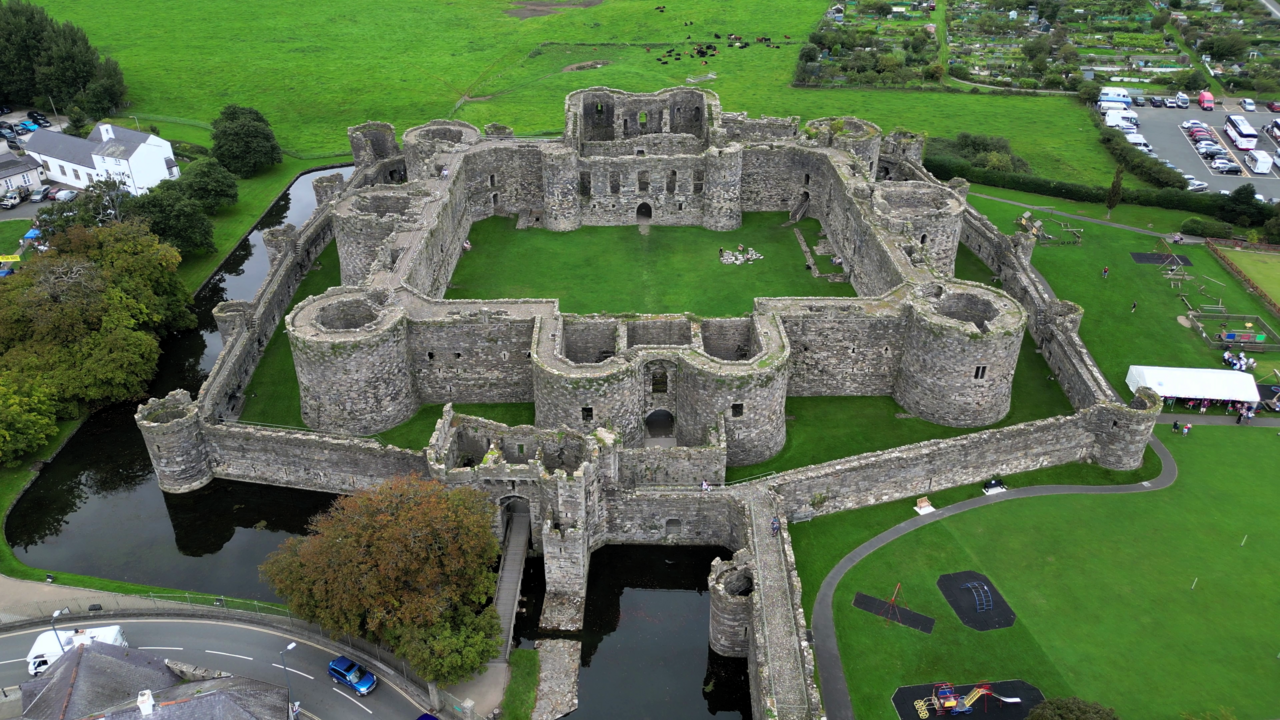
Caer Gybi Roman Fort
Caer Gybi Roman fort in Holyhead stands as a remarkable testament to Roman military architecture and early Christian heritage in Wales. This small but strategically significant Roman fortlet and naval base dates back to the late 3rd or early 4th century AD, constructed to defend the western coastline of Roman Britain against seaborne threats, particularly raids from across the Irish Sea. Today, visitors can explore the atmospheric ruins, including substantial defensive walls and watchtowers, alongside the medieval ecclesiastical buildings that succeeded the Roman site.
Historical context and military purpose
Caer Gybi was established during the Late Roman period as part of a broader network of coastal defenses in Britannia Superior. Its primary role was to serve as a smaller outpost complementing the larger fort of Segontium near Caernarfon. Positioned on Holy Island, the fort's location allowed it to monitor and protect important maritime routes and local settlements from Irish sea raiders.
The fort's strategic placement near the sea enabled it to function as a naval base, with one side of the fort open to the water, likely serving as a dock for Roman warships patrolling the area. This design highlights the dual military function of Caer Gybi as both a defensive stronghold and a maritime facility.
Roman control of the region ended in the late 4th century, with the fort believed to have been abandoned around 393 AD when troops were redeployed to address internal conflicts within the empire. The site thus encapsulates a critical period of Roman military strategy and frontier defense in northwest Britain.
Architectural features and fortifications
The fort is distinctive for its three-sided stone defensive walls, enclosing the landward sides, while the seaward side remained open to the sea. These walls, built using a herringbone masonry technique, stand up to 4 metres high and approximately 1.5 metres thick, demonstrating advanced Roman engineering aimed at durability and defense.
Each corner of the enclosed sides originally featured circular watchtowers that provided vantage points for surveillance and defense. The north-east tower is particularly well-preserved, rising to about 7.9 metres and showing evidence of medieval restoration, which indicates the site's continued importance beyond the Roman era.
Excavations have revealed ancillary structures adjacent to the main fort walls, including a building near the north-west corner that shares Roman construction characteristics. This suggests the fort's operational footprint extended beyond the main enclosure, likely supporting logistical or administrative functions.
The fort's location approximately 12 metres above sea level on Holy Island provided a commanding view of the surrounding waters, enhancing its defensive capabilities and maritime oversight.
Transition to early Christian use and medieval history
Following the Roman withdrawal, the site entered a new phase of significance in the 6th century when it was granted by King Maelgwn Gwynedd to Saint Cybi. The saint established a monastery within the old Roman walls, marking the fort's transformation from a military installation to a religious center.
The Church of St Cybi still stands within the fort's perimeter, alongside Eglwys y Bedd, a small chapel reputed to mark the saint's grave. These ecclesiastical buildings preserve the spiritual legacy of the site and highlight its continuous occupation and adaptation through centuries.
In the 10th century, the monastery suffered a Viking raid, reflecting the turbulent nature of the medieval period in this region. Later, in the 13th century, a new church was constructed just outside the original fort walls, indicating a shift in the religious landscape and architectural development of the site.
Archaeological significance and visitor experience
Caer Gybi offers a unique glimpse into Roman military architecture adapted to coastal defense, characterized by its three defensive walls, circular watchtowers, and a seaward quay. The preservation of these features, including walls standing up to 4 metres tall and the well-preserved north-east tower, makes it an important archaeological site.
The juxtaposition of Roman ruins with medieval ecclesiastical structures provides a layered historical narrative, showcasing the site's evolution from a Roman fort to a Christian religious center. Visitors can walk among the walls, explore the towers, and visit the historic churches, gaining insight into over a millennium of history.
Located centrally within modern Holyhead, the fort is accessible and offers educational opportunities about Roman Britain's coastal defenses and early medieval religious history. Interpretive signage and guided tours help contextualize the site's significance for contemporary audiences.
Construction techniques and materials
The use of herringbone masonry in the fort's walls is a notable architectural feature, providing both structural integrity and aesthetic distinction. This technique involves laying stones diagonally in alternating directions, which was a common Roman practice for fortifications requiring strength against attacks and environmental wear.
The circular towers at each corner were built to maximize visibility and defense, allowing defenders to cover all approaches. The surviving north-east tower's height and condition offer valuable insights into Roman military engineering and subsequent medieval modifications.
Relationship with Segontium and regional defense network
Caer Gybi was part of an interconnected system of Roman military sites in northwest Wales. Its connection to Segontium via a Roman road facilitated troop movements and communication, enhancing the overall defensive strategy of the region.
The watchtower on Holyhead Mountain functioned as an early warning post, alerting the fort to approaching threats from the sea. This network of fortifications exemplifies the Roman approach to frontier security and coastal defense.
Frequently asked questions (FAQ)
- How do I get to Caer Gybi Roman Fort?
- Caer Gybi Roman Fort is located in Holyhead, United Kingdom. You can reach the fort easily by car, with parking available nearby, or by public transport, as Holyhead is well-connected by train and bus services.
- What is the historical significance of Caer Gybi Roman Fort?
- Caer Gybi Roman Fort is an important archaeological site that dates back to the Roman period, serving as a coastal defense against invasions. It provides insights into Roman military architecture and life in Britain during the Roman occupation.
- When was Caer Gybi Roman Fort built?
- The fort was constructed around AD 300, during the late Roman Empire, to protect the port of Holyhead. Its strategic location allowed it to serve as a crucial military outpost during this period.
- Can I take guided tours of Caer Gybi Roman Fort?
- Yes, guided tours are available at Caer Gybi Roman Fort, offering visitors a comprehensive overview of its history and architecture. Check the official website for schedule details and to book your tour in advance.
- Why is the architecture of Caer Gybi Roman Fort unique?
- The architecture of Caer Gybi Roman Fort is notable for its well-preserved stone walls and defensive structures, showcasing Roman engineering techniques. The layout of the fort reflects typical Roman military design, which included barracks, a commanding officer's quarters, and storage facilities.
- Is it possible to visit Caer Gybi Roman Fort year-round?
- Yes, Caer Gybi Roman Fort is open to visitors throughout the year, though opening hours may vary by season. It’s advisable to check the official website for the latest information on visiting hours and any seasonal closures.
- What are the ticket prices for Caer Gybi Roman Fort?
- Entry to Caer Gybi Roman Fort is generally free, but donations are encouraged to help with the maintenance of the site. Special events or guided tours may have associated fees, so check in advance for details.
- What is the best time to visit Caer Gybi Roman Fort?
- The best time to visit Caer Gybi Roman Fort is during the spring and summer months when the weather is milder and outdoor exploration is more enjoyable. This period also offers a greater chance of participating in special events and guided tours.
- Are there any nearby attractions to explore while visiting Caer Gybi Roman Fort?
- Yes, nearby attractions include the beautiful beaches of Holyhead, the scenic South Stack Lighthouse, and the Anglesey Coastal Path. These sites provide additional opportunities for exploration and enjoyment of the area's natural beauty.
Information
Website
Visit websiteSources & official resources
Verify the information above using these authoritative references.
Loading map...
Visitor reviews
No reviews yet. Been here? Write the first review and help other travelers!
Write the first reviewVisited this castle? Share your experience
Your review helps other travelers and adds first-hand knowledge to our encyclopedia.