Bytom
Bytom castle stands as a significant historical site in Bytom, Poland, with origins dating back to the High Medieval period. Founded around 1050 by Prince Casimir the Restorer, this hill castle was strategically placed on St. Margaret's Hill to guard and control the vital trade route linking Kiev, Kraków, Wrocław, and Nuremberg. Though now in ruins, the castle's legacy reflects the region's medieval power dynamics and urban development.
Early history and strategic importance
The first documented mention of Bytom appears in a 1123 document by Cardinal Idzi, yet archaeological evidence suggests settlement in the area since the Bronze Age. The castle's establishment was closely tied to the growth of the town as a key node on the trade route, which spurred its rapid development during the High Medieval era. Around 1050, Prince Casimir the Restorer established a fortified stronghold on St. Margaret's Hill, which later evolved into the seat of a castellan in the 12th century.
Development of the castle and town fortifications
Following the death of Prince Władysław of Opole in 1281, the duchy of Bytom passed to his son Kazimierz, who made the town the capital of his duchy. This political shift likely prompted the construction of stone town walls and the castle itself. Although the castle no longer survives, historical research proposes two likely locations for the ducal residence. One hypothesis places it within the town walls near the current Krakowska and Rycerska streets. The alternative suggests a site outside the town walls along present-day Korfantego Street, where an 18th-century map shows an unidentified structure near the Krakowska Gate accompanied by a garden, possibly the castle ruins.
Architectural features and layout
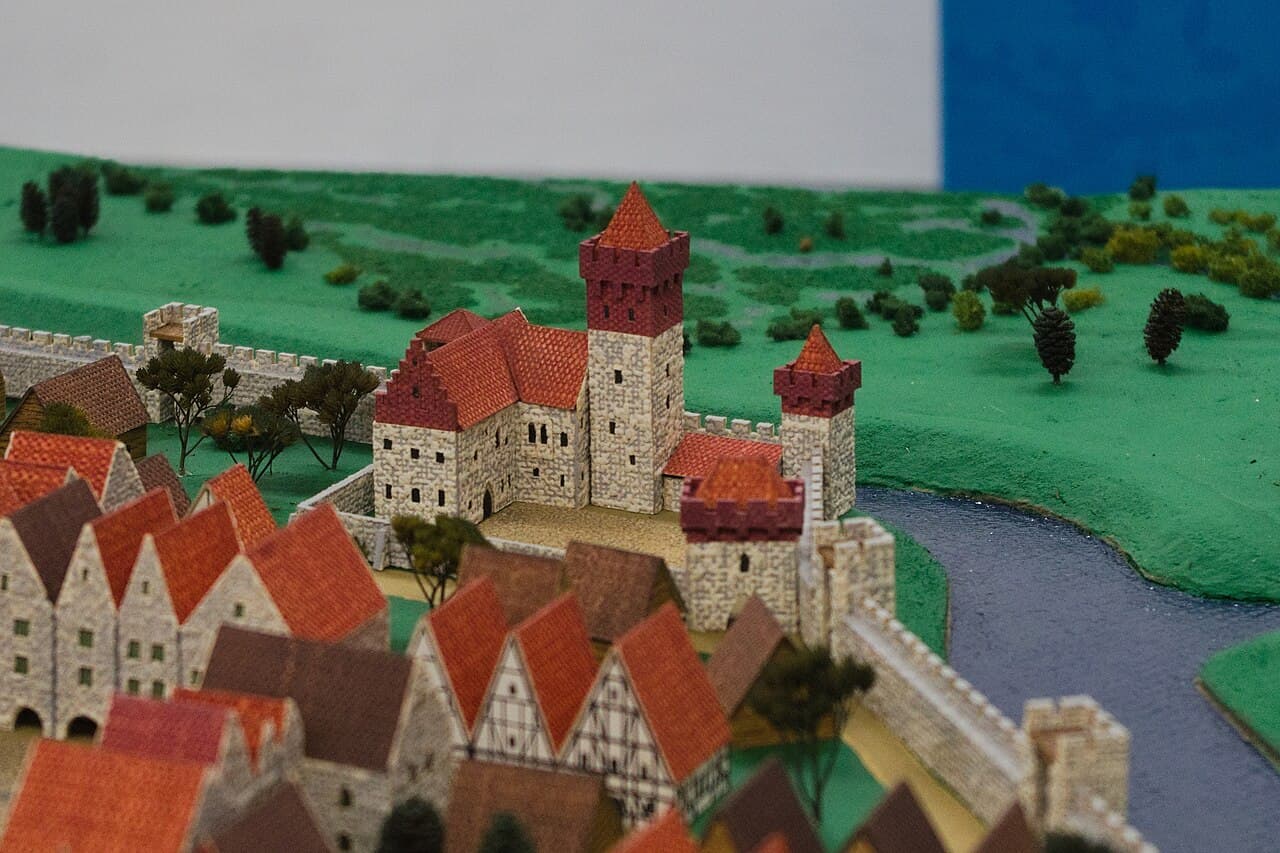
Based on surviving documents, the castle had a rectangular plan with a main stone residential building surrounded by primarily wooden structures. A defensive tower dominated the complex, overseeing the courtyard accessed through a gatehouse. The castle's defenses were naturally enhanced by surrounding moats, ponds, and marshlands, which added layers of protection against invaders.
Political changes and decline
In 1369, the duchy and castle were divided by lot between the Duke of Cieszyn, Przemysław I, who received the southern part, and the Duke of Oleśnica, Konrad II, who took the north. This division contributed to the decline of Bytom's political significance and, consequently, the castle's deterioration. Over subsequent centuries, the castle fell into disrepair and was eventually dismantled. Parts of the structure were repurposed for a brewery, which stood on the site until recent times.
Current status and archaeological potential
Today, no visible remains of the castle's walls survive above ground. The exact location and detailed appearance remain subjects of scholarly debate and await confirmation through archaeological excavations. Such research could provide invaluable insights into the castle's construction, layout, and role within the medieval urban fabric of Bytom.
Bytom castle's cultural and historical significance
Despite its ruinous state, Bytom castle holds a prominent place in the history of Silesia and Poland's medieval heritage. Its strategic location on a major trade route and its role as a ducal residence reflect the complex political landscape of the region during the High Medieval period. The castle's story is intertwined with the rise and fall of the Duchy of Bytom, illustrating broader themes of medieval urban development, feudal power struggles, and architectural evolution.
Visiting Bytom and exploring its medieval past
While the castle itself no longer stands, visitors to Bytom can explore the historic town center, which retains traces of its medieval layout and fortifications. Nearby landmarks and museums provide context for the castle's history and the region's cultural heritage. Archaeological investigations continue to hold promise for uncovering more about this important medieval site.
Frequently asked questions (FAQ)
- When was Bytom castle originally built?
- Bytom castle was founded around 1050 by Prince Casimir the Restorer as a fortified stronghold on St. Margaret's Hill.
- What is the current condition of Bytom castle?
- The castle is currently in ruins, with no visible remains above ground, and its exact location is uncertain.
- Where was Bytom castle located within the town?
- Historians propose two possible locations: within the town walls near Krakowska and Rycerska streets, or outside the walls near present-day Korfantego Street.
- Can visitors see any parts of the original castle today?
- No visible remains of the castle survive today, but archaeological research may reveal more in the future.
- Why did Bytom castle decline in importance?
- The division of the duchy in 1369 between two dukes led to the decline of Bytom's political significance and the castle's eventual deterioration.
Photo gallery

Information
Loading map...
Visitor reviews
No reviews yet. Been here? Write the first review and help other travelers!
Write the first reviewVisited this castle? Share your experience
Your review helps other travelers and adds first-hand knowledge to our encyclopedia.