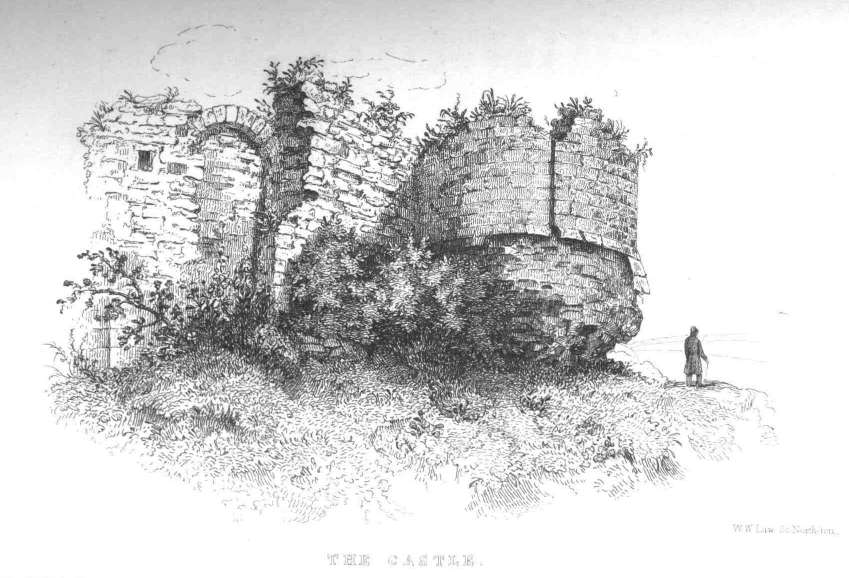
Bury Mount
Bury Mount is a historically significant Norman motte and bailey castle located in the market town of Towcester, Northamptonshire, England. Constructed during the turbulent period known as the Great Anarchy (1135-1152), this fortification reflects the political instability of 12th-century England when rival claims to the throne by King Stephen and Empress Maud led to widespread conflict and the establishment of numerous defensive sites across the country.
The castle's strategic location near the Roman road Watling Street underscores its military and administrative importance in controlling regional transport and trade routes. Bury Mount exemplifies the typical motte and bailey design, featuring a raised earthwork (motte) and an enclosed courtyard (bailey), both surrounded by a large defensive ditch. Unlike the classic conical mounds commonly seen in Norman castles, the motte at Bury Mount has a less rounded profile, suggesting adaptations to the local landscape or construction methods.
Historical context and ownership
The manor of Towcester, originally under royal control, passed into the hands of the St. Hilary family during the mid-12th century, coinciding with the castle's construction. Bury Mount served multiple functions: a military stronghold, a residence for the lord's local official (often a bailiff or reeve), and a venue for manorial administration and hospitality.
By the late 14th century, under the ownership of Reginald de Grey, detailed records describe a substantial manorial complex on the site. This included a manorial hall aligned north to south, chambers at each end, a solar (a private upper chamber), and separate kitchens. The estate was supported by ancillary buildings such as stables, barns, a brewhouse, a dovecote, and a sheepfold designed for approximately 200 sheep, reflecting the agricultural economy intertwined with the castle's domestic life.
Architectural features and layout
The motte and tower
The motte is the most prominent feature of Bury Mount, a raised earthwork that would originally have supported a tower serving as a lookout and defensive stronghold. By the late 14th century, this tower was described as a mound tower surrounded by a moat, indicating a transition from timber to stone construction. Excavations prior to 1824 revealed a rare subterranean arched passage about fifteen yards long beneath the motte's southwest section. This tunnel likely provided secret access to the tower, a feature paralleled by few other English castles such as South Mimms in Hertfordshire.
The bailey and supporting structures
The bailey, accessed through a gate at the junction of two lanes, was densely built-up in the medieval period. The gatehouse was flanked by living quarters for the castle constable and garrison, while the bailey contained detached kitchens, a brewhouse, barns, stables, privies, and a well. Livestock accommodation was also integrated within the bailey, supporting the castle's self-sufficiency during sieges or periods of unrest.
Domestic and agricultural facilities
Within the castle grounds, the manorial hall and solar featured stone roofs, a sign of status and permanence, while other buildings were thatched with straw. The estate's agricultural infrastructure included two large barns, an oxhouse combining stable and cart storage, a dovecote for pigeons, and a substantial sheepfold, highlighting the importance of animal husbandry and food production in sustaining the manor.
Later history and decline
By the late 15th century, the manorial castle was abandoned in favor of a newer manor house on Park Street, part of which survives today as the Mint House. The castle's military role was briefly revived during the English Civil War (1642-1651), when Royalist cavalry under Prince Rupert used Towcester as winter quarters in 1643-44. During this period, Bury Mount was adapted to mount two cannons, reflecting evolving military technology. Following the Royalist withdrawal in spring 1644, the castle was likely slighted—deliberately damaged to prevent further military use.
After its military abandonment, the site was transformed into an orchard and garden serving nearby cottages, which have since been removed. Restoration efforts beginning in 2008 and continuing through 2016 have focused on landscaping, public access improvements, and repair of historic buildings adjacent to the site, ensuring the preservation of this important medieval heritage landmark.
Present-day condition and significance
Today, Bury Mount survives as a well-preserved earthwork comprising the motte and bailey, located on Moat Lane near key town landmarks such as Towcester Town Hall, St Lawrence’s Church, and the Forum building. The site offers visible archaeological features that illustrate the layout and components of a Norman motte and bailey castle adapted over centuries for military, residential, and agricultural purposes.
Its location just east of the market square highlights its historical strategic importance in controlling access along Watling Street, a major Roman road. The castle's unique architectural elements, including the rare subterranean passage and the transition from timber to stone fortifications, make it a valuable example of medieval defensive architecture and manorial life in England.
Visitors today can explore the earthworks and appreciate the castle's role in the region's medieval history, supported by interpretive signage and ongoing conservation efforts. Bury Mount stands as a testament to the Norman legacy in England and the complex social and military history of the Middle Ages.
Frequently asked questions (FAQ)
- How do I visit Bury Mount and what are the opening hours?
- Bury Mount is an open earthwork site accessible to the public year-round with no formal opening hours, as it is an outdoor historic landmark located on Moat Lane in Towcester. Visitors can explore the site at any time during daylight hours.
- What is the historical significance of Bury Mount?
- Bury Mount is a Norman motte and bailey castle built during the Great Anarchy (1135-1152), serving as a military stronghold, manorial residence, and administrative center. Its location near Watling Street highlights its strategic importance in medieval England.
- Are there any unique architectural features at Bury Mount?
- Yes, Bury Mount features a rare subterranean arched passage beneath the motte, likely used as secret access to the tower. The castle also shows a transition from timber to stone fortifications, reflecting evolving medieval defensive architecture.
- Can I see remains of the original castle structures?
- While no standing stone structures remain, the earthworks of the motte and bailey are well-preserved and clearly visible. Interpretive signage helps visitors understand the layout and historical functions of the castle's buildings and defenses.
- Is Bury Mount wheelchair accessible?
- Due to the nature of the earthwork site and uneven terrain, accessibility may be limited for wheelchair users. Visitors with mobility concerns should contact local tourist information centers for advice on access and facilities.
Information
Address
Moat Lane, Towcester, Northamptonshire, UK
Loading map...
Visitor reviews
No reviews yet. Been here? Write the first review and help other travelers!
Write the first reviewVisited this castle? Share your experience
Your review helps other travelers and adds first-hand knowledge to our encyclopedia.