Burtnieki Castle Ruins
Burtnieki Castle ruins stand as a testament to the medieval military and economic strategies of the Livonian Order in what is now Latvia. Constructed around 1284 under the direction of Order Master Wilhelm von Schauerburg, the castle was strategically located near Lake Burtnieks on a hill approximately 16 meters above the water level. This position provided natural defensive advantages and control over the surrounding regions, including the historic Latvian territories of Tālava, the Livonian Metsepole, and the Estonian territory of Sakala. The castle's significance grew from its role as a fortified economic hub and storage stronghold, administered by the nearby Cēsis commandery.
Historical context and strategic importance
Burtnieki Castle was built during the high medieval period, a time marked by the expansion of the Livonian Order in the Baltic region. Its construction reflected the Order's need to secure territorial control amid the complex political landscape of the Northern Crusades. Throughout the 14th to 16th centuries, the castle was a focal point of conflict between the Livonian Order and the Archbishopric of Riga. Official records from 1366 document disputes over control of the fortress, highlighting its contested status within Livonia's feudal power struggles.
The castle's military relevance peaked during the Livonian War (1558–1583), when it suffered extensive damage. In 1560, Russian forces set fire to the castle, which was then occupied by the Polish-Lithuanian Commonwealth in 1562. Subsequent decades saw the fortress change hands between Swedish and Russian armies, underscoring its strategic value. By 1582, the castle came under the control of the Bishopric of Wenden, marking a shift from military to ecclesiastical ownership.
During the 17th century, Burtnieki Castle was involved in the Polish-Swedish conflicts. Swedish troops captured and burned the stronghold, after which it became crown property under Swedish rule. Ownership later passed to prominent figures such as Chancellor Axel Oxenstierna and subsequently to Russian nobles including Counts Löwenwolde and Rumyantsev. In the 19th century, the estate was acquired by Theodor Heinrich Schröder, whose family retained it until the agrarian reforms of 1920.
Architectural features and layout
Burtnieki Castle was originally designed as a hill castle with a largely rectangular footprint covering approximately 6,900 square meters. The fortress incorporated a mantelring—a medieval defensive curtain wall—characterized by its northern and eastern walls which curved significantly. This design combined traditional curtain wall elements with features of a laager-type fortress, inspired by encampments surrounded by protective barriers.
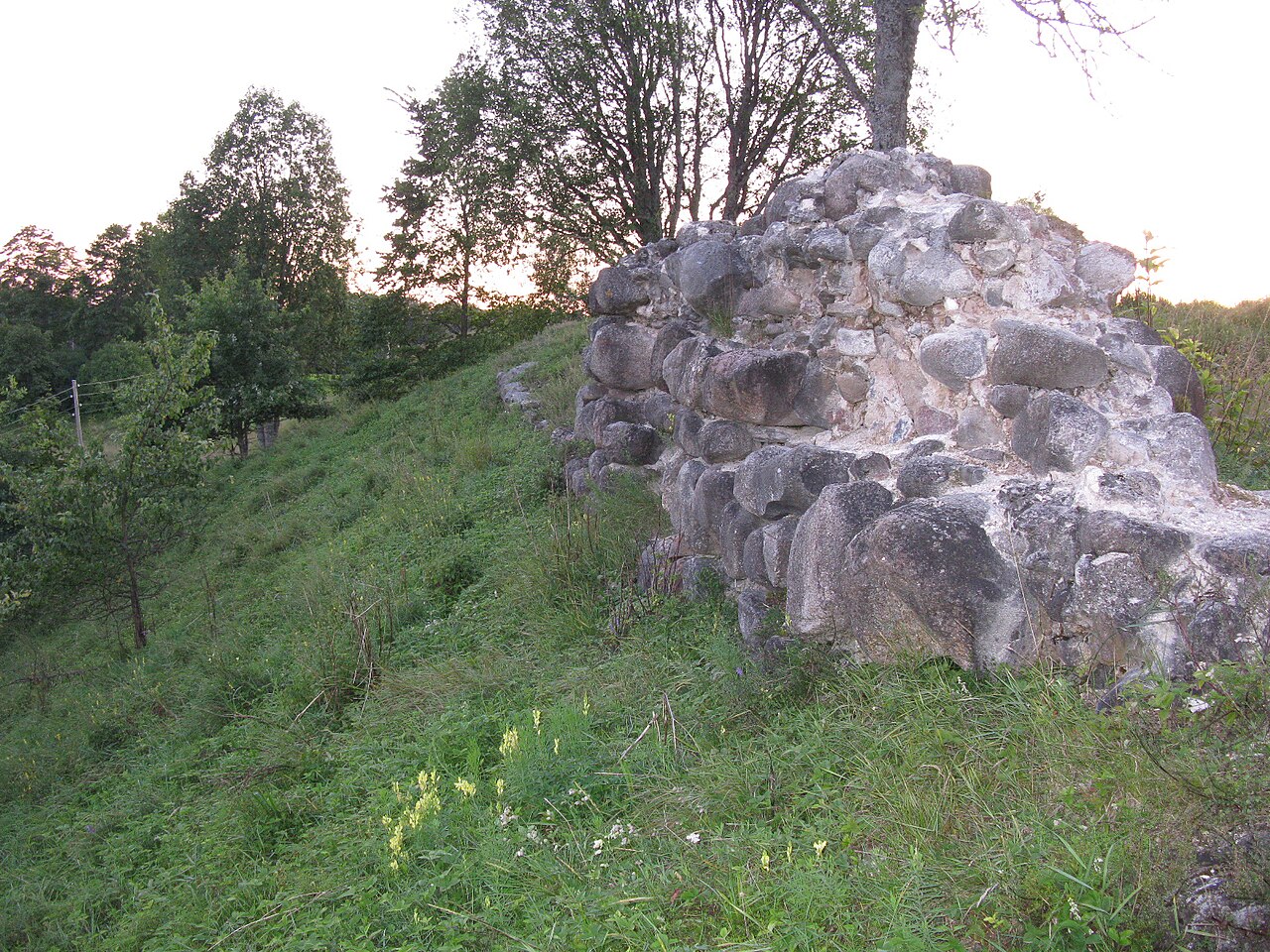
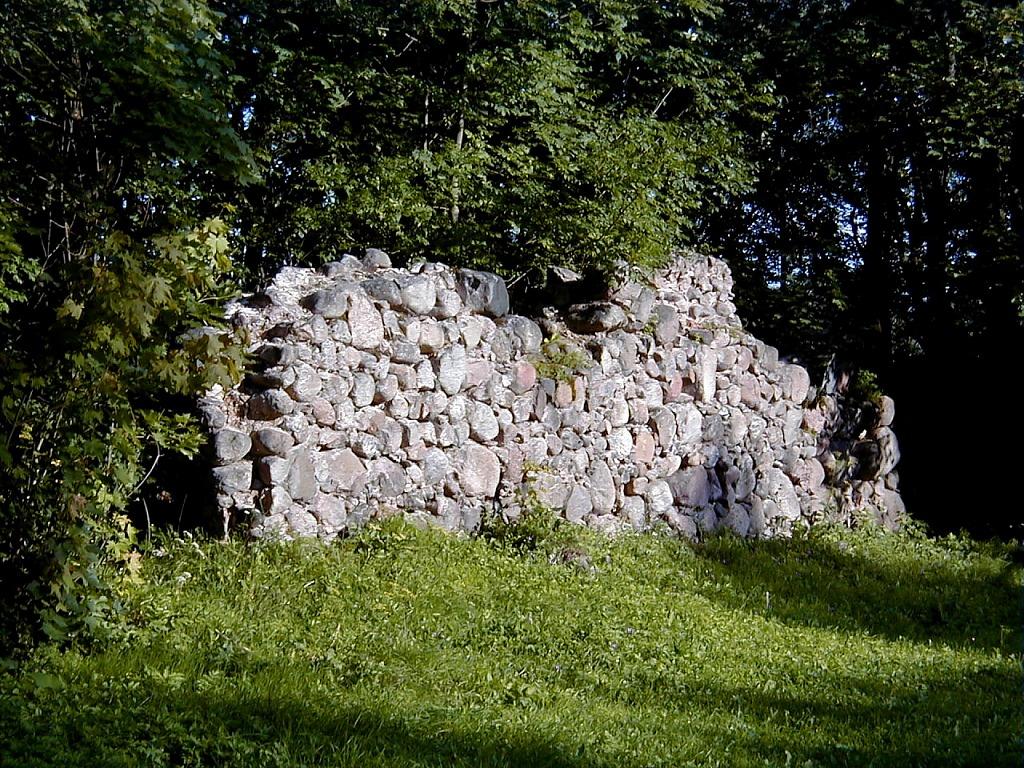
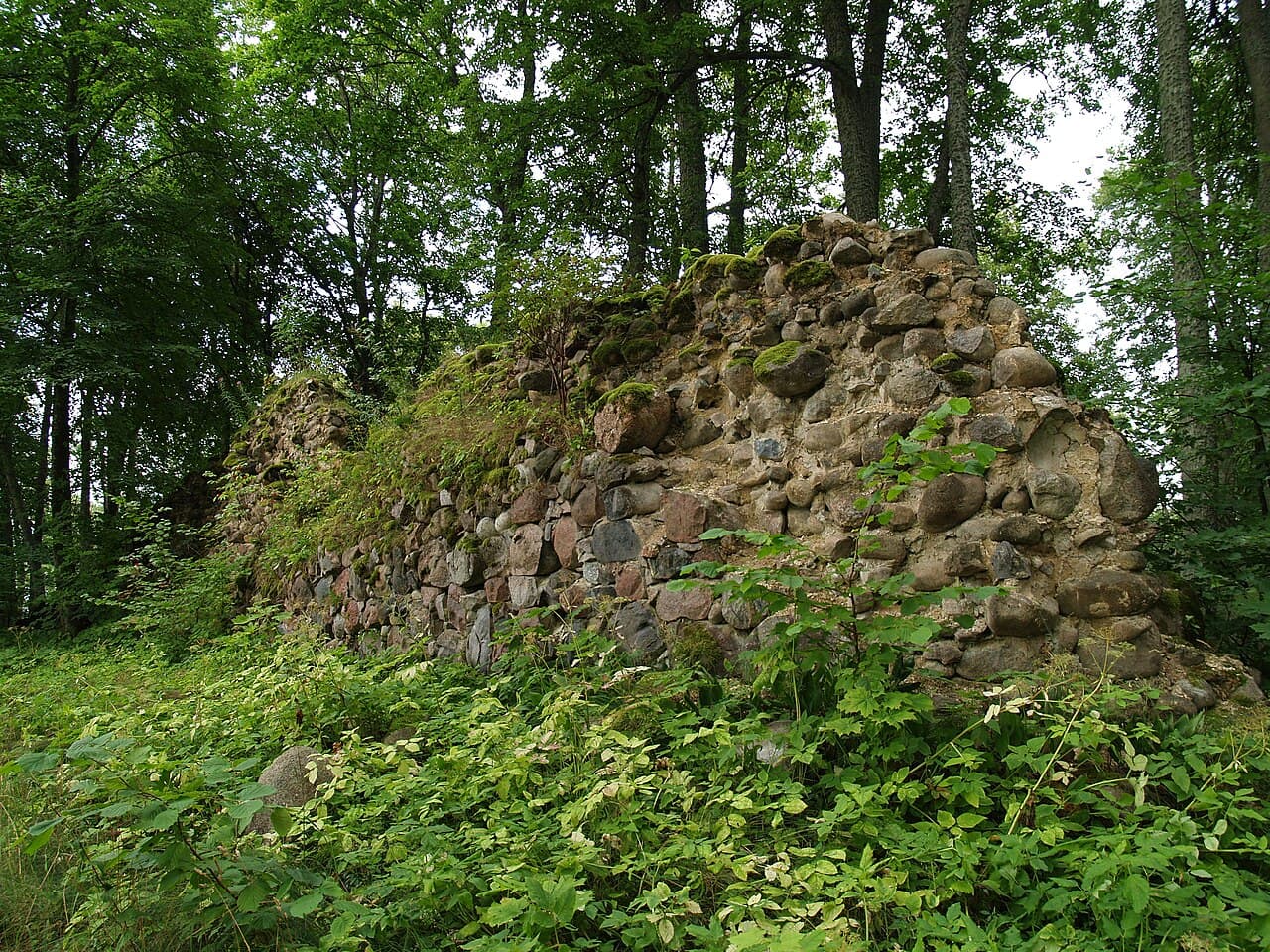
The curtain walls were constructed from large fieldstones, initially measuring about 2.2 meters thick. Surviving sections reach heights between 2.5 and 4 meters. Defensive measures included a moat approximately seven meters wide and 1.5 meters deep along the southern and eastern sides. On the western and southwestern edges, interconnected ponds linked to Lake Burtnieks enhanced the castle's natural defenses.
The main entrance was located at the southwestern corner, featuring a massive gate tower and an advanced foregate. This arrangement gave the castle the appearance of a small tower castle, with multiple towers clustered to protect the gateway. The western wing was the only stone-built interior structure, housing a small military garrison and grain storage facilities. Other buildings within the walls were primarily wooden or half-timbered, reflecting the castle's economic functions alongside its military role.
Historical plans from the 17th century show five distinct building blocks within the enclosure, none of which have survived. The western wing was the largest, rising three stories tall and measuring 35.5 by 12 meters, with walls 2.1 meters thick externally and 1.5 meters internally. Although bastion designs were drafted in the 18th century, these fortifications were never constructed.
Decline and preservation status
The castle's decline accelerated during the 19th and 20th centuries. The gate tower ruins were demolished in the mid-1800s, and much of the structure fell into ruin. In 1816, Theodor Heinrich Schröder rebuilt the northern wing on the remains of older cellar foundations, but the overall site suffered from neglect. During the Soviet era, significant portions of the remaining walls were demolished in 1969 without archaeological documentation, further reducing the site's historical fabric.
Today, only about 100 meters of the eastern curtain wall remain, exposed to the elements and gradually deteriorating. Some parts of the moat system are still visible, though the castle grounds have been significantly altered, with Soviet administrative buildings occupying much of the original footprint. Despite this, Burtnieki Castle is protected as a cultural monument under Latvian heritage laws, though there is no on-site informational signage to guide visitors.
Cultural significance and visitor experience
Burtnieki Castle ruins offer valuable insight into the medieval military architecture and the socio-political dynamics of the Baltic region during the high medieval and early modern periods. The castle's layered history—from a Livonian Order fortress to a contested site during major regional conflicts—reflects the turbulent history of Livonia and its neighboring territories.
Visitors to the site can explore the surviving stone walls and moat remnants, gaining an appreciation for the castle's strategic design and its role in regional defense and administration. The location near Lake Burtnieks provides a scenic backdrop, enhancing the historical atmosphere. However, the lack of interpretive signage means that visitors often benefit from guided tours or supplementary historical materials to fully understand the site's significance.
Efforts to preserve what remains of Burtnieki Castle continue, underscoring its importance as a cultural heritage site in Latvia. The ruins stand as a silent witness to centuries of conflict, governance, and architectural evolution in the Baltic region.
Frequently asked questions (FAQ)
- How do I get to Burtnieki Castle ruins?
- Burtnieki Castle ruins are located in Burtnieki, Vidzeme region, Latvia. Visitors can reach the site by car or local transport from nearby towns such as Valmiera. The site is accessible via local roads, but there is limited public transportation directly to the ruins.
- What is the best time to visit Burtnieki Castle ruins?
- The best time to visit Burtnieki Castle ruins is during late spring to early autumn (May to September) when the weather is mild and the surrounding landscape is lush. Winter visits are possible but less comfortable due to cold and snow.
- Is there an entrance fee to visit Burtnieki Castle ruins?
- There is no entrance fee to visit Burtnieki Castle ruins. The site is open to the public year-round, but facilities are minimal, so visitors should prepare accordingly.
- Can I explore the entire castle grounds?
- Visitors can explore the visible ruins, including the remaining curtain walls and moat areas. However, much of the original castle grounds are occupied by modern buildings, limiting full exploration of the site.
- Are there guided tours available at Burtnieki Castle ruins?
- Currently, there are no regular guided tours at Burtnieki Castle ruins. Visitors interested in detailed historical context may benefit from hiring local guides or consulting historical resources beforehand.
Photo gallery

Information
Sources & official resources
Verify the information above using these authoritative references.
Loading map...
Visitor reviews
No reviews yet. Been here? Write the first review and help other travelers!
Write the first reviewVisited this castle? Share your experience
Your review helps other travelers and adds first-hand knowledge to our encyclopedia.