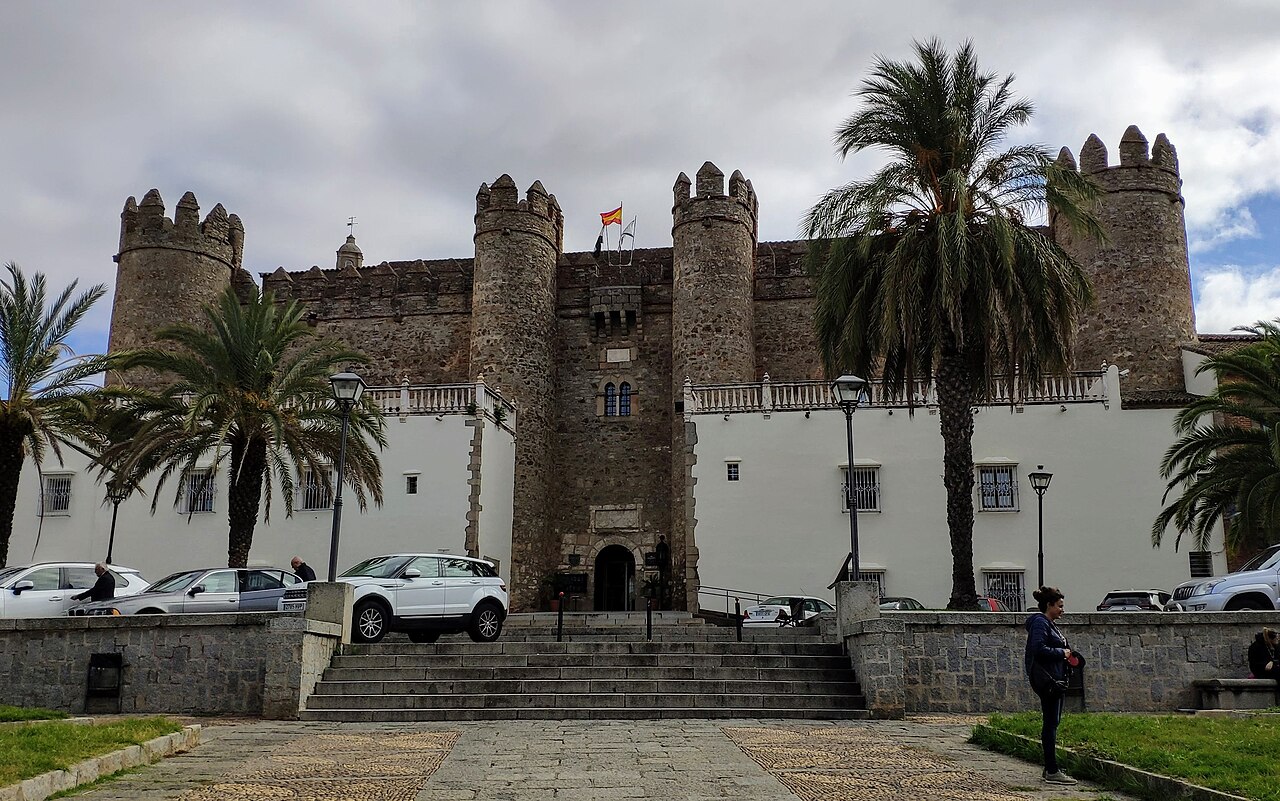
Burguillos del Cerro Castle
Burguillos del Cerro Castle stands as a remarkable example of medieval military architecture in Spain, perched prominently on a rocky hilltop overlooking the village of Burguillos del Cerro. This high medieval hill castle traces its origins back to the early 13th century, embodying a rich history that spans from its initial construction by Muslim inhabitants to its transformation under Christian rule following the Reconquista. The castle's strategic location and robust design reflect its primary function as a defensive fortress, guarding the surrounding territory and asserting control over the region.
The castle's origins and early history
The site originally hosted a Moorish fortification constructed by Muslim settlers who sought to protect their communities from advancing Christian forces during the turbulent period of the Reconquista. This early fortress formed the nucleus around which the later castle was developed. Around 1230, the castle came under the control of the Knights Templar, a powerful Christian military order active in the Iberian Peninsula. This transition was formalized in 1240 when King Fernando III of Castile and León granted the castle and its surrounding lands to the Templars, marking a significant shift in the castle's political and military role.
Medieval ownership and architectural evolution
Following the disbandment of the Templars by the Council of Vienne between 1311 and 1312, the castle passed into the hands of secular nobility. In 1320, it was awarded by King Alfonso XI to Alfonso Fernández Coronel, lord of Aguilar, and later in 1393 to Diego López de Zúñiga, head of the influential House of Béjar. The Zúñiga family maintained control over the castle through the late medieval period, overseeing significant modifications and fortifications that adapted the structure to the evolving demands of warfare and residence.
Architectural features and layout
The castle is characterized by its quadrangular plan, a common medieval design that provided a compact and defensible footprint atop the rocky hill. Its defensive system includes two main towers—the Torre Parda and the Torre del Homenaje—along with three smaller towers and robust curtain walls that once enclosed the fortress.
The Torre del Homenaje, or keep, is a prominent feature with a distinctive machicolation projecting from its upper section, allowing defenders to repel attackers by dropping objects or pouring substances. Inside, the tower houses a large hall covered by two domes and a staircase leading to upper levels, emphasizing its dual role as a defensive stronghold and noble residence.
The castle's courtyard or patio de armas is surrounded by various rooms, including an aljibe or cistern, essential for water storage during sieges. Originally, a moat and a defensive wall encircled the castle, although much of the wall has not survived. The main entrance features a Gothic-style door adorned with the heraldic shield of the Zúñiga family, topped by a decorative machicolation that combines functionality with ornamental detail.
Historical significance and legacy
Burguillos del Cerro Castle embodies the complex history of medieval Spain, illustrating the transition from Muslim to Christian control and the role of military orders such as the Knights Templar in the Reconquista. Its successive ownership by notable noble families reflects the feudal dynamics and political shifts of the period. The castle's architecture showcases adaptations to changing military technologies and residential needs over the 13th to 15th centuries.
Preservation and current state
Today, the castle is well preserved, with its main towers, courtyard, and keep largely intact. Visitors can explore the fortress's historic form and appreciate its architectural details, including the machicolations, domed halls, and defensive structures. The castle remains a significant cultural landmark in the region, attracting those interested in medieval history, military architecture, and Spanish heritage.
Frequently asked questions (FAQ)
- When was Burguillos del Cerro Castle built and by whom?
- Burguillos del Cerro Castle was originally constructed as a Moorish fortification in the early 13th century by Muslim inhabitants of the region.
- What architectural features make Burguillos del Cerro Castle unique?
- The castle features a quadrangular plan with two main towers, including the Torre del Homenaje with a machicolation, domed halls, and a Gothic-style entrance adorned with the Zúñiga family shield.
- Who controlled the castle after the Knights Templar?
- After the Knights Templar were disbanded in the early 14th century, the castle was awarded to Alfonso Fernández Coronel and later to Diego López de Zúñiga, head of the House of Béjar.
- Is Burguillos del Cerro Castle open to visitors?
- The castle is well preserved and accessible to visitors, offering insights into medieval military architecture and Spanish history, though specific visiting hours should be checked locally.
- What defensive structures did the castle have originally?
- Originally, the castle was protected by a moat and defensive walls, with towers and machicolations designed to repel attackers and secure the fortress.
Information
Website
Visit websiteSources & official resources
Verify the information above using these authoritative references.
Loading map...
Visitor reviews
No reviews yet. Been here? Write the first review and help other travelers!
Write the first reviewVisited this castle? Share your experience
Your review helps other travelers and adds first-hand knowledge to our encyclopedia.