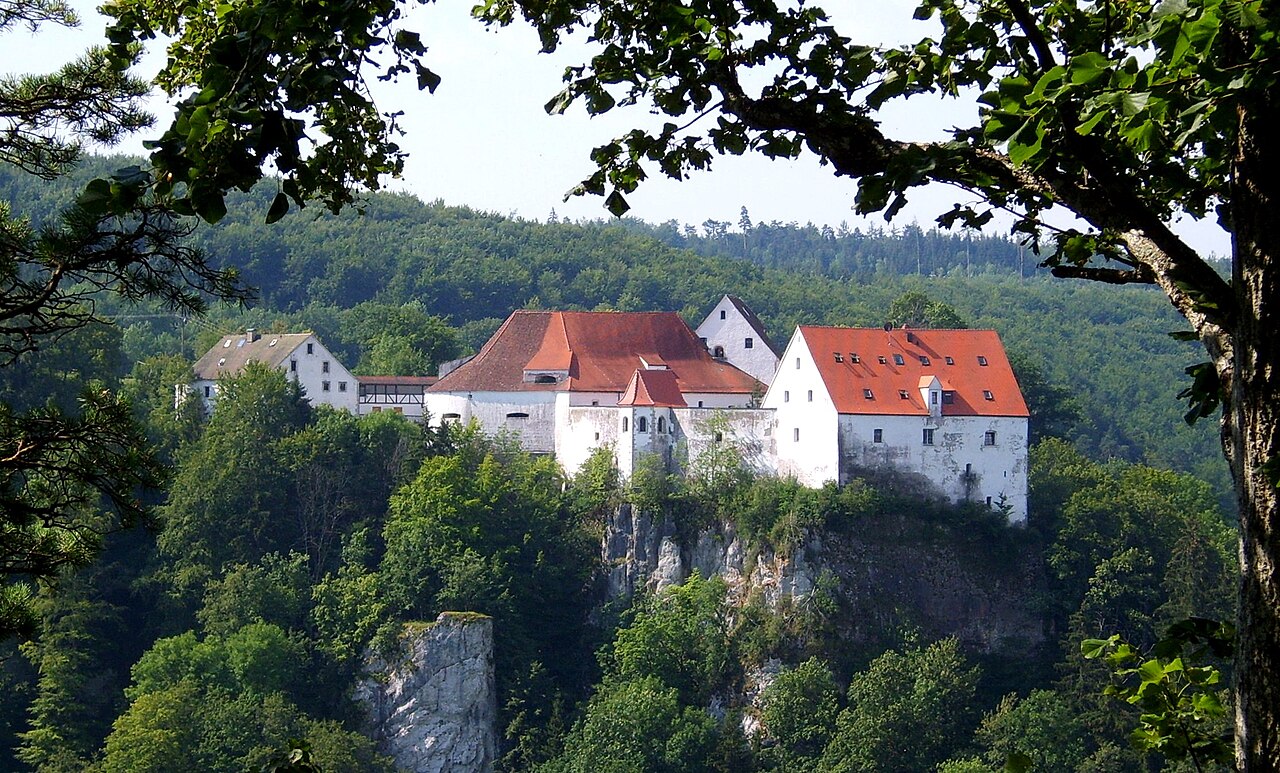
Burgruine Granegg
Burgruine Granegg stands as a significant medieval hill castle ruin located near the municipality of Egesheim in the German region known for its rugged landscapes and historical fortifications. Constructed in the 11th century by the noble Michelstein family, the castle exemplifies the strategic use of natural terrain in medieval European defensive architecture.
The castle's earliest documented mention dates back to 1102, when Reginhard von Michelstein appeared as a witness on a donation document, highlighting the castle's early role in regional noble affairs. Originally known as Michelstein castle, it retained this name until the 16th century, reflecting the prominence of its founding family. The last known member of the Michelstein lineage, Agnes von Michelstein, was recorded in 1305, marking the end of the family's direct association with the site.
Historical significance and ownership transitions
The castle endured considerable adversity during the 14th century. In 1356, a powerful earthquake inflicted partial destruction on the fortress, a rare but impactful natural event that shaped its subsequent history. Further damage occurred in 1377 during the first major city war, when forces from the imperial city of Rottweil attacked the castle. This conflict also devastated the nearby village of Bubsheim, underscoring the turbulent regional dynamics of the period.
Following these events, the castle experienced a series of ownership changes that reflected shifting political and social landscapes. In 1483, Duke Sigmund of Austria granted the ruined castle as a fief to Bertold von Balgheim. Shortly thereafter, in 1489, control passed to the Stain von Steinegg family. From 1536 to 1792, the castle was held by the Ifflinger family of Granegg, during which time the castle adopted the name Granegg, replacing its original designation.
The late 18th and early 19th centuries saw further changes in ownership. In 1792, Karl-Alexander Ifflinger sold the ruin and its estates to brothers Emanuel and Michael Levi from Hechingen for 95,000 gulden. Approximately four decades later, in 1831, Karl von Ifflinger reacquired the property. By the early 20th century, the castle's stewardship shifted to ecclesiastical hands when the Catholic church administration in Rottweil took possession of the tower ruins in 1923. Later, in 1931, the Swabian Alb Association assumed responsibility and initiated preservation efforts that continue to this day.
Architectural features and construction details
Burgruine Granegg is perched atop the Schlossfelsen, a rocky outcrop reaching an elevation of 921 meters above sea level. This elevated position provided a naturally defensible site typical of hill castles and rock castles in medieval Germany. The castle's design demonstrates the strategic integration of natural rock formations with human-made fortifications.
The surviving ruins reveal a construction style characterized by the use of rough rubble stone combined with sections of bossage ashlar masonry. This technique, where stones are shaped with raised faces and smooth edges, allowed for tightly fitted walls that enhanced the castle's durability and defensive capability. The masonry reflects building practices from the 11th century and subsequent restoration phases.
The bergfried and defensive walls
One of the castle’s most prominent features is the remains of the bergfried, the main defensive tower that served as a last refuge during sieges. Although partially damaged, the bergfried’s standing sections provide valuable insight into medieval military architecture and the castle's original silhouette.
Traces of the castle’s defensive walls further illustrate its fortified nature. Foundations and wall remnants outline the castle's footprint on the rocky ledge, showcasing the adaptation of medieval fortification methods to the natural landscape. The walls would have been integral to the castle’s defense, protecting inhabitants from external threats.
Preservation and cultural importance
The current condition of Burgruine Granegg is classified as ruins, with fragmented structures that nevertheless convey the castle’s historical and architectural significance. Photographic documentation and archaeological studies have helped preserve knowledge of the site’s layout and construction techniques.
Preservation efforts initiated by the Swabian Alb Association since the early 20th century have been crucial in maintaining the ruins for educational and cultural purposes. These initiatives ensure that the castle remains a valuable heritage site, offering insights into medieval fortification strategies and regional history.
Visitor experience and accessibility
The castle's elevated position on the Schlossfelsen provides visitors with panoramic views of the surrounding Swabian Jura landscape. While the ruins are accessible, the site’s rugged terrain requires visitors to be prepared for uneven paths and limited facilities. Interpretive signage and guided tours occasionally enhance the visitor experience, highlighting the castle’s historical context and architectural features.
Burgruine Granegg remains an important cultural landmark, attracting historians, architecture enthusiasts, and tourists interested in medieval German castles and their enduring legacies.
Frequently asked questions (FAQ)
- When was Burgruine Granegg originally constructed?
- Burgruine Granegg was originally constructed in the 11th century by the noble Michelstein family, marking it as a significant medieval hill castle.
- What architectural features remain at Burgruine Granegg?
- The ruins include remnants of the bergfried (main defensive tower), defensive walls, and masonry featuring rough rubble stone and bossage ashlar, illustrating medieval construction techniques.
- How did natural events affect the castle?
- A major earthquake in 1356 caused partial destruction, significantly impacting the castle’s structure and leading to subsequent repairs and modifications.
- Who owned the castle after the Michelstein family?
- After the Michelstein family, the castle passed through several owners including Bertold von Balgheim, the Stain von Steinegg family, and the Ifflinger family, who renamed it Granegg.
- Is Burgruine Granegg accessible to visitors?
- Yes, the castle ruins are accessible to visitors, though the terrain is rugged. Visitors can explore the site and enjoy panoramic views of the Swabian Jura region.
Information
Loading map...
Visitor reviews
No reviews yet. Been here? Write the first review and help other travelers!
Write the first reviewVisited this castle? Share your experience
Your review helps other travelers and adds first-hand knowledge to our encyclopedia.