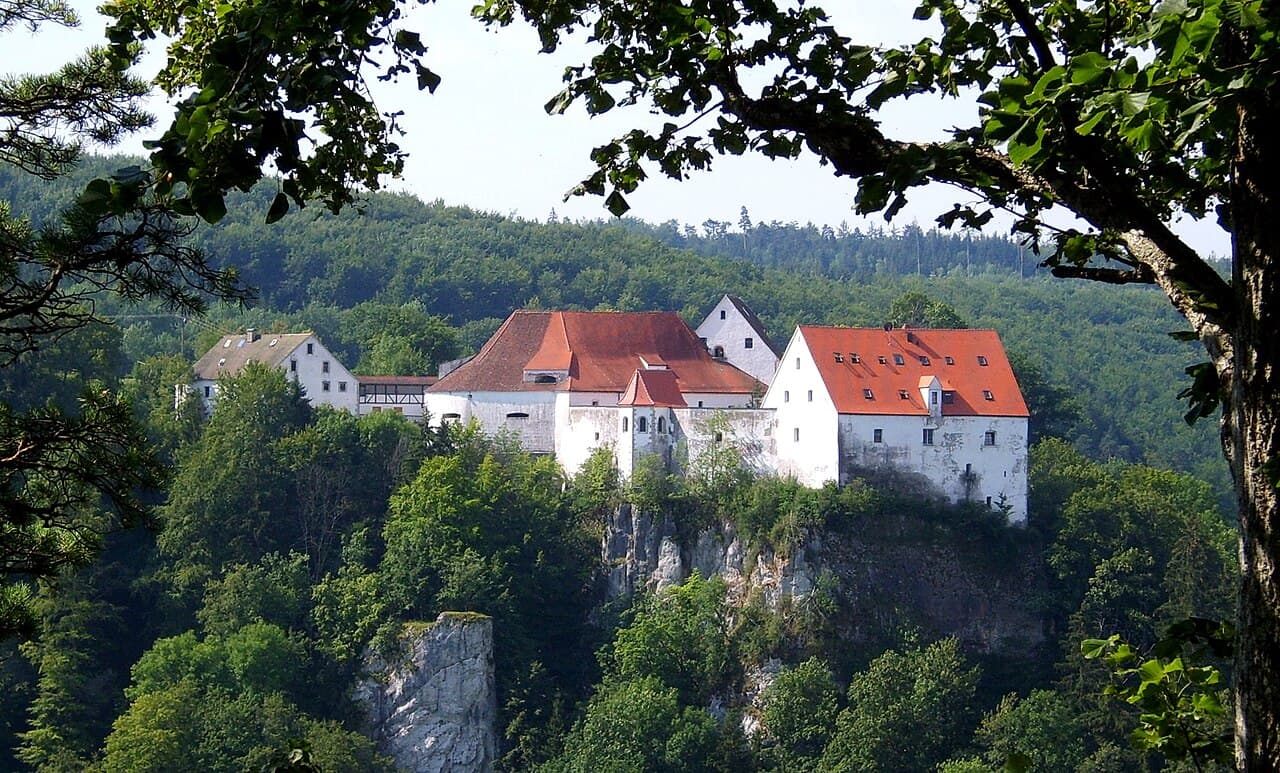
Burg Altwildenstein
Burg Altwildenstein, also known as Vorderwilderstein, stands as a remarkable example of a high medieval spur castle constructed in the 12th century by the German nobility. Located near Leibertingen in the modern German state of Baden-Württemberg, this castle exemplifies the strategic use of natural topography in medieval fortification design. Perched atop a narrow rock pinnacle approximately 780 meters above sea level, the castle commands sweeping views over the Danube valley, underscoring its military and territorial significance during the Middle Ages.
The origins of Burg Altwildenstein are closely associated with the free noble family von Wildenstein, who likely established it as their initial seat of power. While no contemporary documents precisely date the castle's founding, archaeological evidence such as pottery shards and masonry styles firmly place its construction in the early to mid-12th century. Historical records from between 1168 and 1174 mention two brothers from the Wildenstein lineage as lords of the area, suggesting their role in erecting this and other nearby cliff castles designed to control the rugged landscape.
Architectural design and fortifications
Burg Altwildenstein was ingeniously built on a 10-meter-high rocky spur at the end of a ridge, with natural defenses on its south and east sides formed by steep cliffs that functioned as a shield wall. The castle's compact layout was confined to a buildable area roughly 18 by 9 meters, reflecting the constraints imposed by the rugged terrain. Its primary structure was a substantial main residential tower, possibly serving as a keep, measuring approximately 14 meters in length and 8 meters in width, with an attached southern annex.
The masonry exhibits a sophisticated combination of bossed ashlar blocks—stones intricately dressed with raised rectangular decorations—and rubble stone walls. Notably, seven courses of corner stones remain intact, including a prominently bossed corner stone facing south, highlighting the craftsmanship invested in the castle's construction. Evidence of a later remodeling phase is visible in the southern corner, where a newer stone facing overlays older masonry, indicating ongoing maintenance and adaptation during its occupation.
Access to the castle was carefully controlled by a hollowed-out defensive ditch carved into the rock, separating it from the spur leading to the nearby Wildenstein fortress. A narrow rock ledge on the western edge provided the sole entrance, opening onto a terrace overlooking the steep valley drop to the northwest. This terrace likely hosted a lower or outer bailey, where supporting economic buildings and a small forecourt were situated. Although only fragments of retaining walls and a finely constructed ashlar wall remain today, these ruins hint at the castle's once-functional ancillary structures.
Additional architectural features include a beam socket carved into the rock at the northeastern edge of the outer bailey, suggesting structural connections to the core castle. On the east side of the main tower, a coarse rubble-stone retaining wall approximately four meters tall and eight meters long provides essential support on the sloping terrain. The northwest corner of the keep reveals three courses of larger bossed stones with shallow bosses and finely cut edges, demonstrating the builders' attention to detail and defensive strength.
Near the tower, a shallow elongated hollow carved into the rock may have housed a cellar or cistern. Traces of mortar mixed with brick dust found in the surrounding debris suggest the presence of waterproof masonry, likely intended for water storage, a critical feature for sustaining the castle during sieges or dry periods. These remains collectively illustrate a small but well-fortified medieval castle, expertly adapted to its steep and commanding landscape.
Historical context and ownership changes
Throughout the 13th century, Burg Altwildenstein underwent significant modifications, including an update to its main residential tower to enhance its defensive and residential qualities. Concurrently, a new fortress called Wildenstein was constructed nearby, eventually becoming the dominant stronghold in the region. This development shifted the strategic importance away from Burg Altwildenstein.
In 1263, ownership of Burg Altwildenstein and its surrounding estates passed through marriage to Anselm IV of Justingen. Following this transfer, the castle was gradually abandoned as a residence. Archaeological evidence indicates that the castle fell out of use by around 1300 or possibly earlier, marking the end of its active role in regional defense and administration.
Location and strategic significance
Situated near the town of Leibertingen in the Swabian Jura region of southern Germany, Burg Altwildenstein occupies a commanding position on the edge of the Danube valley. The castle's location atop a high spur allowed it to control important medieval trade routes and monitor movement through the valley. Its proximity to other castles on steep cliffs in the area reflects a network of fortifications designed to secure territorial claims and provide mutual defense.
The castle's natural defenses, including the steep cliffs on multiple sides and the hollowed defensive ditch, exemplify the medieval strategic use of terrain to compensate for limited manpower and resources. This approach was typical of hill castles in the region during the high medieval period, emphasizing strongholds that leveraged elevation and rugged landscapes for protection.
Preservation and archaeological significance
Today, Burg Altwildenstein remains a partially preserved ruin, with key structural elements such as the main tower's masonry, retaining walls, and defensive ditch still visible. The site offers valuable insights into 12th-century castle construction techniques, noble residence layouts, and medieval defensive strategies.
Archaeological investigations have uncovered pottery fragments and masonry details that help date the castle and understand its phases of use and abandonment. The presence of waterproof mortar in the cistern area highlights the builders' technical knowledge, while the combination of bossed ashlar and rubble stonework reflects regional architectural styles of the period.
As a cultural heritage site, Burg Altwildenstein attracts historians, archaeologists, and castle enthusiasts interested in the evolution of medieval fortifications in Germany. Its dramatic cliffside setting and well-preserved masonry make it a compelling example of a high medieval hill castle adapted to challenging terrain.
Frequently asked questions (FAQ)
- How do I get to Burg Altwildenstein?
- Burg Altwildenstein is located near Leibertingen in Baden-Württemberg, Germany. Visitors can access the site by car or local transport to Leibertingen, followed by a hike to the castle ruins situated on a rocky spur overlooking the Danube valley.
- What is the historical significance of Burg Altwildenstein?
- Burg Altwildenstein is a notable example of a 12th-century high medieval hill castle built by the noble von Wildenstein family. It illustrates medieval defensive architecture adapted to rugged terrain and played a role in regional territorial control during the Middle Ages.
- Can I visit the interior of Burg Altwildenstein?
- As a partially preserved ruin, Burg Altwildenstein does not have accessible interior rooms like a restored castle. Visitors can explore the exterior remains, including the main tower masonry, defensive ditch, and terraces, while appreciating the castle's strategic location and historical context.
- When was Burg Altwildenstein abandoned?
- The castle was abandoned as a residence around 1300, following its transfer to Anselm IV of Justingen in 1263 and the rise of the nearby Wildenstein fortress as the dominant stronghold.
- Is Burg Altwildenstein wheelchair accessible?
- Due to its location on a steep rocky spur and the nature of the ruins, Burg Altwildenstein is not wheelchair accessible. Visitors should be prepared for uneven terrain and hiking to reach the site.
Photo gallery

Information
Website
Visit websiteSources & official resources
Verify the information above using these authoritative references.
Loading map...
Visitor reviews
No reviews yet. Been here? Write the first review and help other travelers!
Write the first reviewVisited this castle? Share your experience
Your review helps other travelers and adds first-hand knowledge to our encyclopedia.



