Burgruine Eppenstein
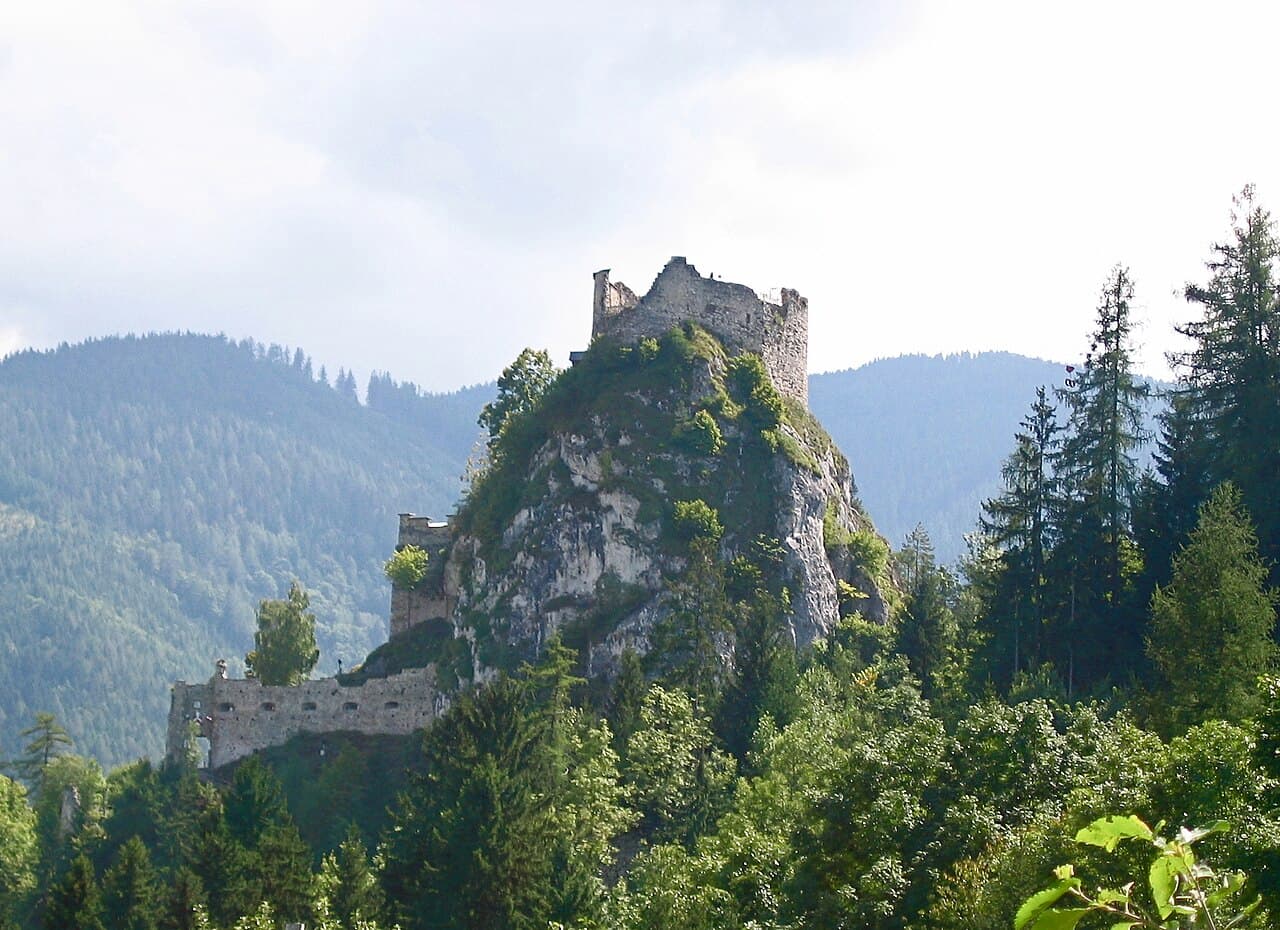
Burgruine Eppenstein stands as a striking example of a medieval hill castle perched atop a steep rock spur at approximately 736 meters above sea level in the municipality of Eppenstein, Austria. Its commanding position overlooking the surrounding landscape underscores its historical role as a strategic fortress. The castle's origins trace back to the early medieval period, with initial construction likely in the 10th century, originally built primarily of wood before evolving into a formidable stone stronghold.
Historical origins and noble lineage
The castle was first documented in 1160, attributed initially to the noble Traungauer family, who held titles as counts and later dukes. The Traungauer lineage ended in 1122, after which ownership transferred to the Wildon family. The Wildons played a significant role during the Austrian interregnum, a period of political instability in the region. Their involvement in a conspiracy against King Přemysl Ottokar II of Bohemia led to the castle's occupation by royal troops. Following King Ottokar's defeat at the Battle on the Moravian Field in 1278 by the Habsburgs, control of the castle reverted to the Wildons.
Throughout the late medieval period, Burg Eppenstein changed hands multiple times, reflecting its importance as a noble seat and strategic fortress. Ownership passed among prominent families including the Dukes of Carinthia, and noble houses such as Colledo, Nádasdy, Pranckh, Sessler, and Graben von Stein. These transitions illustrate the castle's enduring political and military significance in the region.
Architectural evolution and fortifications
A major reconstruction in 1478 transformed the castle in the Gothic style, significantly enhancing its defensive capabilities. The renovation included the addition of two artillery bastions, reflecting the adaptation to emerging gunpowder weaponry. These bastions protruded from the curtain walls, allowing defenders to mount cannons and repel attackers more effectively.
The castle's layout is roughly pentagonal, characterized as a hilltop ring castle with thick curtain walls encircling the inner fortress area. At the highest point stands the bergfried, a tall main tower serving dual purposes as a watchtower and a refuge during sieges. Unlike many contemporary castles, Eppenstein did not feature a separate motte; instead, it relied on the natural elevation of the rocky spur for defense.
Access to the castle was deliberately limited to a narrow, winding path climbing steeply to the main gate, which was heavily fortified and protected by a deep, water-filled moat crossed by a drawbridge. Adjacent to the entrance was a substantial gatehouse, forming a critical part of the defensive complex. The palas, the main residential building, was situated within the fortified core alongside the bergfried, providing living quarters for the lord and his family.
The castle's steep slopes negated the need for an outer ward or bailey, as the natural terrain combined with robust fortifications made it nearly impregnable. Historical records note that the fortress fell only once to an enemy force, and that was due to internal betrayal during a Hungarian military campaign.
Damage, decline, and current state
The early 16th century brought significant calamity when a large fire, compounded by a powerful earthquake, severely damaged the castle. Partial repairs were undertaken around 1570, but the construction of the nearby Neu-Eppenstein fortress diminished the old castle's strategic importance. By 1583, the castle was described as deteriorating and was eventually abandoned, leading to its current status as a ruin.
Today, Burgruine Eppenstein remains a compelling historical site, with surviving elements including sections of the curtain walls, artillery bastions, foundations of the bergfried, parts of the gate complex, and a dry moat. Although no significant restoration has occurred since the 18th century, local efforts aim to secure funding for preservation. The ruins continue to convey the castle's medieval grandeur and its role as a formidable defensive structure.
Strategic importance and architectural significance
The castle's location on a steep rock spur provided a natural defensive advantage, making it a classic example of a hill castle designed to dominate its surroundings. The pentagonal layout and continuous curtain walls exemplify medieval military architecture adapted to the terrain. The addition of artillery bastions in the late 15th century demonstrates the castle's evolution in response to changing warfare technologies.
Its bergfried served not only as a lookout but also as a last refuge, a common feature in German-speaking castle architecture. The absence of a motte and reliance on natural elevation highlight a strategic choice in fortification design. The castle's near impregnable reputation, only overcome by betrayal, underscores the effectiveness of its defensive features.
Visitor experience and cultural heritage
While Burgruine Eppenstein is currently in a state of ruin, its remnants offer visitors a tangible connection to Austria's medieval past. The site provides panoramic views of the village of Eppenstein and the surrounding landscape, allowing visitors to appreciate the strategic considerations of medieval castle builders.
Efforts by local associations to promote the castle underscore its cultural and historical value. Visitors interested in medieval architecture, military history, and noble lineage will find Burgruine Eppenstein a fascinating destination. The steep approach path and rugged terrain also appeal to those interested in hiking and exploring historical ruins.
Frequently asked questions (FAQ)
- When was Burgruine Eppenstein originally built?
- Burgruine Eppenstein was likely constructed in the 10th century, with the earliest written record dating from 1160.
- What architectural style characterizes Burgruine Eppenstein?
- The castle features Gothic architectural elements, especially following a major reconstruction in 1478 that enhanced its defenses.
- How was the castle defended against attacks?
- The castle's steep natural location, thick pentagonal curtain walls, bergfried tower, water-filled moat, drawbridge, and artillery bastions made it highly defensible.
- Why did the castle decline and fall into ruin?
- A devastating fire and earthquake in the early 16th century caused severe damage. Later, the construction of Neu-Eppenstein reduced its strategic importance, leading to abandonment.
- Can visitors access the castle ruins today?
- Yes, visitors can explore the ruins of Burgruine Eppenstein, which offer panoramic views and insights into medieval fortification architecture.
Photo gallery

Information
Loading map...
Visitor reviews
No reviews yet. Been here? Write the first review and help other travelers!
Write the first reviewVisited this castle? Share your experience
Your review helps other travelers and adds first-hand knowledge to our encyclopedia.