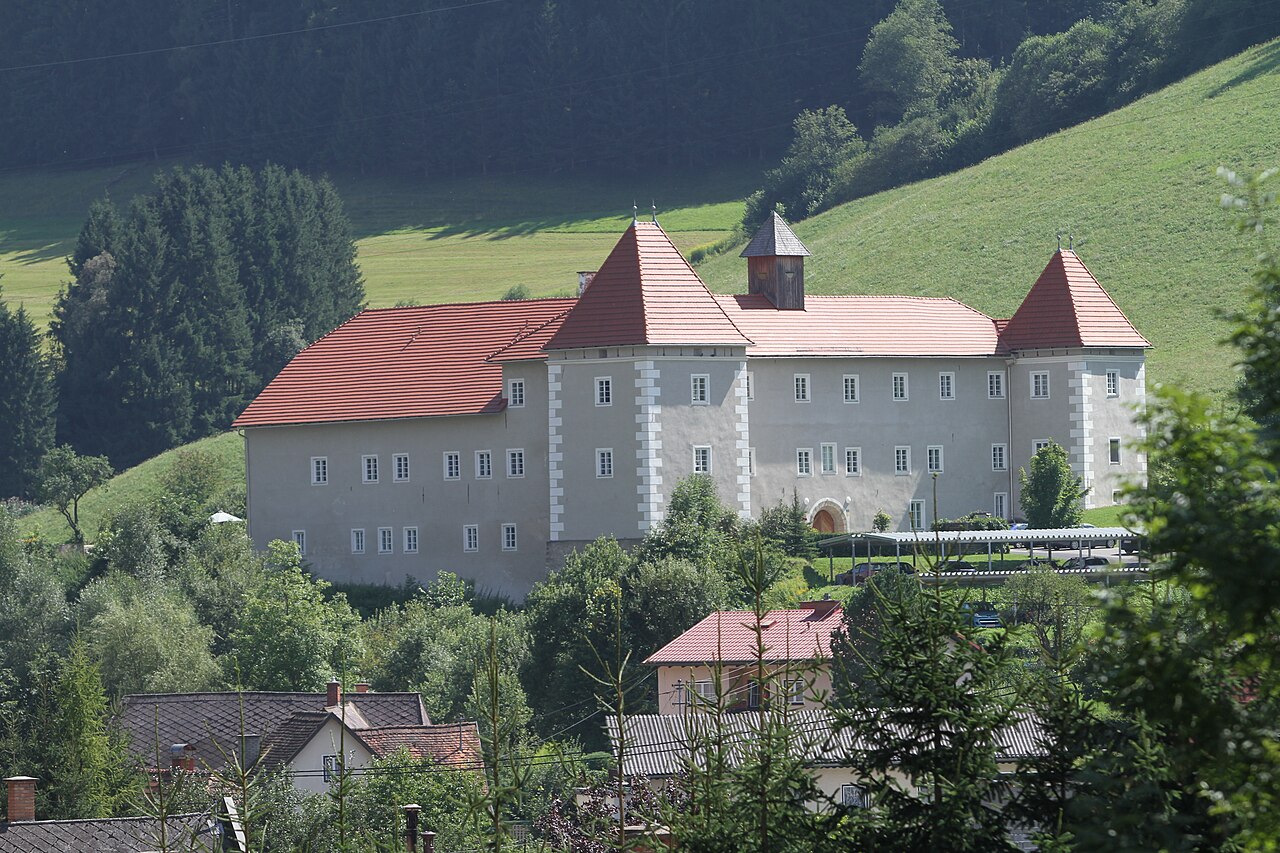
Ruine Offenburg
Ruine Offenburg is a notable medieval hill castle located near the village of Pöls in the municipality of Pöls-Oberkurzheim, Austria. Constructed in the early 12th century, this fortress was established under the influence of the prominent Eppenstein family, who played a significant role in the region's medieval history. The castle's strategic position atop the steep ridge of Ederkogel mountain allowed control over a vital passage through the Pöls valley, making it an important stronghold for regulating movement and trade during the Middle Ages.
The earliest documented association of the castle is with Offo (Otto) von Teufenbach, a nobleman active between 1160 and 1212. It is likely that the original builder was his father, also named Offo, who laid the foundations of the fortress. In 1122, ownership transferred to the Traungau family, the margraves of Styria, who entrusted the castle's administration to ministeriales from the Liechtenstein family. These unfree knights managed the estate on behalf of their overlords until their involvement in a failed noble conspiracy in 1268 led to the castle's seizure.
Historical significance and ownership transitions
Following the seizure, King Ottokar II Přemysl appointed Dietrich von Füllenstein as burgrave, a position akin to castle governor. Dietrich became infamous for offenses against the nearby Abbey of Seckau's lands. The castle was reclaimed by the Liechtenstein family in 1276 after they expelled Bohemian forces. During this period, Offenburg was linked to a regional court with jurisdiction extending from Teufenbach to Kraubath an der Mur, though the court's authority diminished by 1443.
Throughout the late 13th and 14th centuries, the castle changed hands among various noble families, including partial pledges to the Counts of Heunburg in 1295 and the Galler family in the mid-1300s. The death of the last Galler owner led to Duke Ernst's possession and subsequent pledge to Andree Ramung in 1421. Restoration efforts were undertaken between 1459 and 1496 by Hans Ramung to repair structural decline.
After Bernhard Ramung died without heirs, King Ferdinand I confiscated the property and sold it in 1531 to Hans Hofmann von Grünbühel. In 1532, Offenburg served as a beacon station, a key point for signal communication. The estate was sold in 1589 to Carl and Offo Teufenbach, who shifted administrative focus to nearby Reifenstein castle. The Teufenbach family resided at Schloss Sauerbrunn, maintaining the estate but not the castle itself.
A devastating fire in 1590 caused extensive damage that was never repaired, leading to the castle's abandonment. Subsequent ownership passed through the Saurau and Sidenitsch noble families before coming into the hands of the Schwarzenberg family in 1698, who remain the current owners. By the 17th century, Ruine Offenburg had fallen into ruin.
Architectural features and defensive design
Ruine Offenburg's location on a steep ridge with sheer drops on three sides provided natural defense, with access limited to a narrow northern landform. The castle's layout was heavily influenced by this geography, featuring a main gatehouse protected by extensive fortifications.
The northern gate was defended by a rock-cut ditch and masonry reinforcements, spanned by a drawbridge leading to a massive rectangular gate tower. Two tall, slender residential buildings extended southward from this tower, forming the castle's living quarters. A battlemented curtain wall with a protected walkway connected the gate tower to another tower in the southeastern corner.
On the western edge stood the castle's principal tower, the bergfried, dating from the 13th century. This tower remains the best-preserved structure on site, standing approximately 18 meters tall with a square base measuring seven meters per side. Reinforcements added in the 15th century include a distinctive pyramidal masonry covering at its foundations. Unusually, the bergfried is detached from the main complex by about 30 meters, with its Romanesque main entrance elevated on the second floor's south side, oriented away from potential attackers to enhance defense.
Inner and outer defensive works
The castle includes a long, narrow inner courtyard enclosed by a second outer wall that returns toward the gatehouse. This area contained several economic buildings whose exact functions are now uncertain. A cistern within the courtyard provided essential water storage. Most constructions feature rubble stone walls dating from the 12th to 14th centuries, with some 15th-century expansions and 16th-century brick repairs.
Near the northeast corner, a debris pile marks the former location of the palas, the main residential building of the lord. South of the central area, on slightly lower ground, stood a square four-story tower surrounded by its own defensive wall connected to the main fortress.
Outer defensive zones called zwingers were located east and west of the main castle. These enclosed spaces between inner and outer walls added layers to the castle's defense, though many outer walls have since collapsed.
Current condition and heritage significance
Today, Ruine Offenburg stands as a ruin, partially overgrown during summer months, offering valuable insight into medieval fortification techniques and aristocratic residence in Austria. The towering bergfried remains a dominant feature, illustrating the castle's original defensive and residential functions. The site reflects architectural evolution from the Romanesque through the late medieval period, with elements of 15th and 16th-century modifications.
Ruine Offenburg's historical connections to prominent noble families, its strategic location in Styria, and its layered fortifications make it an important cultural and architectural landmark. Although in ruins, the site continues to attract interest from historians, archaeologists, and visitors fascinated by medieval European castles and their role in regional power dynamics.
Frequently asked questions (FAQ)
- What is the historical significance of Ruine Offenburg?
- Ruine Offenburg, dating back to the 12th century, is a prominent example of medieval architecture in Austria. It played a crucial role in the defense strategies of the region and reflects the feudal power dynamics of its time.
- When was Ruine Offenburg built?
- The construction of Ruine Offenburg began in the 12th century, with significant expansions occurring in the following centuries. Its strategic location made it a vital fortress during various conflicts in history.
- Can I visit Ruine Offenburg?
- Yes, visitors are welcome to explore Ruine Offenburg. The site offers a glimpse into medieval life and architecture, making it a popular destination for history enthusiasts and tourists alike.
- What are the opening hours for Ruine Offenburg?
- Ruine Offenburg is typically open to visitors from spring to autumn, with specific hours varying by season. It is advisable to check the official website or local tourism information for the most current opening times before your visit.
- Is it possible to access Ruine Offenburg by public transport?
- Yes, Ruine Offenburg is accessible by public transport. Local buses connect nearby towns to the castle, making it convenient for visitors without a car.
- What is the best time to visit Ruine Offenburg?
- The best time to visit Ruine Offenburg is during the late spring and early autumn months when the weather is pleasant. This allows for comfortable exploration of the ruins and stunning views of the surrounding landscape.
- Are there any nearby attractions to visit along with Ruine Offenburg?
- Yes, visitors can explore other nearby attractions such as the historic town of Pöls and the scenic hiking trails in the region. These locations offer additional opportunities for outdoor activities and cultural experiences.
- What are the ticket prices for visiting Ruine Offenburg?
- Entry to Ruine Offenburg is generally free, although there may be a small fee for guided tours or special events. Always check for any updates regarding ticketing policies before your visit.
Information
Loading map...
Visitor reviews
No reviews yet. Been here? Write the first review and help other travelers!
Write the first reviewVisited this castle? Share your experience
Your review helps other travelers and adds first-hand knowledge to our encyclopedia.