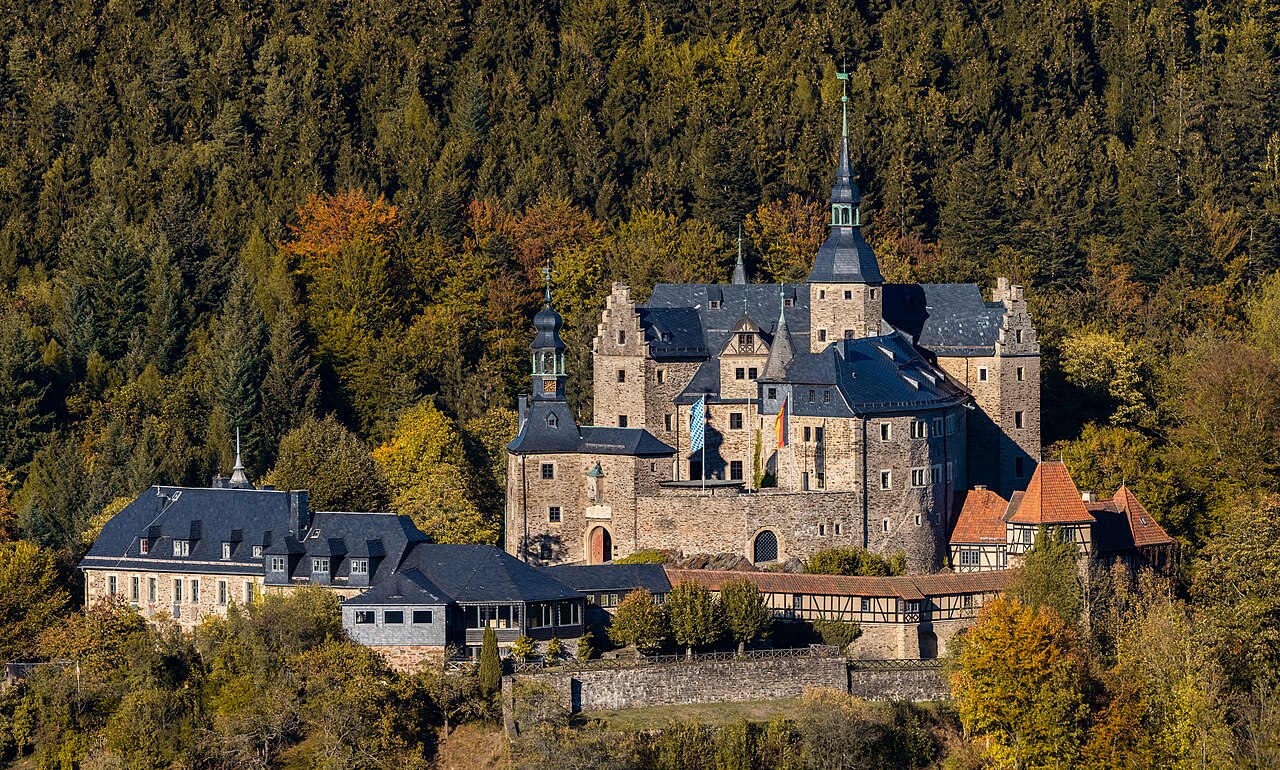
Burgruine Blankenberg
Burgruine Blankenberg is a notable hill castle ruin located near the village center of Blankenberg, within the municipality of Rosenthal am Rennsteig in Thuringia, Germany. Perched strategically on a south-facing spur above the Saale River, the castle commands a commanding view of the surrounding landscape, reflecting its original purpose as a fortress controlling key regional routes.
The castle's origins date back to the High Middle Ages, with its first documented mention in 1192. It was likely constructed under the orders of Emperor Frederick I Barbarossa during the period of dynastic conflicts between the Staufer (Hohenstaufen) and Welf families. The castle served as a strategic stronghold to secure the Vogtland region and protect the Egerland from Welf incursions, rather than as a defense against local Slavic groups such as the Sorbs.
Historical significance and ownership
Throughout the 13th century, Burgruine Blankenberg was administered by the Vögte of Weida, Gera, and Plauen, who acted as stewards managing the estate and surrounding lands. By 1371, the castle had come under the direct control of Emperor Charles IV, underscoring its continuing importance within the territorial framework of the Holy Roman Empire.
As the medieval period transitioned into the early modern era, the castle's role evolved from a purely military fortress to a more residential and administrative function. Architectural modifications introduced rounded corners and softened the previously austere Romanesque masonry, reflecting a shift towards noble residence rather than defense. This transformation included the remodeling of parts of the structure to accommodate more domestic uses.
Architectural features and layout
Location and defensive elements
The castle occupies a prominent hilltop position on a natural rock formation, separated historically by a moat that is still visible today. The main building was constructed primarily from durable local slate plates, featuring thick Romanesque walls reinforced by seven massive buttresses to provide stability and defense.
Structural design and interior spaces
The lower stories of the castle were designed with defense in mind, featuring narrow embrasures and slits that allowed archers and crossbowmen to repel attackers while minimizing exposure. Windows were limited to the upper floors, indicating the later adaptation of the castle for residential purposes.
Within the castle's enclosed area lies a spacious courtyard, which functioned as the administrative center for managing the surrounding knightly estate. A castle chapel was also part of the complex, serving as a place of worship for the inhabitants and local community, hosting regular Sunday services.
Decline, destruction, and restoration
Burgruine Blankenberg remained largely intact until the 20th century. However, after World War II, under Soviet occupation, the castle was ordered to be dismantled as part of efforts to remove noble estates deemed politically undesirable. The demolition took place on June 14, 1948, reducing the once formidable fortress to ruins.
Starting in 1995, local community initiatives began restoration projects aimed at clearing overgrowth and stabilizing the ruins. These efforts included partially rebuilding key components such as the tournament ground and a new gate, as well as restoring essential retaining walls to secure the hilltop terrain.
A castle garden and pavilion were also established near the ruins, enhancing the site's historical ambiance. The vaulted cellar of the former manor house has been conserved and now hosts a small exhibition displaying archaeological finds uncovered during excavations, offering visitors insight into the castle’s past.
In 2007, a detailed scale model at one-tenth size was installed on a roundel at the foot of the ruins. This model provides a visual interpretation of the castle’s original form, aiding in the understanding of its architectural and historical significance.
Cultural heritage and visitor experience
Today, Burgruine Blankenberg stands as an important cultural heritage site in Thuringia. Its ruins offer a glimpse into medieval fortification techniques and the evolution of castle architecture from military fortress to noble residence. The site’s preservation and interpretive exhibits make it accessible for visitors interested in the region’s history and medieval architecture.
The castle’s hilltop location provides scenic views of the surrounding landscape, including the Saale River valley, enhancing its appeal as a destination for history enthusiasts and hikers alike.
Frequently asked questions (FAQ)
- When was Burgruine Blankenberg originally built?
- Burgruine Blankenberg was first mentioned in historical records in 1192, indicating its construction likely dates to the late 12th century during the High Middle Ages.
- What architectural style characterizes Burgruine Blankenberg?
- The castle primarily features Romanesque architectural elements, including thick walls, rounded corners, and massive buttresses typical of the period.
- What led to the castle's decline and ruin?
- After World War II, Soviet authorities ordered the dismantling of the castle in 1948 as part of political measures against noble estates, leading to its demolition and ruin.
- What restoration efforts have been made at Burgruine Blankenberg?
- Starting in 1995, local community-led restoration projects cleared overgrowth, stabilized ruins, partially rebuilt the tournament ground and gate, and conserved archaeological remains.
- Is there an exhibition at the castle site?
- Yes, the vaulted cellar of the manor house has been preserved and now hosts a small exhibition displaying archaeological finds from the castle excavations.
Information
Loading map...
Visitor reviews
No reviews yet. Been here? Write the first review and help other travelers!
Write the first reviewVisited this castle? Share your experience
Your review helps other travelers and adds first-hand knowledge to our encyclopedia.