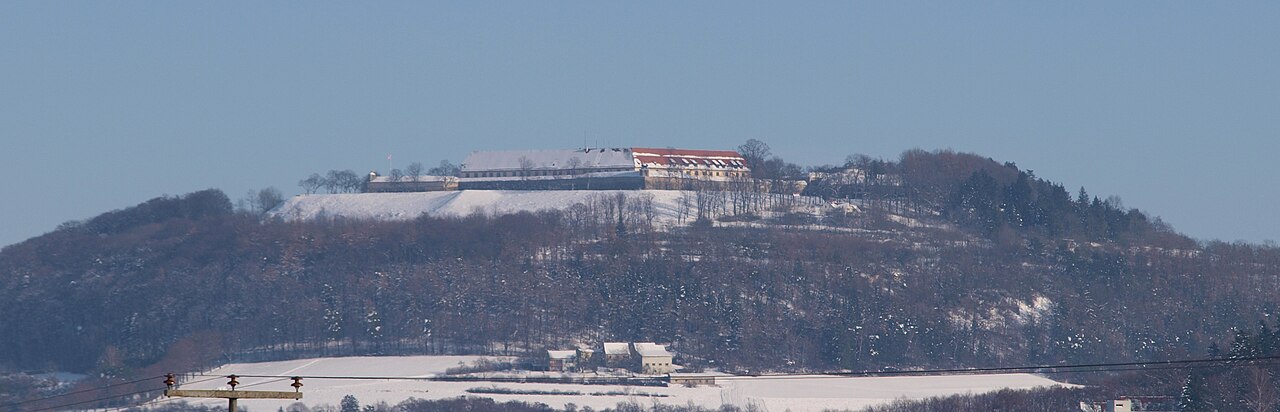
Burg Wernfels
Burg Wernfels stands prominently on a hill above the village of Wernfels in the municipality of Spalt, Bavaria, Germany. This medieval hill castle dates back to the High Middle Ages and offers a remarkable glimpse into the architectural and historical development of fortifications in the region. Its origins, architectural evolution, and varied ownership reflect the complex feudal and ecclesiastical history of southern Germany.
Early history and founding
The castle’s earliest core is a large residential building constructed in the second half of the 13th century, embodying the early Gothic architectural style. Dendrochronological analysis of a wooden post dates this structure to approximately 1270-1280. The first indirect mention of the castle appears in 1283, naming Albert II, known as “dictus Rindesmul de Werdenfels,” linking the site to the Reichsministerial family Rindsmaul, likely its founders and initial owners.
Contrary to earlier assumptions, there is no direct documentary evidence connecting Burg Wernfels to the Burgraves of Nuremberg, although their nearby castle at Abenberg influenced the local landscape and power dynamics. In 1284, the castle was sold by Albert Rindsmaul to Reinboto von Meilenhart, the Prince-Bishop of Eichstätt, marking the beginning of ecclesiastical ownership that would shape much of its later history.
Architectural development and expansions
14th and 15th centuries
Under the prince-bishops’ control, Burg Wernfels underwent significant expansions during the 14th and 15th centuries. A key addition was the construction of a protective ring wall with a gate tower that enclosed the original residential structure, enhancing the castle’s defensive capabilities. This ring wall survives today to parapet height and is buttressed externally, showcasing medieval fortification techniques.
Early modern renovations
The early 17th century saw further renovations, particularly in 1600 when Prince-Bishop Johann Konrad von Gemmingen refurbished the castle’s interior. This refurbishment included the installation of wooden ceilings and window frames, which remain visible today and are commemorated by inscriptions. Minor expansions and adaptations continued sporadically into the 18th century, reflecting changing tastes and functional needs.
Later history and modern use
Following the secularization of the Eichstätt prince-bishopric in 1803, Burg Wernfels passed into private hands and gradually fell into neglect. In 1882, the castle was acquired by Louis Braun, a Munich-based royal professor and battle scene painter, who prevented its ruin. After Braun’s death, the castle changed private ownership several times until it was purchased by the Bavarian Evangelical Young Men’s Association (Christlicher Verein Junger Männer, CVJM) in 1925.
Under CVJM management, the castle served as a youth facility until 1933, when Nazi policies forced the integration of Evangelical youth groups into the Hitler Youth. During World War II, from 1941, it housed ethnic German refugees returning from Eastern Europe. After the war, the CVJM regained possession and undertook extensive renovations, including a major restoration in 1965 and a roof replacement in 1972.
Today, Burg Wernfels is adapted as a youth hostel with modern amenities such as a festival hall built in 2001, an elevator installed in 2004 for barrier-free access, and a heated outdoor swimming pool added the same year. These adaptations blend the castle’s medieval heritage with contemporary use.
Architectural features and layout
Main residential building
The castle’s core is a three-story residential building with two wings, constructed of rusticated ashlar stones known as buckelquader, notable for their rough, protruding surfaces. This rectangular medieval structure forms the heart of the castle, with a courtyard enclosed by a wall approximately 45 by 50 meters in size.
Gatehouse and fortifications
The gatehouse survives as the primary remnant of the outer bailey. Its lower section dates to the Gothic period and features well-preserved portcullis grooves, which were channels guiding the defensive iron grilles. An 18th-century timber-framed upper floor was added later, illustrating the castle’s architectural evolution.
Originally, access to the main courtyard was via a stone bridge spanning a neck ditch, a defensive trench carved across the ridge neck. This ditch has since been filled and converted into a parking area, but its original defensive purpose remains evident in the castle’s design.
Courtyard buildings and chapel
Inside the courtyard, a ring wall surrounds the site, mostly surviving to parapet height and reinforced with buttresses and retaining walls. The north facade of the main building’s first floor features arcade windows marking the location of the former grand hall used for social and administrative functions.
A chapel stands on the northern side within the courtyard, characterized by Baroque exterior walls but containing a medieval core. This suggests the chapel may have originally been part of the narrow west wing of the main building before being adapted or rebuilt. Nearby, a two-story outbuilding with Baroque and timber-framed elements occupies the southwest corner of the courtyard.
Historical records from around 1800 indicate the castle grounds included various economic buildings such as stables, a carriage house, washhouse, henhouse, and a well, highlighting the castle’s role as a self-sufficient estate. Documents from 1657 mention a spring water supply system, though its construction date remains unknown.
Location and surroundings
Burg Wernfels occupies an east-facing ridge overlooking the Rezat valley in the forested Rangau region. The castle’s strategic position provided both defensive advantages and commanding views of the surrounding landscape, typical of hill castles built during the medieval period to control trade routes and local territories.
Cultural significance and preservation
Today, Burg Wernfels is considered well preserved and is an important cultural heritage site reflecting the layered history of medieval and early modern Bavaria. Its adaptation as a youth hostel ensures the castle remains a living monument, blending historical preservation with modern community use. The castle’s architectural features, from its Gothic origins to Baroque modifications, offer valuable insights into the evolution of castle construction and regional history.
Frequently asked questions (FAQ)
- How do I visit Burg Wernfels?
- Burg Wernfels is open to youth groups and visitors by appointment. It is recommended to contact the Bavarian Evangelical Young Men’s Association for arranging visits and group bookings.
- What is the historical significance of Burg Wernfels?
- Burg Wernfels is a notable example of a medieval hill castle with origins in the 13th century. It reflects the history of the Reichsministerial family Rindsmaul and the Prince-Bishopric of Eichstätt, showcasing Gothic architecture and later Baroque modifications.
- Can I see original medieval architectural features at Burg Wernfels?
- Yes, the castle retains original Gothic elements such as the rusticated ashlar stonework, portcullis grooves in the gatehouse, and arcade windows of the grand hall. Interiors also preserve wooden ceilings and window frames from the early 17th century renovation.
- Is Burg Wernfels accessible for visitors with mobility issues?
- The castle has been adapted with modern amenities including an elevator installed in 2004, providing barrier-free access to key areas. However, some historic parts may have limited accessibility due to their medieval construction.
- What are the best times to visit Burg Wernfels?
- Visits are typically arranged for youth groups and special events, so the best times depend on scheduled activities. Spring through autumn offer pleasant weather for exploring the castle’s surroundings and outdoor features.
- Are there any nearby attractions to combine with a visit to Burg Wernfels?
- The castle is located in the scenic Rangau region near Spalt, known for its natural beauty and historic towns. Visitors can explore the Rezat valley and nearby medieval sites such as the castle at Abenberg.
Information
Opening hours
Open to youth groups and by appointment
Ticket prices
Varies by event and group
Current owner
Bavarian Evangelical Young Men’s Association (Christlicher Verein Junger Männer, CVJM)
Website
Visit websiteSources & official resources
Verify the information above using these authoritative references.
Loading map...
Visitor reviews
No reviews yet. Been here? Write the first review and help other travelers!
Write the first reviewVisited this castle? Share your experience
Your review helps other travelers and adds first-hand knowledge to our encyclopedia.