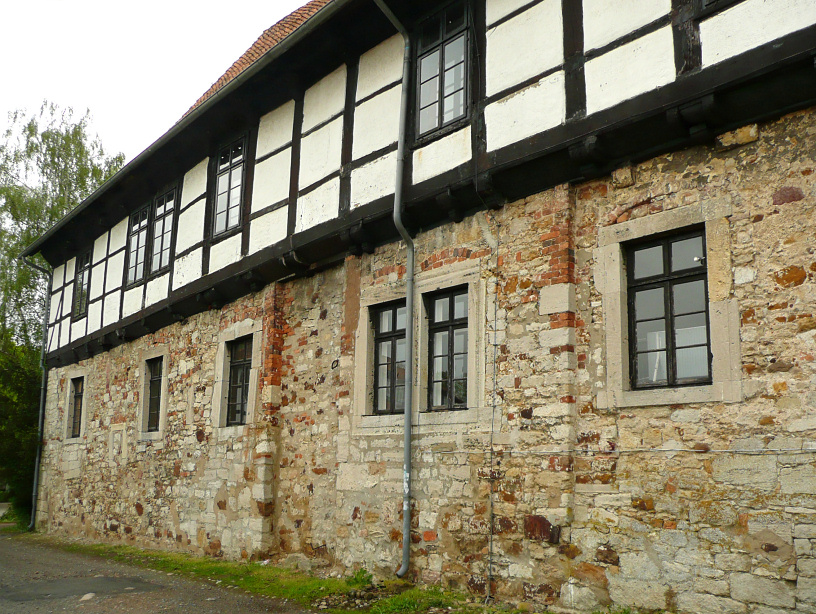
Burg Warberg
Burg Warberg is a notable water castle located in the municipality of Warberg, Germany. Constructed in the early 13th century by the noble von Warberg family, it served as their ancestral home for several generations. The castle replaced the earlier Old Burg Warberg, which was destroyed in 1199 by Archbishop Ludolf von Kroppenstedt of Magdeburg. This transition marked a significant moment in the region's medieval fortification history, reflecting evolving defensive needs and noble ambitions.
Medieval origins and early construction
The castle's foundation featured a central bergfried or keep, a nearly square tower approximately eight meters on each side and nineteen meters tall, designed with narrow arrow slits for archers' defense. This keep formed the core of the upper castle, surrounded by a single-story building with a decorative portal dating from the late 16th century, which was once part of a larger three-story structure with renaissance-style gables as depicted in a 1654 engraving by Merian. The upper castle's plateau is separated from the lower castle by a retaining wall, highlighting the site's strategic layout.
Expansion and fortification in the 14th and 16th centuries
In the 14th century, the barons of von Warberg expanded the castle by adding a manor house around the original keep, enhancing its residential and defensive capabilities. The castle sustained heavy damage during a conflict in 1356 with the Archbishop of Magdeburg. Subsequently, it was rebuilt on a larger scale with stronger fortifications, reflecting the heightened need for defense during this turbulent period. By the 16th century, economic difficulties led the von Warberg family to accept the castle as a fiefdom under the Dukes of Brunswick-Wolfenbüttel, marking a shift in sovereignty and political alignment.
Architectural features and castle layout
The castle complex is divided into two main sections: the upper castle to the southwest and the lower castle to the northeast. The lower castle encloses its courtyard on three sides with buildings including a three-story stone main house and a chapel first documented in 1346, indicating the religious functions within the complex. A half-timbered building on a stone basement, originally part of the castle's distillery operations, stands along the northern boundary.
Defensive features include moats up to fifteen meters wide, with remnants still visible on the east and west sides, and a forewall extending from the southwest measuring thirty-eight meters long and nearly four meters high, serving as an additional protective barrier. Historical records show that the southern ring wall's course changed over time, reflecting adaptations in fortification strategies.
Historical transformations and later uses
Following the Thirty Years’ War (1618–1648), the manor house suffered significant damage amid widespread turmoil. In 1650, Duke August of Brunswick-Wolfenbüttel seized the castle as a completed fief and repurposed it as an administrative center, later designating it as a domain estate from 1686 onward. In 1758, Georg Wilhelm Wahnschaffe, a prominent Prussian official and entrepreneur, leased the estate, establishing his residence and operating a distillery on-site.
In the 20th century, the castle underwent substantial changes. After becoming a state domain in 1918, it was purchased in 1938 by the Reichs-Landhandelsschule association and remodeled extensively between 1938 and 1942 to serve as a commercial agricultural school, with little regard for preserving historical architecture. During World War II, Burg Warberg was used as a military hospital and later as a tuberculosis hospital for the Helmstedt district from 1948 to 1955.
Modern preservation and current function
Since the mid-20th century, Burg Warberg has functioned as a training center for the private agricultural trade school Bundeslehranstalt Burg Warberg. Renovation efforts began in 1999 by the Freundeskreis Burg Warberg, focusing first on the upper castle until 2004, followed by conservation work on the lower castle completed in 2005. These efforts have helped preserve the castle's medieval origins and its layered historical significance as both a noble residence and an agricultural estate.
Significance and cultural heritage
Burg Warberg exemplifies the evolution of a medieval noble fortress into a multifunctional estate adapting to changing political, economic, and social circumstances. Its architectural features, including the bergfried, manor house, chapel, and defensive moats, illustrate typical elements of German water castles from the High and Late Medieval periods. The castle's continuous use and adaptations over eight centuries reflect the dynamic history of the region and contribute to its cultural heritage value today.
Frequently asked questions (FAQ)
- How do I visit Burg Warberg?
- Burg Warberg is accessible to visitors as it currently functions as a training center. It is advisable to check with the Bundeslehranstalt Burg Warberg for visiting hours and any guided tours available.
- What historical events affected Burg Warberg?
- The castle was damaged during a 1356 conflict with the Archbishop of Magdeburg and suffered further during the Thirty Years’ War. It also served various roles during the 20th century, including as a military and tuberculosis hospital.
- What are the main architectural features of Burg Warberg?
- Key features include the nearly square bergfried with arrow slits, the Renaissance-style manor house remains, defensive moats, a chapel first recorded in 1346, and a forewall protecting the southwest side.
- Is Burg Warberg open to the public?
- As it is currently used as an agricultural training center, public access may be limited. Visitors should inquire in advance for access and guided tours.
- When was Burg Warberg built?
- Burg Warberg was constructed in the early 13th century by the von Warberg family, replacing an earlier fortress destroyed in 1199.
Information
Website
Visit websiteSources & official resources
Verify the information above using these authoritative references.
Loading map...
Visitor reviews
No reviews yet. Been here? Write the first review and help other travelers!
Write the first reviewVisited this castle? Share your experience
Your review helps other travelers and adds first-hand knowledge to our encyclopedia.