Burg Veldenstein
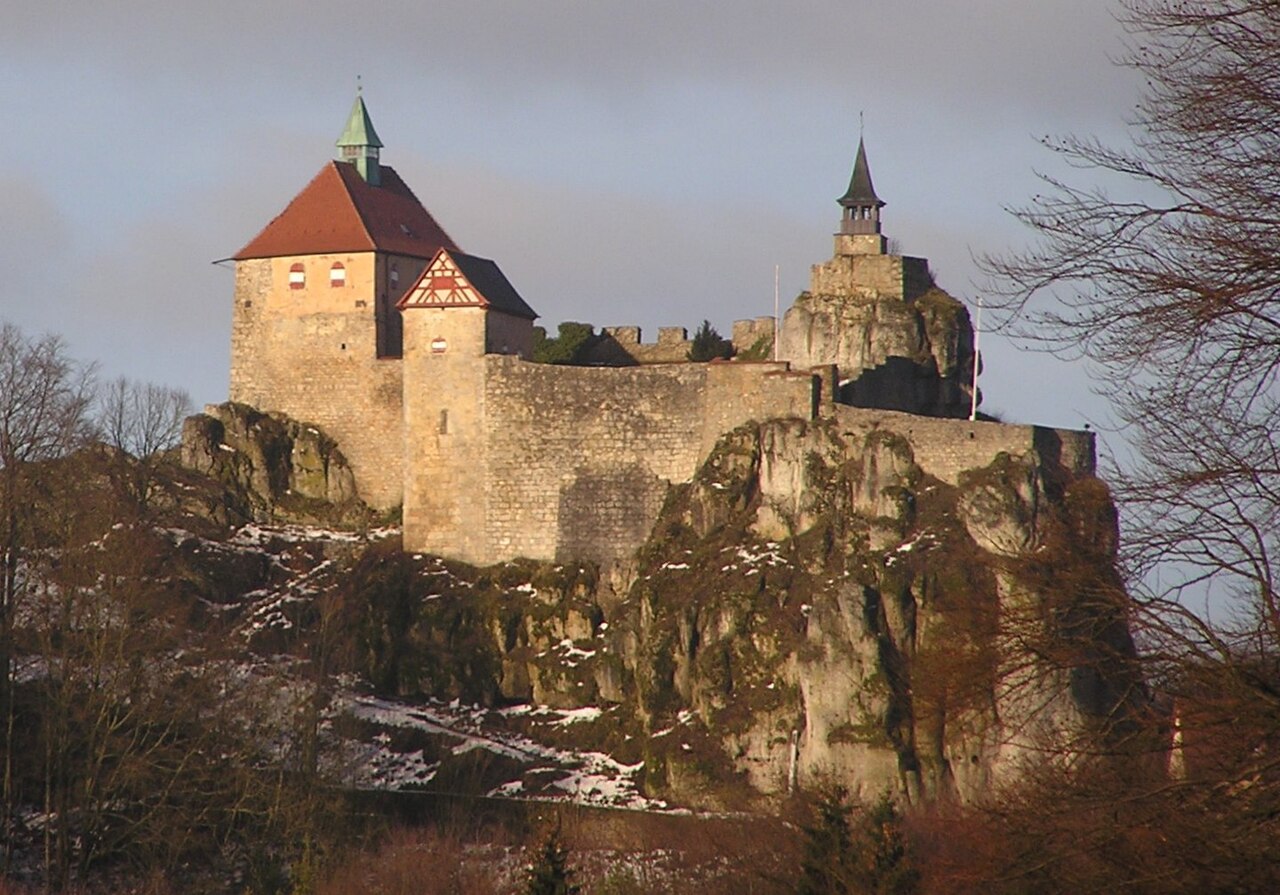
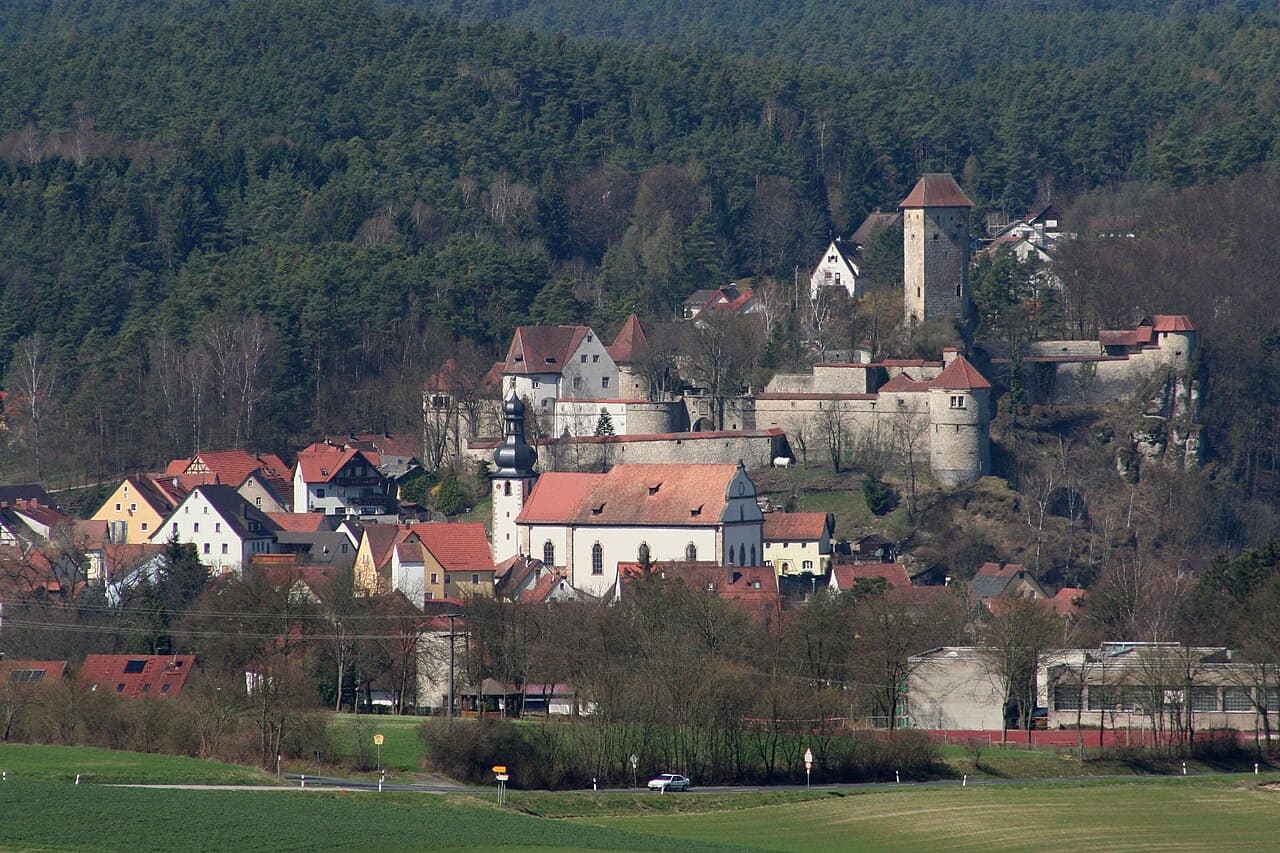
Burg Veldenstein is a prominent medieval hilltop fortress located near Neuhaus an der Pegnitz in the Bavarian region of Germany. This castle stands at approximately 419 meters above sea level, commanding views over dense forests and rolling hills. Its origins trace back to the early Middle Ages, with construction beginning around the year 1008 under the authority of the Bishop of Eichstätt and with the approval of Emperor Conrad II. The fortress was strategically established to serve as a northern border defense for the bishopric’s territories, marking it as a significant military and administrative site in the region.
The first documented mention of the castle appears in 1269, referred to as the "novum castrum" or "new castle," which indicates its recognized importance by that time. By 1323, the name Veldenstein was in use, reflecting the development of its distinct identity. Initially, the castle functioned primarily as a small refuge for local peasants, centered around its main defensive tower known as the bergfried, a typical feature of medieval fortifications designed for refuge and surveillance.
Medieval ownership and architectural evolution
Throughout the 13th century, Burg Veldenstein was held as a fief by several noble families, including the von Stör, von Egloffstein, and von Wiesenthau clans. These families maintained the fortress on behalf of the Bishopric of Bamberg. Significant reconstruction efforts were undertaken in the early 15th century by Hans von Egloffstein, who enhanced the castle’s inner structures, adapting it to evolving defensive needs.
Later in the 15th century, ownership returned to the bishops with Bishop Georg I von Schaumberg, who reclaimed the castle from the Egloffstein family. His successor, Philipp von Henneberg, expanded the castle by adding an outer ward and a zwinger, an enclosed defensive courtyard designed to trap attackers between walls. These additions transformed Burg Veldenstein into the official residence of the Bamberg bishops, who used it to administer their lands and receive formal oaths of loyalty.
Military significance and conflicts
During the 16th and 17th centuries, Burg Veldenstein demonstrated its strategic military value by withstanding multiple sieges and changing hands amid regional conflicts. The castle was occupied by troops from Brandenburg and Nuremberg, and during the Thirty Years’ War, it was held by Swedish forces in 1632 before being retaken by Bavarian troops in 1635. Despite the turmoil, the bishops restored the castle in the late 17th century and continued to use it as a residence until 1708.
That year, a lightning strike caused the castle’s powder tower to explode, resulting in a devastating fire that severely damaged the complex. This event marked a turning point, leading to the abandonment of Burg Veldenstein as a bishop’s residence and initiating a period of decline.
Ownership changes and restoration efforts
Following the secularization and political changes after the Treaty of Lunéville in 1803, Burg Veldenstein became state property of Bavaria but was soon sold to private owners due to limited interest. In 1863, Carl Heinrich Friedrich August May consolidated ownership and undertook restoration of residential buildings and the main tower, reviving parts of the castle.
In 1890, the castle was purchased by Dr. Hermann von Epenstein, who invested in repairing walls, towers, and gates before World War I. After Epenstein’s death in 1939, his widow sold the property to Hermann Göring, a prominent Nazi official. Göring added a bomb-resistant underground bunker beneath the main house in 1942, equipped with independent power, air filtration, and water supply systems, reflecting the castle’s adaptation to 20th-century warfare.
Postwar use and modern preservation
After World War II, American forces captured the castle, searching for valuables but finding only modest items. The castle provided shelter for refugees in the immediate postwar years, with some rooms partitioned for accommodation. By 1950, the Bavarian government declared Burg Veldenstein a state-owned historic monument, recognizing its cultural and architectural significance.
Starting in 1968, the castle became a venue for falconry events and, in 1972, was leased to a local brewery that converted parts into a hotel and restaurant, opening the site to the public by 1974. From 2002 until 2014, Burg Veldenstein hosted medieval-themed festivals, enhancing its role as a cultural attraction.
In 2013, a significant section of the castle’s wall collapsed, causing damage to nearby houses and prompting evacuations. The site was temporarily closed for repairs and safety assessments. A viewing platform was established to allow visitors to observe the damage safely. Restoration efforts have focused on stabilizing the structure and preserving the historic fabric, with major work ongoing into the early 2020s.
Architectural features and layout
Burg Veldenstein exemplifies a medieval fortress with a layout centered on a small inner ward dominated by the bergfried, the main defensive tower typical of German hill castles. The castle’s stone masonry construction reflects the durable building materials favored in the Middle Ages.
The late 15th-century expansions introduced an outer ward and a zwinger, creating layered defenses that enhanced the castle’s military effectiveness. The zwinger served as a killing ground for attackers trapped between walls, a common feature in high medieval fortifications.
The castle’s powder tower, used for storing gunpowder and munitions, was a critical but vulnerable element, whose destruction in 1708 dramatically altered the site.
During the 19th century, a grain storage building was replaced by a manor house built in the architectural style of the period, providing more comfortable living quarters. This manor remains part of the castle complex today.
The 20th-century addition of the bomb-proof underground bunker beneath the main house represents a rare integration of modern military architecture within a medieval fortress, equipped with advanced systems for independent operation during conflict.
Today, the castle includes defensive walls, towers, gates, and courtyards that have hosted markets and festivals, contributing to its ongoing cultural life. The castle is protected as an important architectural and archaeological monument by the Bavarian State Office for Monument Protection, ensuring its preservation for future generations.
Frequently asked questions (FAQ)
- How do I get to Burg Veldenstein?
- Burg Veldenstein is located in Neuhaus an der Pegnitz, Germany, easily accessible by car or public transport. The nearest train station is in Neuhaus, from where you can take a short taxi ride or enjoy a scenic walk to the castle.
- What is the historical significance of Burg Veldenstein?
- Burg Veldenstein dates back to the 13th century and played a crucial role in the region's defense during the medieval period. It is a testament to the architectural and cultural heritage of the Franconian region, showcasing the evolution of castle design through the centuries.
- When was Burg Veldenstein built?
- Burg Veldenstein was constructed around 1250, making it over 770 years old. Its strategic location and robust structure were designed to protect the local populace and assert control over the surrounding lands during turbulent times.
- Can I visit Burg Veldenstein as part of a guided tour?
- Yes, guided tours of Burg Veldenstein are available, providing visitors with in-depth knowledge of the castle's history and architecture. Tours are typically conducted in German, but English-speaking guides may be available upon request.
- Why is Burg Veldenstein considered an architectural gem?
- Burg Veldenstein features a blend of Romanesque and Gothic architectural styles, characterized by its imposing towers and intricate stonework. The castle's well-preserved structure offers a fascinating glimpse into medieval construction techniques and design aesthetics.
- Is it possible to access all areas of Burg Veldenstein?
- While many parts of Burg Veldenstein are accessible to visitors, some areas may be restricted for preservation purposes. It's advisable to check in advance regarding any accessibility options if you have specific needs.
- What are the opening hours for Burg Veldenstein?
- Burg Veldenstein is typically open to visitors from April to October, with varying hours throughout the week. It’s best to check the official website or contact the castle directly for the most current opening times before planning your visit.
- What are the ticket prices for visiting Burg Veldenstein?
- Ticket prices for Burg Veldenstein are generally affordable, with discounts available for students and seniors. Family tickets and group rates may also be offered, so be sure to inquire about any available deals when purchasing your tickets.
- When is the best time to visit Burg Veldenstein?
- The best time to visit Burg Veldenstein is during the late spring and early autumn months when the weather is mild and the surrounding landscapes are at their most picturesque. Visiting during this time also allows you to enjoy various events and activities hosted at the castle.
- Are there any nearby attractions to explore after visiting Burg Veldenstein?
- Yes, there are several nearby attractions, including the beautiful Pegnitz Valley and several hiking trails that showcase the natural beauty of the region. Additionally, the charming town of Neuhaus offers quaint shops and local dining options to enhance your visit.
Photo gallery

Information
Website
Visit websiteSources & official resources
Verify the information above using these authoritative references.
Loading map...
Visitor reviews
No reviews yet. Been here? Write the first review and help other travelers!
Write the first reviewVisited this castle? Share your experience
Your review helps other travelers and adds first-hand knowledge to our encyclopedia.