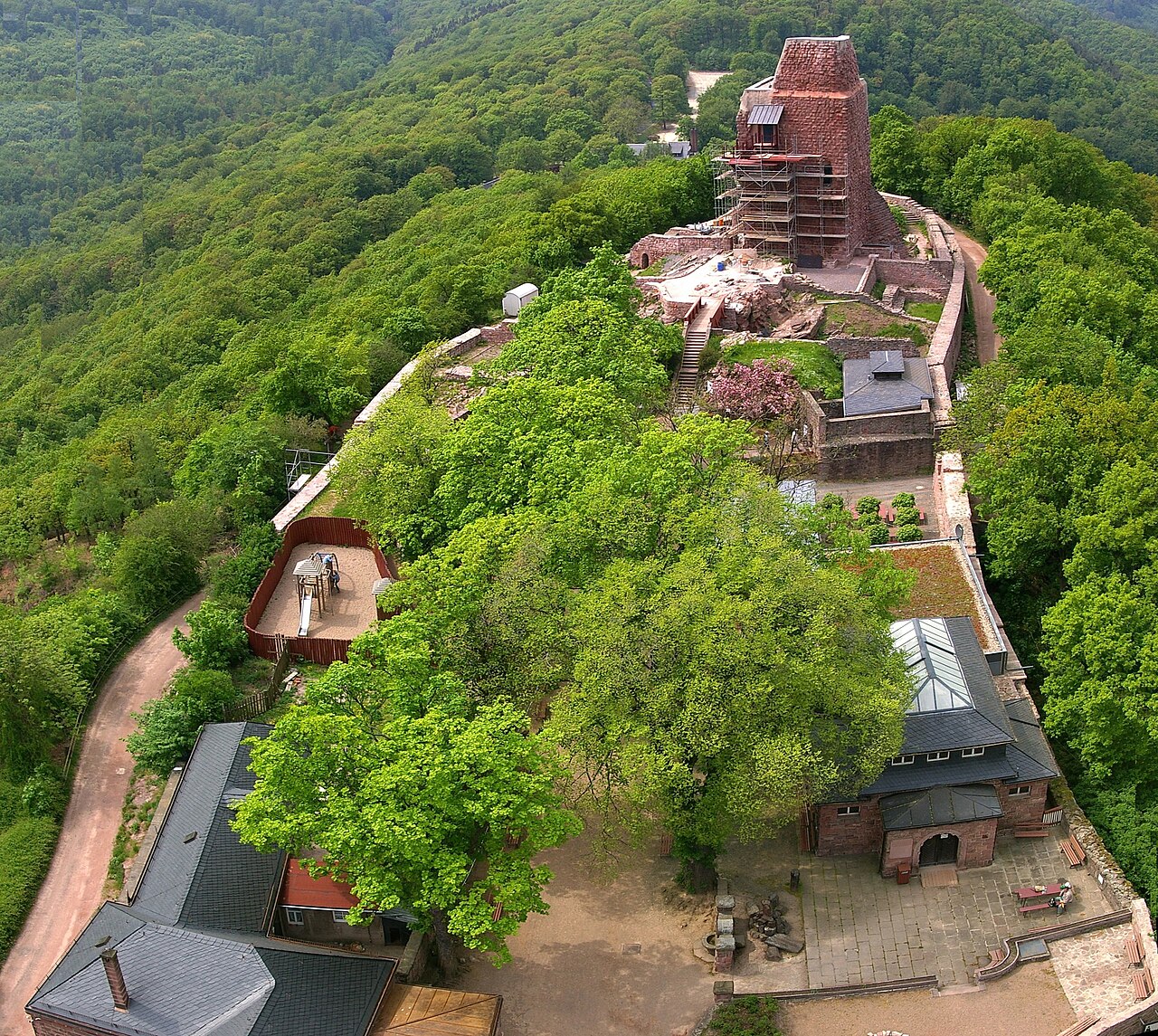
Burg Straußberg
Burg Straußberg is a significant medieval hill castle located in the municipality of Sondershausen, in the German region of Thuringia. Constructed around the year 1200, it served as a ministerial seat for the Landgraves of Thuringia, a key territorial power during the High Medieval period. The castle's strategic position on a 390-meter-high spur of the Dün ridge allowed it to function both as a fortified stronghold and an administrative center, overseeing local governance and defense.
Early history and political context
The earliest written record of Burg Straußberg dates from 1267, when Berthold von Schlotheim, a steward loyal to the Wettin Landgraves, issued a deed related to a land grant at the castle. This document highlights the castle's early role in regional administration. Between 1285 and 1316, the castle hosted officials such as chamberlains from the nearby imperial city of Mühlhausen, indicating its importance as a meeting place for local governance. During this time, local knights were entrusted with the castle's defense and management, reflecting the feudal structure of the period.
Ownership transitions and regional power struggles
Throughout the 14th and 15th centuries, Burg Straußberg changed hands several times. Around 1318, the Counts of Hohnstein acquired the castle, which subsequently passed by inheritance to the Counts of Schwarzburg in 1356. In 1421, the lordship was pawned to the Archbishop of Mainz, a transaction that influenced ongoing power struggles between ecclesiastical and secular authorities in the region. From 1465 to 1548, the castle was held by the Tütcheroda family under a pawning arrangement before returning to the Counts of Schwarzburg.
Renaissance renovations and later use
Count Wilhelm of Schwarzburg made Burg Straußberg his residence from 1552 until 1598. During his tenure, significant renovations were undertaken in 1581 to modernize the castle's facilities, including the kitchen and gatehouse. These adaptations reflect the transition from purely defensive medieval architecture to more comfortable residential use during the Renaissance period.
After Count Wilhelm's death, the castle became state property and was repurposed primarily as a domain estate. Its robust buildings served practical functions such as grain storage, with structural reinforcements added to preserve the site. Burg Straußberg remained an administrative seat of Schwarzburg-Rudolstadt until approximately 1850. During this time, the castle housed official measurement stones used to prevent fraudulent grain measuring practices, underscoring its continued role in local governance and economy.
Architectural features and castle layout
The castle occupies a roughly trapezoidal area measuring about 70 by 70 meters, surrounded by a moat that enhanced its defensive capabilities. Its most prominent surviving structure is the bergfried, a tall, round keep projecting from the southern castle wall. Constructed of small rubble stones, the bergfried features thick walls with narrow slits for windows, designed to allow defenders to observe and shoot while remaining protected. The original entrance was positioned high above ground level and accessed by a ladder, a common defensive feature in medieval keeps.
Although the bergfried now serves as a viewing platform without battlements, nineteenth-century illustrations depict it topped by a tall conical roof with a weather vane. The main gate, once located on the southern side and defended by a drawbridge crossing the moat, has fallen into ruin but would have been the primary controlled entry point.
Residential buildings, including the palas as the main living quarters, were arranged on the north side of the inner courtyard. Historical records from around 1880 mention associated outbuildings such as a smithy and an old kitchen with a chimney, indicating the castle's self-sufficiency in daily operations.
West of the bergfried lies the castle chapel, partially restored around 1870. The choir section remains from the original structure, while the nave was converted into a grain storage area due to its relatively dry conditions. Inside the chapel's antechamber were three distinctive stones resembling hollow measures used as official standards for grain volume, demonstrating the castle's administrative function in regulating trade and preventing fraudulent practices.
Defensive and administrative significance
Burg Straußberg's location on the Dün ridge and its moat provided strong natural and man-made defenses typical of hill castles in the region. Its role as a meeting place for officials, residence of regional counts, and center for land administration highlights its multifaceted importance beyond military functions.
Preservation and cultural context
Despite its robust construction, Burg Straußberg fell into decay starting in the 1950s. Since 1990, local preservation efforts have aimed to maintain the remaining structures under expert guidance. The castle is part of a network of medieval fortifications along the nearby Hainleite ridge, including ruins and castles such as Sargberg, Kirchberg Alte Kirche, Kirchberg Alte Burg, Rauchenberg, Schloss Wernrode, and Zengenberg. This cluster reflects the dense territorial division and strategic significance of the region during the Middle Ages.
Today, Burg Straußberg stands as a valuable heritage site illustrating the evolution of medieval castle architecture, regional governance, and the transition from feudal stronghold to Renaissance residence and administrative estate. Its surviving features, including the bergfried and chapel, offer insight into the castle's defensive and civic roles over several centuries.
Frequently asked questions (FAQ)
- What is the historical significance of Burg Straußberg?
- Burg Straußberg is a medieval castle that dates back to the 12th century, showcasing the architectural styles of various periods. It played a crucial role in the region's defense and governance throughout the Middle Ages, making it a significant landmark in Sondershausen's history.
- When was Burg Straußberg built?
- Burg Straußberg was originally constructed in the early 12th century, with significant expansions and renovations occurring in the following centuries. Its long history is reflected in its diverse architectural features, which tell the story of its evolution over time.
- What are the opening hours for Burg Straußberg?
- Burg Straußberg is generally open to visitors from 10 AM to 6 PM daily, although hours may vary during the off-season or due to special events. It is advisable to check the official website or contact the castle directly before planning your visit to confirm current hours.
- Can I visit Burg Straußberg year-round?
- Yes, Burg Straußberg is open for visitors throughout the year, although specific areas of the castle may be closed during the winter months for maintenance. Always verify in advance to ensure the best experience on your visit.
- Is there an admission fee to enter Burg Straußberg?
- Yes, there is a nominal admission fee to enter Burg Straußberg, which helps support the maintenance and preservation of the castle. Discounts may be available for students, seniors, and groups, so be sure to inquire at the ticket counter.
- What is the best time to visit Burg Straußberg?
- The best time to visit Burg Straußberg is during the spring and early autumn when the weather is pleasant, and the surrounding landscape is at its most beautiful. Visiting during the summer can also be enjoyable, but be prepared for larger crowds.
- How do I get to Burg Straußberg?
- Burg Straußberg is accessible by public transportation, with local buses connecting to Sondershausen. For those driving, there is a parking area nearby, making it easy to reach the castle by car.
- Are there any nearby attractions to Burg Straußberg?
- Yes, there are several nearby attractions, including the beautiful Sondershausen Palace and the picturesque gardens surrounding it. Additionally, the area offers various hiking trails for those looking to explore the natural beauty of the region.
- Is Burg Straußberg accessible for visitors with disabilities?
- Burg Straußberg has made efforts to improve accessibility for all visitors, including ramps and designated pathways. However, due to the castle's historical nature, some areas may still present challenges, so it is recommended to check in advance if specific accommodations are needed.
Information
Website
Visit websiteSources & official resources
Verify the information above using these authoritative references.
Loading map...
Visitor reviews
No reviews yet. Been here? Write the first review and help other travelers!
Write the first reviewVisited this castle? Share your experience
Your review helps other travelers and adds first-hand knowledge to our encyclopedia.