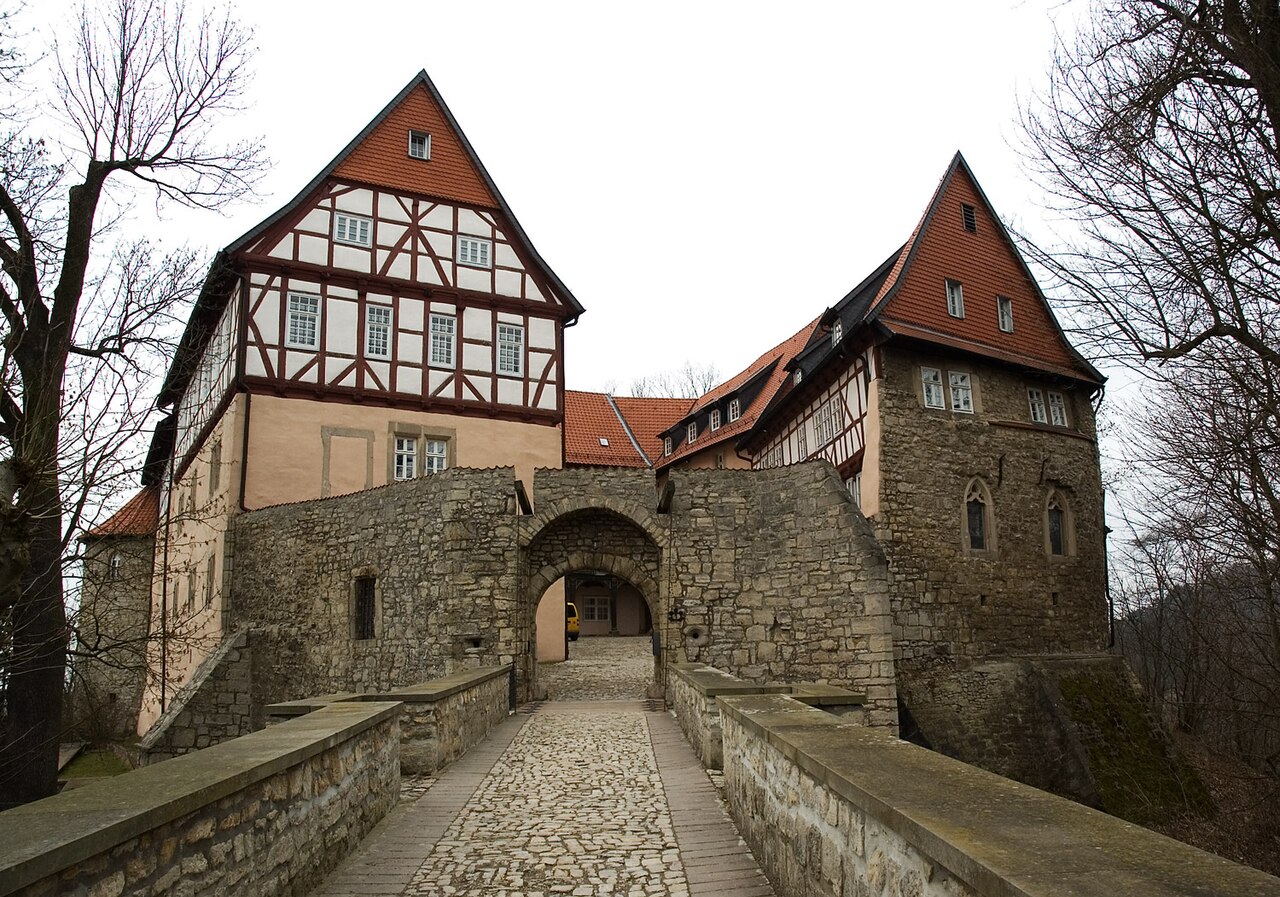
Burg Lohra
Burg Lohra stands as a remarkable example of a medieval hill castle located in the municipality of Großlohra, within the historic region of Thuringia, Germany. Constructed during the 11th century, this fortress occupies a strategic hill spur at approximately 410 meters elevation, surrounded by dense forested hills that provided natural defense and commanding views of the surrounding landscape. Its location and enduring architecture reflect the military and residential ambitions of the German nobility during the early Middle Ages.
The earliest documentary evidence of Burg Lohra dates back to 1116, mentioning Berengar, Count of Lare, a member of the noble family that established and controlled the castle. While this is the first surviving record, archaeological and architectural analysis suggest that the castle's initial construction likely began several decades earlier, placing its origins firmly in the early medieval period. Over the centuries, Burg Lohra evolved from a primarily defensive stronghold into a significant administrative and residential center.
Historical development and ownership
Throughout the 12th century, the Counts of Lohra maintained close ties with the powerful Hohenstaufen dynasty, a connection that facilitated the castle's expansion and enhancement. Under Count Ludwig III in the latter half of the century, Burg Lohra underwent substantial development, including the construction of a large bergfried—a tall, fortified tower serving both as a last refuge in defense and a symbol of lordly power. The architectural style of the bergfried shows clear influence from the Hirsau monastic tradition, indicating the involvement of skilled craftsmen familiar with contemporary ecclesiastical and military building techniques.
The Counts of Lohra also commissioned the construction of a distinctive double chapel, a rare two-level religious structure designed to accommodate different social strata within the castle. The upper chapel was reserved exclusively for the noble family, while the lower chapel served the castle's other inhabitants, reflecting the strict social hierarchy of the medieval period. The stonework and stylistic details of the chapel bear resemblance to those found in Staufer-period castles such as Königslutter, suggesting that the same workshops or master masons were employed.
After the extinction of the Counts of Lohra in the early 13th century—likely connected to the death of Count Ludwig IV on a crusade—the castle passed to the Counts of Beichlingen around 1227. In the early 14th century, parts of the estate were sold to the Counts of Hohnstein, who made Burg Lohra their residence. The Hohnstein family undertook important fortification upgrades in the 15th century, reinforcing the castle's defenses to meet the evolving military challenges of the time.
The castle suffered significant damage during the Thirty Years’ War in the 17th century, enduring multiple sieges and episodes of destruction. Despite this, Burg Lohra was repeatedly rebuilt and maintained, passing through the hands of notable owners such as Johann VIII of Sayn-Wittgenstein-Hohenstein and later the Hardenberg family. From 1712 onward, the castle became part of the Prussian territories, during which time some of its stone was removed for use in other constructions.
Architectural features and layout
Bergfried and fortifications
The most prominent surviving feature of Burg Lohra is its imposing bergfried, constructed under Count Ludwig III. This tower exemplifies the Hirsau architectural style, characterized by robust stone masonry and a design optimized for both defense and symbolic dominance. The bergfried served as a refuge during attacks and as a lookout point, commanding extensive views over the surrounding Thuringian landscape.
Encircling the castle is a thick ring wall that once provided formidable protection against invaders. The wall's substantial thickness and height underscore the strategic importance of the site and the desire of its owners to create a defensible residence comparable to other major regional strongholds such as Runneburg and Neuenburg. The 15th-century enhancements by the Counts of Hohnstein further bolstered these defenses, adapting the castle to the changing nature of warfare.
Double chapel and residential buildings
The double chapel remains one of Burg Lohra's most architecturally significant elements. This two-story chapel features an internal opening connecting the upper and lower levels, allowing for simultaneous but socially segregated worship. The upper chapel was reserved for the noble family, emphasizing their elevated status, while the lower chapel accommodated other castle residents and retainers. The craftsmanship of the chapel's stonework links it to the broader tradition of Staufer-period ecclesiastical architecture.
Adjacent to the chapel are the remnants of the palas, the main residential building of the castle. This structure provided living quarters for the Counts of Lohra and later occupants, combining domestic comfort with defensive considerations. The palas, together with the chapel and bergfried, formed the core of the castle's complex, illustrating the dual role of Burg Lohra as a noble residence and fortified stronghold.
Preservation and cultural significance
Despite centuries of conflict and partial quarrying, Burg Lohra retains a largely intact medieval character. The castle's preservation owes much to the efforts of individuals such as Clara Döring, known locally as the "Burgfräulein," who championed the castle's conservation from the 1960s through the 1990s. Her dedication was recognized with the Federal Cross of Merit in 1992.
Since 1992, a heritage association based in Weimar has managed Burg Lohra, overseeing ongoing maintenance and restoration efforts. Notably, the castle's chapel underwent a significant restoration in 2000, supported by the German Foundation for Monument Protection, ensuring the survival of its unique architectural features for future generations.
Today, visitors to Burg Lohra can explore a well-preserved example of a 12th-century hill castle, experiencing firsthand the architectural ingenuity and historical depth of this medieval fortress. The site offers insights into the social hierarchies, defensive strategies, and artistic traditions of the Staufer period, making it a valuable cultural and heritage landmark in Thuringia.
Visitor experience and accessibility
Burg Lohra is accessible to the public, inviting exploration of its historic walls, towers, and chapel. The castle's elevated position provides panoramic views of the Thuringian landscape, enhancing the visitor experience. Interpretive signage and guided tours help contextualize the site's history and architecture, making it an educational destination for those interested in medieval castles and German history.
Visitors are encouraged to plan their visit during favorable weather conditions to fully appreciate the outdoor elements of the castle. The heritage association occasionally hosts cultural events and medieval reenactments, further enriching the experience and connecting modern audiences with the castle's storied past.
Frequently asked questions (FAQ)
- How do I get to Burg Lohra?
- Burg Lohra is located in Großlohra, Germany, and is accessible by car or public transport. If traveling by car, you can follow the local road signs from nearby towns. For public transport, check local bus and train schedules for routes that stop near Großlohra.
- What are the opening hours of Burg Lohra?
- Burg Lohra is typically open to visitors from 10 AM to 6 PM during the summer months and from 10 AM to 4 PM in the winter. However, it's advisable to check the official website or contact local tourism information for any seasonal changes or special events that may affect these hours.
- When was Burg Lohra built?
- Burg Lohra dates back to the early 12th century, making it a significant historical site in the region. Its architecture reflects the typical style of medieval fortifications, showcasing the defensive strategies of its time. Over the centuries, it has witnessed numerous historical events that shaped the surrounding area.
- Can I take guided tours of Burg Lohra?
- Yes, guided tours are available at Burg Lohra, providing visitors with detailed insights into its history and architecture. These tours are usually led by knowledgeable guides who can share fascinating stories about the castle and its past. It's recommended to book in advance, especially during peak tourist seasons.
- Is Burg Lohra accessible for visitors with disabilities?
- Burg Lohra has made efforts to improve accessibility for visitors with disabilities, although some areas may still present challenges due to the castle's historic architecture. There are designated pathways and assistance available, but it's best to contact the castle management ahead of your visit to confirm specific accessibility features.
- Why is Burg Lohra significant in German history?
- Burg Lohra is significant not only for its architectural features but also for its role in regional politics and military history during the Middle Ages. It served as a strategic point for various noble families, influencing the power dynamics of the time. Today, it stands as a testament to the rich history of the area and attracts historians and tourists alike.
- What are the ticket prices for visiting Burg Lohra?
- Ticket prices for Burg Lohra vary based on age and group size, with discounts often available for students, seniors, and families. Typically, adult tickets are around €5, while children under 12 may enter for free or at a reduced rate. Check the official website for the most current pricing and any special offers.
- When is the best time to visit Burg Lohra?
- The best time to visit Burg Lohra is during the late spring or early autumn when the weather is mild and the surrounding scenery is particularly beautiful. These seasons also tend to have fewer crowds compared to the peak summer months. Additionally, visiting during local festivals can enhance your experience with unique cultural events.
- What nearby attractions can I explore after visiting Burg Lohra?
- After exploring Burg Lohra, visitors can enjoy several nearby attractions, including scenic hiking trails and charming villages in the Harz region. The historic town of Goslar, a UNESCO World Heritage site, is also just a short drive away and offers additional cultural experiences. Be sure to check out local eateries for a taste of regional cuisine.
Information
Website
Visit websiteSources & official resources
Verify the information above using these authoritative references.
Loading map...
Visitor reviews
No reviews yet. Been here? Write the first review and help other travelers!
Write the first reviewVisited this castle? Share your experience
Your review helps other travelers and adds first-hand knowledge to our encyclopedia.