Burg Querfurt
Burg Querfurt stands as one of the most significant medieval hill castles in Germany, located in the municipality of Querfurt in Saxony-Anhalt. This imposing fortress showcases a rich architectural and historical evolution spanning over a millennium, reflecting its strategic importance and the changing needs of its noble inhabitants. Established initially by the noble family of Querfurt in the 10th century, the castle has witnessed numerous phases of construction, expansion, and adaptation, making it a remarkable testament to medieval and early modern fortification design.
The site of Burg Querfurt reveals a long history of human settlement, with archaeological evidence indicating occupation dating back to the early Bronze Age. The earliest written records referencing Querfurt appear between 881 and 899, in a Hersfeld monastery register, which notes the community's obligation to pay tithes. By 979, Emperor Otto II formally recognized the site as a castellum, underscoring its role as a fortified administrative center during the early medieval period.
Medieval origins and religious significance
The castle's early development in the 11th and 12th centuries saw the construction of robust stone buildings and fortifications, marking a transition from wooden structures to durable masonry. Around 1004, a castle chapel and a collegiate foundation were established, emphasizing the site's growing religious importance. The Romanesque church, begun in 1162 within the castle courtyard, further solidified Querfurt's ecclesiastical role. This church featured a cruciform plan with an octagonal crossing tower dating from the late 12th century, a rare architectural element that highlights the castle's spiritual prestige.
The 14th century introduced the addition of a burial chapel, which became the final resting place of Count Gebhard XIV of Querfurt. This chapel is notable for its late medieval Bohemian-influenced sculpture, reflecting the cultural exchanges of the period. The castle church underwent significant Baroque remodeling between 1698 and 1716, incorporating decorative shell-shaped openings, intricate stuccowork, and richly painted ceilings by artists such as Andreas Mateyerlein and the Minetti brothers. The church's organ heritage continues with a modern instrument installed in 1994, maintaining its musical tradition.
Fortifications and defensive architecture
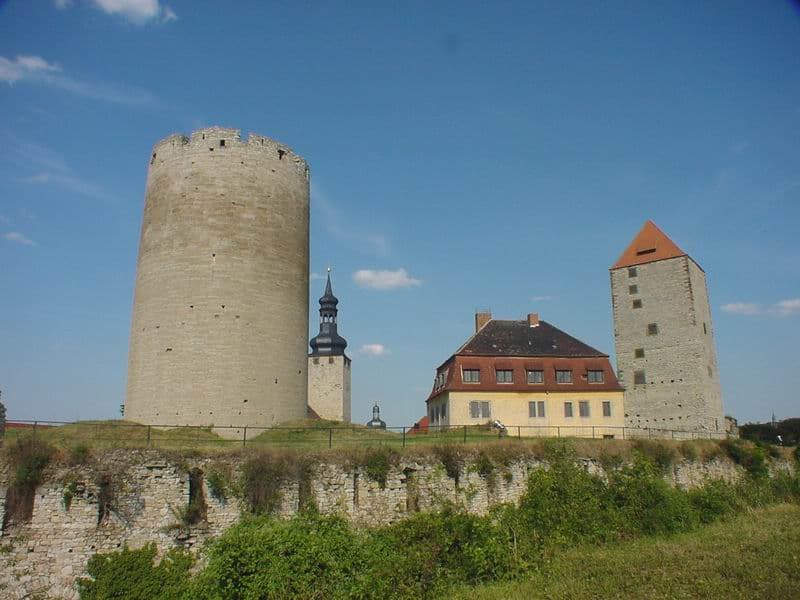
Burg Querfurt's fortifications evolved extensively from the 12th to the 15th centuries, adapting to advances in military technology and the region's political turbulence. The centerpiece of its defenses is the massive Dicke Heinrich round tower, constructed in the 12th century. This Romanesque tower rises 27.5 meters with walls over 4 meters thick, originally built without windows or chimneys to maximize defense. In the 15th century, it gained a crenellated crown with arrow slits, enhancing its protective capabilities.
Other significant towers include the Marterturm, initially a residential tower from the early 13th century, later expanded in the 14th century, and repurposed as a granary after the Thirty Years' War. The Pariser Turm (also known as the Hausmannsturm), built in the late 14th century, served as a watchtower, dungeon, and fire observation point until 1969. Standing 57 meters tall, it features a Baroque roof added in 1659 and offers panoramic views to visitors today.
The castle is enclosed by a formidable outer ring wall constructed around 1350, nearly two meters thick and ten meters high, with arrow slits designed for effective defense. Instead of a traditional water moat, Burg Querfurt employs a wide, dry moat carved into the local shell limestone bedrock, measuring approximately 11 meters across and 5 meters deep, forming a natural defensive barrier.
In the late 15th century, bastions were added to the fortifications, including large shell-shaped towers known as "Rondelle," which were equipped with loopholes for handguns, reflecting the adaptation to gunpowder weaponry. These bastions, built between 1450 and 1479, represent some of the earliest examples of artillery fortifications in the region. Despite damage during the Thirty Years' War, they have been carefully restored to preserve their historical integrity.
The Western Gate complex, constructed between 1385 and 1479, is notable for its massive scale and defensive sophistication, comparable to the renowned Wartburg Castle. Its design includes specialized arrow slits that cover wide angles, enabling defenders to secure the castle entrance effectively.
Residential and administrative buildings
Following the death of Bruno IX in 1496, Burg Querfurt passed to the Archbishopric of Magdeburg. In the 16th century, under Albrecht of Brandenburg, significant structural modifications were made in 1528 and 1535, including Renaissance-style renovations. The castle later became the residence of the princes of Saxony-Querfurt from 1663, serving as the capital of their territory.
The Fürstenhaus (prince's house), constructed between 1660 and 1668, exemplifies Baroque residential architecture, incorporating remnants of an earlier Romanesque palace known as the Ottonenkeller. This building underwent Renaissance remodeling in 1528 before its Baroque transformation, reflecting the layered history of the site.
The Korn- und Rüsthaus (granary and armory) dates to 1535 but rests on foundations from the 10th century, including parts of the northern gatehouse and earlier residential structures. Originally, its basement served as an armory, while the upper floors were adapted for storage. Renovations between 1680 and 1685 gave the building its current appearance.
Additional historic buildings on the site include the castle barn, documented since 1469, and the Amtshaus and Pächterhaus, late Baroque administrative buildings that have been modified over time to suit changing functions.
Historical events and preservation efforts
Burg Querfurt played a role in regional conflicts, notably enduring multiple sieges during the Thirty Years' War between 1640 and 1642, followed by Swedish occupation until 1650. The castle's defenses were modernized around 1700 with new artillery positions placed on a widened berm above the zwinger, reflecting evolving military strategies.
After the death of Adolph III of Saxony-Weißenfels, the castle reverted to the Electorate of Saxony, and in 1815 it became part of the Kingdom of Prussia. It served as a state domain until the mid-20th century, during which time the castle church received Baroque remodeling and later restorations preserved its historical character.
From the 1970s onward, extensive restoration and archaeological research have been undertaken to protect and better understand Burg Querfurt's complex history and architecture. Excavations of the castle well, which historically provided the sole water supply, revealed a depth of approximately 33 meters, with the current water level about 2.5 meters below the surface.
Today, Burg Querfurt remains a well-preserved example of a medieval hill castle with a diverse architectural heritage. Its massive towers, robust walls, and layered residential and religious buildings offer visitors a comprehensive glimpse into the evolution of castle construction and noble life in central Germany across centuries.
Frequently asked questions (FAQ)
- How do I get to Burg Querfurt?
- Burg Querfurt is easily accessible by car and public transport. If you're traveling by train, the nearest station is Querfurt, from where you can take a short bus ride or walk to the castle.
- What is the historical significance of Burg Querfurt?
- Burg Querfurt is one of the largest castles in Germany and dates back to the 9th century. It played a crucial role in the defense of the region and served as a royal residence, showcasing the architectural evolution from the Romanesque to Gothic styles.
- When was Burg Querfurt built?
- Construction of Burg Querfurt began in the 9th century, making it one of the oldest fortifications in the area. It underwent several expansions and renovations over the centuries, reflecting various architectural influences.
- Can I take a guided tour of Burg Querfurt?
- Yes, guided tours are available at Burg Querfurt, providing visitors with in-depth insights into the castle's history and architecture. It's recommended to check the schedule in advance as tours may vary by season.
- Why is Burg Querfurt a popular tourist attraction?
- Burg Querfurt is popular due to its impressive scale, rich history, and stunning views of the surrounding landscape. Visitors appreciate the blend of historical significance and architectural beauty, making it a must-see for history enthusiasts.
- Is it possible to host events at Burg Querfurt?
- Yes, Burg Querfurt offers facilities for hosting various events, including weddings and corporate gatherings. The picturesque setting and historical ambiance make it a unique venue for special occasions.
- What are the opening hours of Burg Querfurt?
- Burg Querfurt typically opens to visitors from 10 AM to 6 PM during the summer months and may have reduced hours in winter. It's advisable to check the official website for the most current information before your visit.
- What are the ticket prices for Burg Querfurt?
- Ticket prices for Burg Querfurt vary depending on age and group size, with discounts often available for students and seniors. Children under a certain age may enter for free, making it an affordable outing for families.
- When is the best time to visit Burg Querfurt?
- The best time to visit Burg Querfurt is during the spring and fall when the weather is mild and the surrounding nature is beautiful. Summer can be quite busy with tourists, while winter offers a quieter experience but may limit accessibility.
- Are there any nearby attractions to Burg Querfurt?
- Yes, there are several attractions near Burg Querfurt, including the historic town of Querfurt itself and the scenic landscapes of the Saale-Unstrut region. Visitors can enjoy hiking, local wineries, and other historical sites in the area.
Photo gallery

Photo by Mewes at German Wikipedia•Public domain
Information
Website
Visit websiteSources & official resources
Verify the information above using these authoritative references.
Loading map...
Visitor reviews
No reviews yet. Been here? Write the first review and help other travelers!
Write the first reviewVisited this castle? Share your experience
Your review helps other travelers and adds first-hand knowledge to our encyclopedia.



