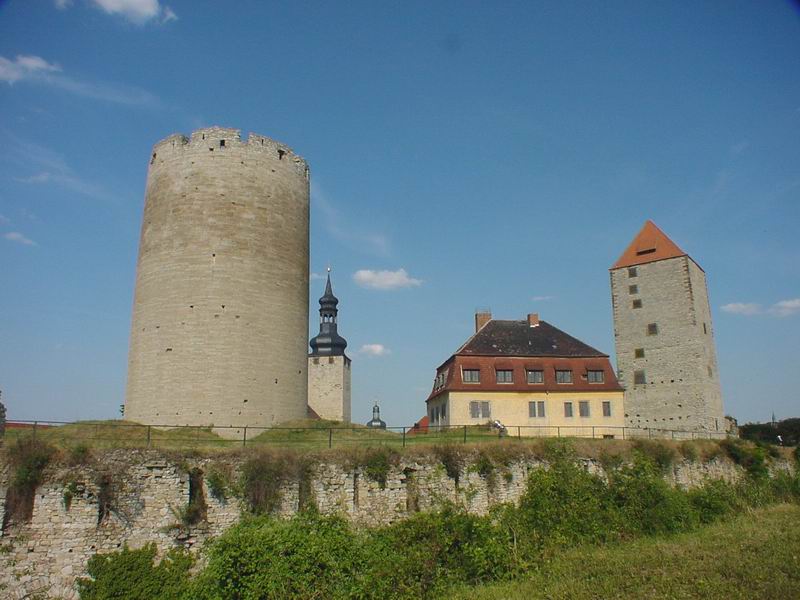
Schloß Allstedt
Schloß Allstedt stands as a remarkable testament to the layered history of medieval Germany, originating as an Ottonian royal palace in the 8th century and evolving through centuries into a fortified noble residence. Located in the municipality of Allstedt in modern-day Germany, this castle complex embodies the architectural and political transformations from the early medieval period through the Baroque era.
The earliest recorded mention of the site dates back to the year 777 AD, with the castle appearing as "urbs Altstediburg" in the Hersfeld tithe register between 880 and 899. This early reference highlights its importance within the royal estate system of the Ottonian dynasty. Originally established as a Königspfalz or royal palace, Schloß Allstedt served as a significant administrative and residential center for the German kings and emperors during the 10th century.
King Heinrich I notably issued official documents from Allstedt in 935, underscoring the site's role as a royal administrative hub. Later, Emperor Otto II confirmed donations from Allstedt to the nearby monastery of Memleben in 979, linking the palace to ecclesiastical institutions and highlighting its religious and political significance.
Medieval transformation and noble stewardship
From around 1150, the castle and its surrounding royal forest were placed under the stewardship of the Vögte of Allstedt, marking a shift from direct royal control to noble custodianship. By the mid-14th century, Schloß Allstedt became the administrative center of the Pfalzgrafschaft Sachsen-Allstedt, a territorial county established between 1348 and 1356 during the reign of Emperor Karl IV.
The castle underwent significant architectural transformation under the noble Querfurt family between 1369 and 1496. They demolished the original Ottonian structures and constructed new wings, curtain walls, and gatehouses, creating much of the complex's current form. These additions reflect the changing needs of defense and residence in the late medieval period, transitioning the site into a fortified noble residence.
Subsequently, ownership transferred to the Ernestine branch of the Wettin dynasty from 1496 to 1526. During this period, the castle was expanded with the addition of the east wing and several auxiliary buildings. This era also witnessed the historic sermon by Thomas Münzer in 1524 on the castle grounds, which criticized arbitrary rule and foreshadowed the social upheavals of the Reformation.
Architectural features and structural evolution
The castle complex is strategically situated on a hill spur approximately 800 meters northeast of Allstedt's historic center. Its layout comprises three distinct sections arranged in a sequence, separated by remnants of deep moats and groups of buildings typical of a fortified medieval estate. To the east lies a large depression interpreted as the site of a former neck ditch, a defensive trench protecting the castle hill.
Excavations in the 1960s uncovered a broad moat, about 12 meters wide, encircling the castle hill and separating it from the surrounding plateau. This moat likely dates back to the Ottonian period, providing physical evidence of the site's early defensive measures.
The oldest surviving structures date from the mid-13th century, including a prominent residential tower near the entrance, built around 1400. This tower served both defensive and domestic functions, combining protection with living quarters.
The 14th and 15th centuries saw the Querfurt family adding substantial constructions such as the north and west wings, which housed the great hall, kitchen, and large chambers essential for noble administration and daily life. Shield walls and gatehouses were also erected to fortify the castle's most vulnerable approaches.
The Ernestine Wettins' expansions included the east wing and various auxiliary buildings, enhancing the castle's residential and ceremonial spaces. The castle chapel was completely rebuilt in 1721 in the Baroque style, reflecting the religious and aesthetic sensibilities of the early 18th century.
In the mid-18th century, a Baroque front palace was initiated to embellish the castle's entrance, although the project was only partially completed. This preservation of medieval structures alongside Baroque additions illustrates the complex's architectural layering.
Later history and modern restoration efforts
Throughout the 16th century, Schloß Allstedt experienced fluctuating ownership, including pledges to the counts of Mansfeld and Stolberg, before returning to the Ernestine Wettins in 1575. These changes reflect the intricate political and financial dynamics of the period.
In the late 17th century, the castle's upper floors were altered to transform it into a more comfortable residential palace. The chapel's 1721 renovation further enhanced its religious function and aesthetic appeal.
By the 20th century, the castle's historic furnishings were removed in 1926. Archaeological and architectural investigations led by Reinhard Schmitt in the late 1980s and early 1990s provided valuable insights into the site's complex evolution.
Since 2022, the Kulturstiftung Sachsen-Anhalt has owned Schloß Allstedt and initiated comprehensive restoration efforts. Certain areas of the castle remain closed to the public to ensure careful conservation. Meanwhile, community engagement continues through initiatives like the local association that has illuminated the castle at night since 1993, enhancing its visibility and cultural presence.
Current structure and visitor experience
The castle's outer bailey, known as the Vorburg, includes the south castle with its east and west wings, a gate tower, and two cavalier houses historically used by officers or senior servants. Adjacent stables supported the estate's functional needs.
Since 2017, this section has been repurposed for commercial and hospitality uses, including a beer garden opened in 2019, offering visitors a blend of historical ambiance and modern amenities.
Surrounded by a landscape of forested hills and agricultural land within a hemiboreal climate, Schloß Allstedt provides a unique blend of historical depth and natural beauty. The castle's architectural evolution from an early medieval royal palace to a fortified noble residence and later a Baroque palace reflects broader trends in German history and castle architecture.
Schloß Allstedt remains a significant cultural landmark, embodying centuries of political, architectural, and social change. Its ongoing restoration and adaptive reuse ensure that this historic site continues to engage and educate visitors while preserving its rich heritage for future generations.
Frequently asked questions (FAQ)
- What are the opening hours of Schloß Allstedt?
- Schloß Allstedt is typically open to visitors from 10 AM to 5 PM, Tuesday through Sunday. It is closed on Mondays, so plan your visit accordingly to explore the castle's rich history and stunning architecture.
- When was Schloß Allstedt built?
- Schloß Allstedt dates back to the 12th century, with its initial construction attributed to the counts of Verden. Over the centuries, it has undergone various renovations, making it a fascinating blend of architectural styles.
- Can I take guided tours of Schloß Allstedt?
- Yes, guided tours are available and highly recommended for an in-depth understanding of the castle's history and architecture. These tours typically run several times a day, so be sure to check the schedule upon your arrival.
- Is Schloß Allstedt accessible for visitors with disabilities?
- Schloß Allstedt strives to be accessible to all visitors, with ramps and designated areas to accommodate those with mobility challenges. However, some historic sections may have limitations, so it's best to inquire at the entrance for specific accessibility information.
- What is the historical significance of Schloß Allstedt?
- Schloß Allstedt played a crucial role in the history of the region, serving as a residence for various noble families and a site for important political events. Its well-preserved structures offer a glimpse into the medieval past of Germany.
- What are the ticket prices for visiting Schloß Allstedt?
- Tickets for adults are priced at €8, while children and students can enter for €4. Family tickets and group discounts may also be available, so check the official website for the most current pricing details.
- When is the best time to visit Schloß Allstedt?
- The best time to visit Schloß Allstedt is during the spring and early autumn months when the weather is pleasant and the castle grounds are in full bloom. Additionally, the castle often hosts events and exhibitions during these seasons, enhancing your experience.
- Are there any nearby attractions to visit along with Schloß Allstedt?
- Yes, there are several attractions nearby, including the charming town of Allstedt with its quaint shops and cafes, as well as the scenic landscapes of the surrounding countryside. Consider visiting the nearby St. George's Church for a taste of local history and architecture.
Information
Website
Visit websiteSources & official resources
Verify the information above using these authoritative references.
Loading map...
Visitor reviews
No reviews yet. Been here? Write the first review and help other travelers!
Write the first reviewVisited this castle? Share your experience
Your review helps other travelers and adds first-hand knowledge to our encyclopedia.