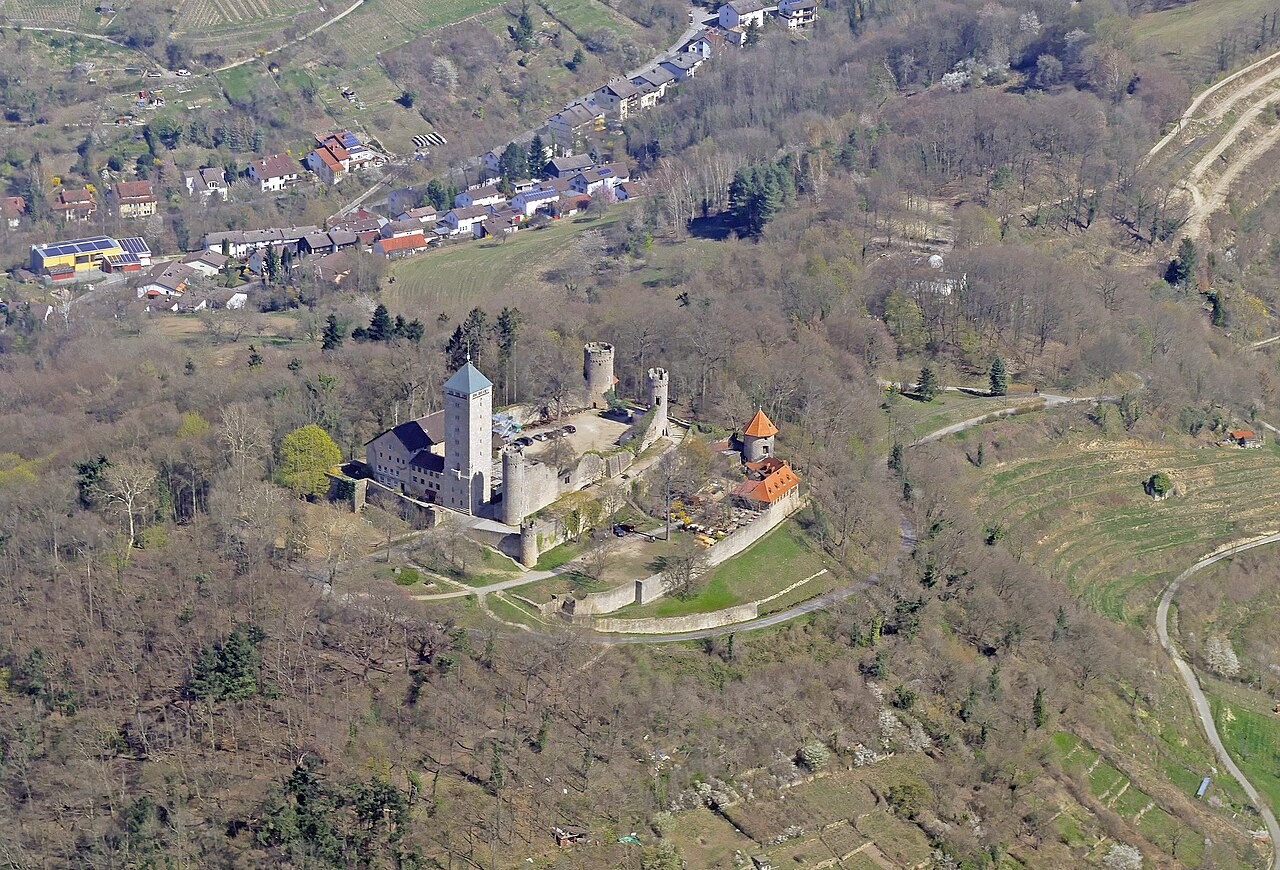
Burg Lindenfels
Burg Lindenfels stands as a significant medieval hill castle ruin nestled near the town of Lindenfels within the historic inner Odenwald region of Germany. This fortress, constructed during the High Medieval period, reflects the architectural and military evolution characteristic of castles built for both defense and noble residence. Its strategic location atop a hill provided commanding views over the surrounding landscape, enabling control over important trade routes and territorial boundaries.
The early history and political significance
The earliest documented mention of the site is found in the Lorsch Chronicle dating between 1077 and 1088, where it was originally known as Schlierburg. By 1123, the castle had been renamed Burg Lindenfels, as evidenced by Count Berthold the Younger adopting the title "Count of Lindenfels." This renaming marks the castle's emergence as a seat of local nobility and a symbol of territorial authority.
Throughout the 12th and 13th centuries, Burg Lindenfels was a contested stronghold among powerful dynasties, including the Staufer and Welf families. Control of the castle signified influence over the region, and its possession was crucial in the broader political and military struggles of the Holy Roman Empire during this era.
In 1277, the castle came under the control of Count Palatine Ludwig II, marking a new chapter in its history. The castle's role as a military fortress and administrative center continued, although its prominence began to decline towards the late 15th century.
Decline and transformation in the early modern period
The early 16th century saw notable events such as the death of Duke Eberhard VI of Württemberg in 1504 while in exile at the castle, highlighting its continued use as a noble residence despite waning military importance. Financial difficulties faced by the Palatine administration led to the dismantling of key defensive structures, including the demolition of the main tower, or bergfried, in 1728. Further dismantling occurred in 1779, reflecting the castle's reduced strategic value.
Following territorial realignments, Burg Lindenfels ceased to be part of the Palatinate in 1802 and was incorporated into the jurisdiction of the Landgraviate of Hesse-Darmstadt, marking the end of its role as a feudal stronghold.
Architectural features and surviving structures
The fortified enclosure and ring wall
The castle is defined by a roughly circular fortified enclosure featuring a polygonal ring wall primarily constructed from durable granite blocks. This robust defensive wall was adapted over centuries, incorporating architectural enhancements to improve its strength and resistance to siege warfare. In areas requiring more refined masonry, such as corners, door frames, and oriel windows, smooth sandstone was skillfully employed, blending functionality with aesthetic detail.
The bergfried and courtyard
At the heart of the castle once stood the bergfried, a tall, round tower that served as a key defensive lookout and last refuge during attacks. Although dismantled in the 18th century, the bergfried's original location is now marked by a reconstructed masonry section, allowing visitors to appreciate its historical prominence within the castle's layout.
Defensive zwingers and outer fortifications
Burg Lindenfels is surrounded by three successive zwingers, or defensive enclosures, that provided layered protection. The innermost zwinger closely follows the ring wall, while the two outer zwingers extend further outward, partially integrating with the medieval town's defensive walls. These outer enclosures date from the 14th century and represent an expansion of the fortress's defensive system, designed to safeguard both the castle and the adjacent settlement from attack.
Additional surviving elements
Among the remaining structures are a former residential building on the eastern side, with its gable end still standing, a tower on the northern edge, and the original castle gate. These remnants provide valuable insights into the castle's internal organization and the daily life of its inhabitants during its period of use.
Legacy and cultural significance
Today, Burg Lindenfels stands as a well-known hill castle ruin that attracts visitors interested in medieval architecture and history. Its preservation as a ruin offers a tangible connection to the region's feudal past and the complex political dynamics of medieval Germany. The castle's layered defensive structures, combined with its historical associations with prominent noble families and shifting territorial allegiances, make it a noteworthy example of medieval fortification and noble residence in the Odenwald.
Visitors can explore the castle grounds to observe the interplay of granite and sandstone masonry, the layout of the zwingers, and the remains of the bergfried, gaining a comprehensive understanding of medieval castle construction and defensive strategy. The site also serves as a cultural landmark reflecting the evolution of castle architecture from the High Medieval through the Early Modern periods.
Frequently asked questions (FAQ)
- When was Burg Lindenfels originally constructed?
- Burg Lindenfels was constructed during the High Medieval period, with the earliest records dating back to between 1077 and 1088.
- What architectural features define Burg Lindenfels?
- The castle is characterized by a roughly circular polygonal ring wall made of granite blocks, three defensive zwingers, and the remains of a tall round bergfried tower.
- Can visitors access the ruins of Burg Lindenfels?
- Yes, visitors can explore the ruins of Burg Lindenfels, including the castle gate, tower remains, and the reconstructed section marking the bergfried's original site.
- Why did Burg Lindenfels decline in importance?
- The castle's military and administrative significance declined from the late 15th century due to changes in political control and financial difficulties leading to dismantling of key structures.
- What is the significance of the castle's location?
- Situated on a hill in the Odenwald region, Burg Lindenfels commanded strategic views over trade routes and territorial boundaries, enhancing its defensive and administrative roles.
Information
Website
Visit websiteSources & official resources
Verify the information above using these authoritative references.
Loading map...
Visitor reviews
No reviews yet. Been here? Write the first review and help other travelers!
Write the first reviewVisited this castle? Share your experience
Your review helps other travelers and adds first-hand knowledge to our encyclopedia.