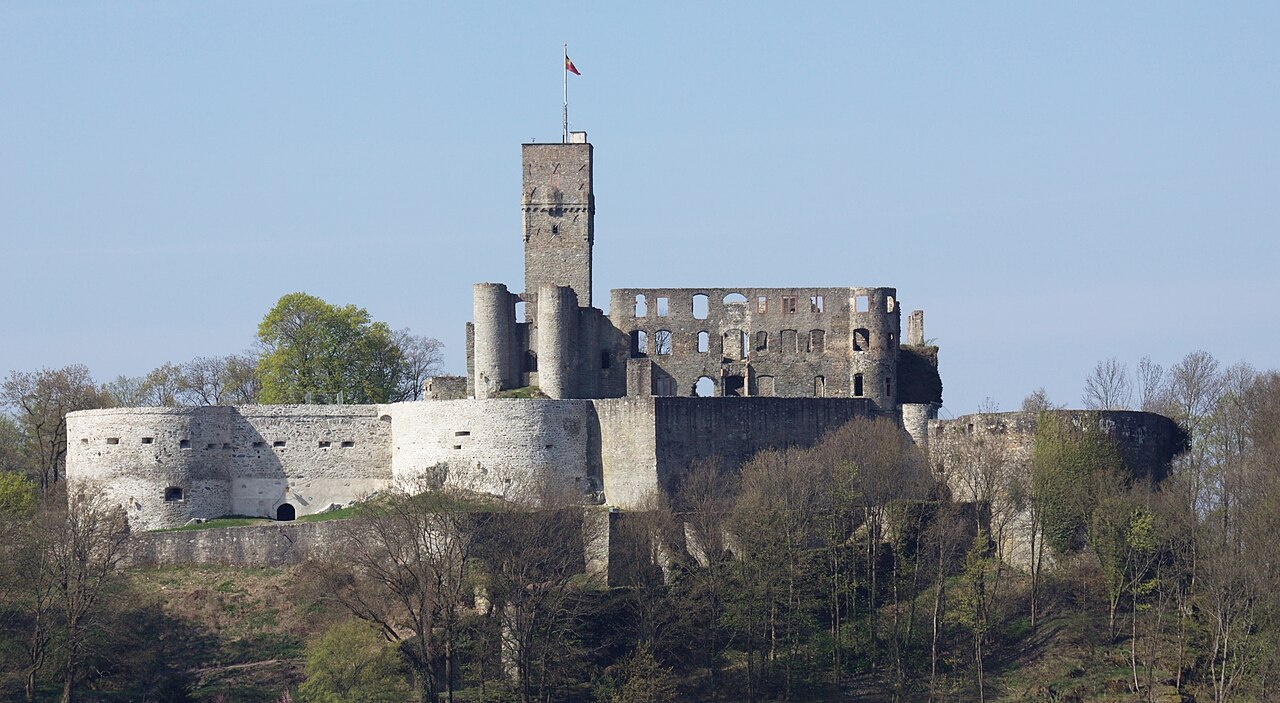
Burg Reifenberg
Burg Reifenberg is a remarkable medieval hill castle located in Schmitten, within the scenic Taunus region of Germany. Its origins likely trace back to the 10th or 11th century, constructed by Germanic nobility as a fortified residence and stronghold. The castle’s first documented mention appears in 1331, linking it closely to the influential Reiffenberger family, who controlled the surrounding lordship and played a significant role in the region's medieval power dynamics.
The Reiffenberger family, possibly related to the nearby Hattstein family, established Burg Reifenberg after their previous stronghold, Burg Hattstein, located just 1.5 kilometers away, became insufficient for their needs. This strategic relocation highlights the evolving demands of noble families in the High to Late Medieval period, reflecting the need for more defensible and spacious residences amid regional conflicts.
Historical context and feudal conflicts
Throughout the 14th century and beyond, Burg Reifenberg was a focal point in a series of feuds and territorial disputes. The castle’s occupants frequently clashed with powerful neighbors such as the Falkensteiners of Königstein, the lords of Kronberg, the free imperial city of Frankfurt, and the Archbishopric of Mainz. These conflicts illustrate the complex political landscape of medieval Germany, where local lordships, imperial cities, and ecclesiastical principalities vied for influence.
A pivotal event was the Hattsteiner Fehde (1428–1435), during which the Reiffenberger allied with Frankfurt and Mainz to attack and capture Burg Hattstein in 1432. The destruction of Burg Hattstein in 1467 marked a significant shift in regional power. Later, in 1560, Friedrich von Reiffenberg of the Weller branch took over Burg Reifenberg, only to burn it down in 1587, an act reflecting the turbulent internal family dynamics and external pressures of the time.
Sieges and reconstruction during the early modern period
The castle’s strategic importance continued into the Thirty Years' War (1618–1648). In 1632, Swedish troops temporarily seized Burg Reifenberg, and it was retaken by imperial forces in 1644. The castle suffered extensive damage during these military actions and was destroyed again in 1646. Following the Peace of Westphalia in 1648, the castle was repaired, demonstrating its continued value as a defensive site.
The extinction of the male Reiffenberger line in Wetterau in 1686 led to the castle’s transfer to Count Johann Lothar Waldbott von Bassenheim. However, the castle’s long history of conflict culminated in its final destruction in 1689 during the War of the Palatine Succession, ending its role as a military fortress.
Architectural features and castle layout
Residential tower
The ruins of Burg Reifenberg reveal a classic medieval hill castle layout, centered around a rectangular residential tower measuring approximately 4.5 by 11 meters and rising to 19 meters in height. The tower’s walls, about 0.8 meters thick, provided substantial protection. Originally, it contained five floors, each offering roughly 17 square meters of living space. Today, the tower is partially exposed to the elements but is protected by a modern metal and glass roof, installed after consultation with monument preservation authorities to safeguard the structure.
A narrow stone spiral staircase within the tower leads visitors to a viewing platform near the top, offering panoramic views of Oberreifenberg and the nearby Großer Feldberg, the highest peak in the Taunus range. This vantage point highlights the castle’s strategic placement overlooking the surrounding landscape.
Bergfried and fortifications
Dominating the castle’s defenses is a massive round bergfried, standing 25 meters tall with a diameter of 8.5 meters. Its walls are exceptionally thick at 2.5 meters, designed to withstand siege weaponry. The entrance to the bergfried is situated about 8 meters above ground level, a common medieval defensive feature that made direct assault difficult and provided a secure refuge during attacks.
Complementing the bergfried is a formidable shield wall with a thickness of up to 4 meters, serving as a robust barrier against frontal assaults. The castle’s fortifications also include remnants of curtain walls and smaller defensive structures scattered across the site, offering insights into the castle’s original extent and defensive strategy.
Preservation and cultural significance
Today, Burg Reifenberg stands as a partially preserved ruin, embodying centuries of medieval and early modern military architecture. The castle’s remains are protected by local preservation groups committed to maintaining its structural integrity and historical value. The installation of a modern protective roof over the residential tower demonstrates a sensitive approach to conservation, balancing preservation with visitor access.
The castle’s history of feuds, sieges, and reconstructions provides a vivid narrative of the region’s turbulent past. Its architectural features, such as the bergfried and shield wall, exemplify typical defensive strategies employed in German hill castles during the High and Late Middle Ages. Visitors today can explore the ruins and appreciate the castle’s commanding views and historical context, making Burg Reifenberg a significant cultural landmark in the Taunus region.
Frequently asked questions (FAQ)
- When was Burg Reifenberg built?
- Burg Reifenberg was likely constructed in the 10th or 11th century, with its first recorded mention in 1331.
- What architectural features can I see at Burg Reifenberg?
- Visitors can see the rectangular residential tower, the tall round bergfried with thick walls, a massive shield wall, and remnants of curtain walls.
- Is there public access to Burg Reifenberg?
- Yes, the castle ruins are accessible to the public during daylight hours and entry is free of charge.
- What historical events affected Burg Reifenberg?
- The castle was involved in the Hattsteiner Fehde, the Thirty Years' War, and was ultimately destroyed during the War of the Palatine Succession in 1689.
- Can I climb the bergfried or the residential tower?
- Visitors can climb the spiral staircase inside the residential tower to reach a viewing platform, but the bergfried is not accessible for climbing due to safety concerns.
Information
Sources & official resources
Verify the information above using these authoritative references.
Loading map...
Visitor reviews
No reviews yet. Been here? Write the first review and help other travelers!
Write the first reviewVisited this castle? Share your experience
Your review helps other travelers and adds first-hand knowledge to our encyclopedia.