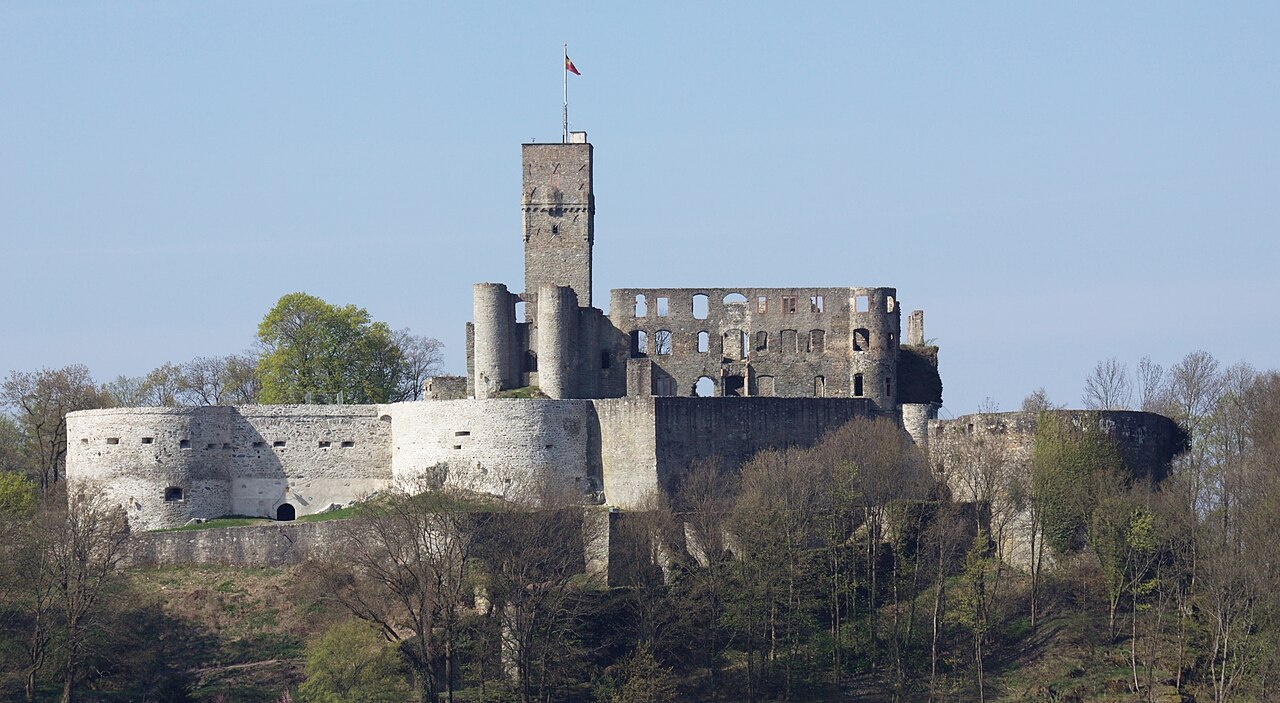
Burg Hattstein
Burg Hattstein stands as a significant medieval hill castle ruin nestled within the municipality of Schmitten im Taunus, Germany. Constructed by Germanic nobility, this castle's origins trace back to at least the 12th century, marking it as an important fortified residence in the historic Taunus region. Its strategic position on the wooded ridge of the Sängelberg hill allowed it to control surrounding valleys and routes, emphasizing its military and administrative role during the Middle Ages.
Early history and foundation
The earliest documented reference to Burg Hattstein dates to 1156, appearing in the foundation charter of the Walsdorf monastery. This document mentions a noble named Guntramus de Hazechenstein, who was likely the castle's lord, establishing the site as a noble residence and regional power center by the mid-12th century. Although the precise construction date is unknown, the castle probably predates nearby Burg Reifenberg, indicating its early significance.
Medieval conflicts and feuds
Throughout the 14th century, the knights of Burg Hattstein gained notoriety as robber barons, engaging in raids that disrupted the peace of the region. This prompted military responses, most notably in 1379 when an alliance from the Free Imperial City of Frankfurt and its allies captured the castle to quell its aggressive activities. Despite pledges to cease hostilities, attacks continued, including a significant assault on the nearby Thron monastery in 1387.
Repeated sieges in 1393 and 1428 failed to capture the castle, reflecting its strong defensive capabilities. However, tensions escalated between Burg Hattstein and the neighboring Burg Reifenberg, culminating in the Hattstein Feud from 1428 to 1435. In 1432, a coalition including the Reifenberg family, Frankfurt, and Kurmainz forces successfully stormed Burg Hattstein. Following this conquest, the castle was administered as a Ganerbschaft (joint inheritance) shared by Frankfurt and Mainz until 1468.
Destruction and partial restoration
Hostilities persisted beyond the mid-15th century. In 1467, Walter von Reifenberg captured the castle and deliberately inflicted damage through slighting to diminish its military value. The following year, the Hattstein family regained control and initiated a restoration campaign lasting about three decades. Despite these efforts, the castle gradually declined and fell into ruin over subsequent centuries.
Ownership and legal disputes
Unlike the allodial ownership of Burg Reifenberg, Burg Hattstein was held as a fief, partially under the suzerainty of the Electorate of Trier. In 1614, Philipp Georg von Hattstein sold his share to Johann Heinrich von Reifenberg, but incomplete payment led to a prolonged legal dispute. This conflict remained unresolved until the extinction of the Hattstein family line in 1767, marking the end of direct noble stewardship.
Architectural features and remains
Burg Hattstein was designed as a spur castle, utilizing the natural contours of the Sängelberg ridge for defense. The most prominent surviving feature is a deep ditch encircling the raised castle site, which would have served as a formidable obstacle to attackers. Remnants of the shield wall—a thick, protective barrier guarding the most exposed side—are still visible, attesting to the castle's robust fortifications.
Access to the ruins is facilitated by trails from the Weiltal valley, Oberreifenberg, and Schmitten. A narrow path traces the outline of the old walls and leads to a small terrace within the former castle grounds. This terrace, situated below the defensive walls, likely functioned as a courtyard or working area rather than a lookout point, as it does not offer panoramic views.
While no detailed architectural elements such as gates, staircases, or inscriptions survive, the earthworks and scattered masonry fragments provide valuable archaeological insight into the castle's layout and defensive strategies. Historical drawings and photographs document the ruins before further decay, preserving knowledge of its structure and appearance.
Cultural and historical significance
Burg Hattstein embodies the turbulent history of medieval nobility in the Taunus region, reflecting the complex interplay of feudal power, regional conflict, and architectural adaptation. Its role as a robber baron stronghold and its involvement in the Hattstein Feud illustrate the challenges of maintaining order in the fragmented political landscape of medieval Germany.
Today, the site offers a tangible connection to this past, with its defensive earthworks and ruins inviting exploration and study. It stands as a testament to medieval military architecture and the enduring legacy of the noble families who shaped the region's history.
Frequently asked questions (FAQ)
- How do I get to Burg Hattstein?
- Burg Hattstein is accessible via hiking trails from the Weiltal valley, Oberreifenberg, and Schmitten. The paths are well-marked and suitable for moderate hikers.
- What is the historical significance of Burg Hattstein?
- Burg Hattstein was a medieval noble residence known for its role in regional feuds, including the notable Hattstein Feud in the 15th century, and as a base for robber barons in the 14th century.
- Are there any visible remains of the castle?
- Yes, visitors can see the deep defensive ditch and fragments of the shield wall that once protected the castle. The site mainly consists of earthworks and scattered masonry.
- When was Burg Hattstein built?
- The castle was first mentioned in 1156, indicating it was built by the mid-12th century, though the exact construction date is uncertain.
- Is there an entrance fee to visit Burg Hattstein?
- Visiting the ruins of Burg Hattstein is free of charge, making it an accessible historical site for all visitors.
Information
Sources & official resources
Verify the information above using these authoritative references.
Loading map...
Visitor reviews
No reviews yet. Been here? Write the first review and help other travelers!
Write the first reviewVisited this castle? Share your experience
Your review helps other travelers and adds first-hand knowledge to our encyclopedia.