Burg Questenberg
Burg Questenberg stands as a significant medieval hill castle ruin located near the village of Questenberg within the municipality of Mansfeld-Südharz in Germany. Constructed in the early 13th century, most likely between 1200 and 1250, it was established by the noble Counts of Beichlingen, a family influential in the region during that period. The castle's strategic hilltop position at approximately 280 meters elevation provided commanding views of the surrounding landscape, essential for defense and surveillance.
Historical background and ownership lineage
The castle first appears in historical documentation in 1349 under the name "hus zcuo Questinberg," with earlier references dating to 1275 mentioning a "Fredericus de Questenberg," a vassal to Count Friedrich von Beichlingen. This indicates that the family named after the castle exerted local influence during the 13th and 14th centuries. Ownership transitioned in the early 14th century when the Counts of Beichlingen transferred their holdings to the Counts of Hohnstein in 1305. Subsequently, in 1383, Landgrave Balthasar of Thuringia acquired Burg Questenberg, integrating it into the Thuringian territorial domain.
Throughout the late medieval period, the castle's lordship was frequently used as pawn collateral by the ruling landgraves of Thuringia, reflecting its political and economic significance. By 1430, the Counts of Stolberg took possession, linking the castle to another prominent noble lineage. Over subsequent centuries, ownership passed through various families, including the Knaut and von Bertkow families, with the Stolberg-Wernigerode branch administering the fief from 1645 onward. Full ownership was secured by the Counts of Stolberg-Roßla in 1718.
The castle's military function concluded in 1633 during regional conflicts involving local militias known as Harz shooters. At that time, it served as quarters for a company under war commissioner Valenthin Rothmehler. Notably, Burg Questenberg was already in ruins during the early 16th century Peasants' War, and by 1649 much of the structure was dilapidated, with only a few subterranean cellars remaining usable.
Architectural features and defensive design
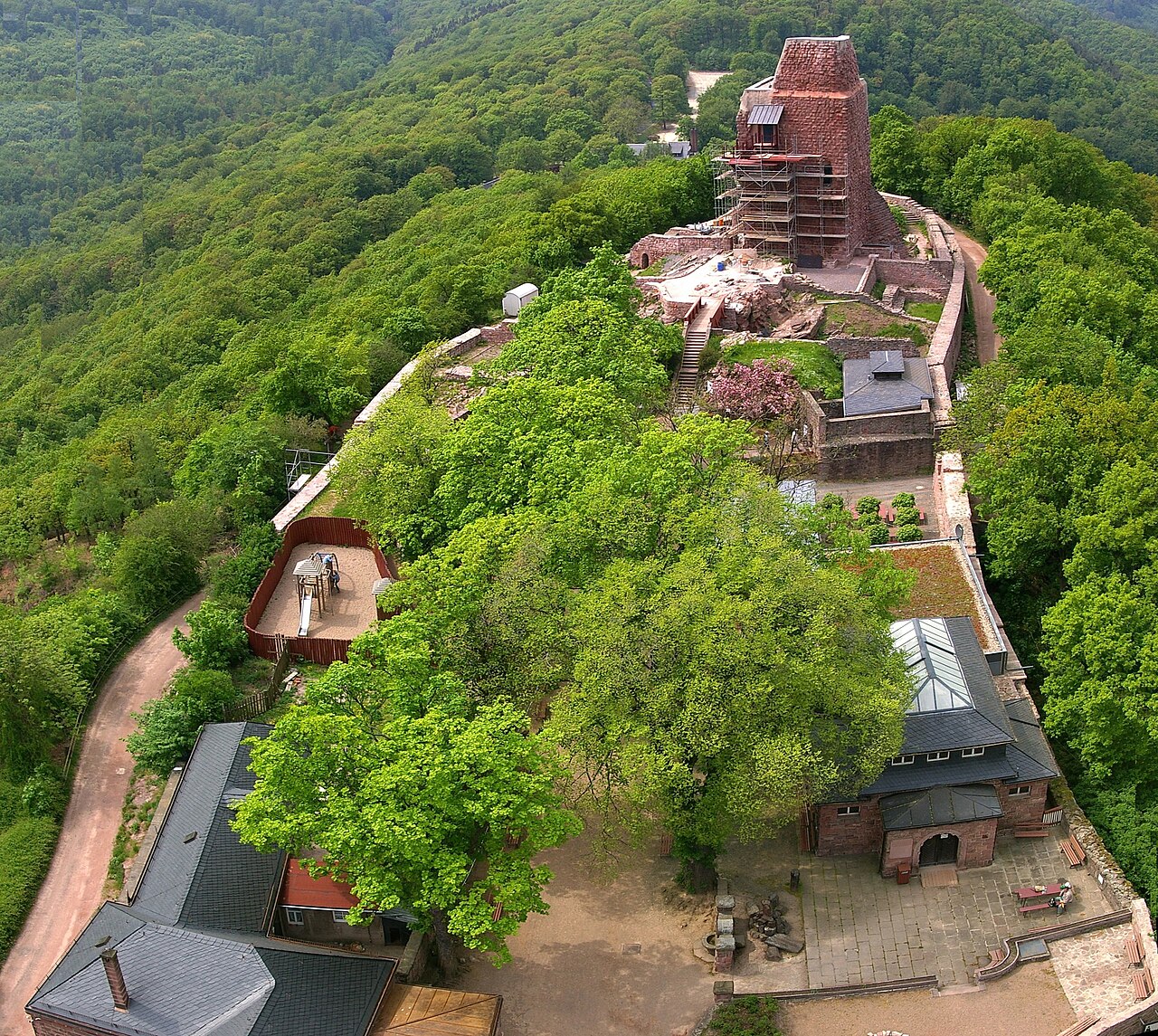
Burg Questenberg was constructed primarily as a hill castle, leveraging its elevated location for defense. The surviving remains provide valuable insight into the castle's original layout and fortifications. A dominant feature is the bergfried, a tall main tower that functioned both as a lookout post and a last-resort stronghold during sieges. This tower remains a prominent symbol of the castle's medieval military architecture.
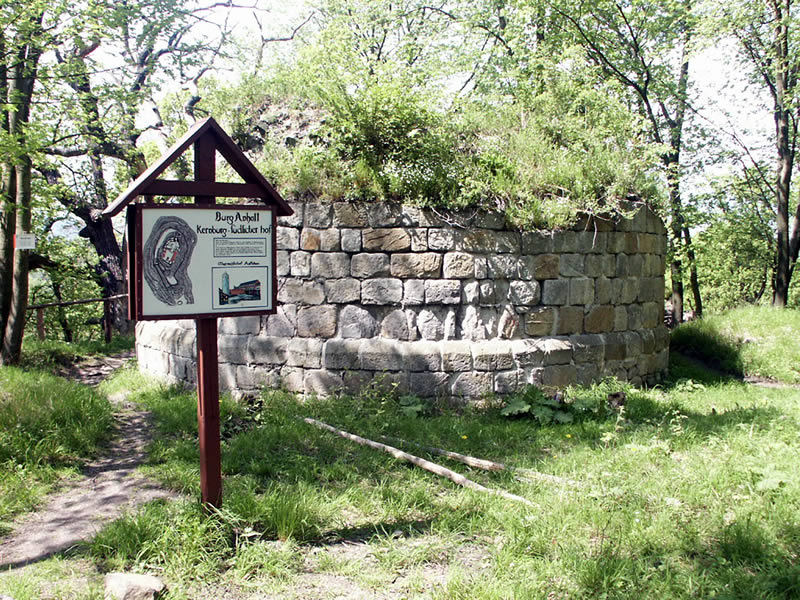
Surrounding the castle is a ring wall, which formed the outer defensive barrier protecting the inner buildings. The wall's construction reflects typical medieval fortification techniques, designed to resist assault and provide a secure enclosure. Two historic cellars survive beneath the site, likely used for storage of provisions and as shelter during attacks or severe weather conditions.
Part of the palas, the main residential building where the lords and their retinue lived, also remains, with one wall still standing. The palas would have contained living quarters, a great hall, and administrative rooms, indicating the castle's dual function as a fortress and noble residence.
Defensive and domestic elements
The castle's design balanced military and domestic needs. The bergfried was not only a defensive structure but also a status symbol, demonstrating the lord's power. The ring wall included battlements and possibly arrow slits for archers. The cellars beneath the castle were crucial for food storage, especially during sieges, ensuring sustainability. The palas provided comfort and administrative space, highlighting the castle's role as a center of local governance.
Decline and preservation efforts
Burg Questenberg's decline began in the early 16th century, notably during the Peasants' War, when it was already noted as being in ruins. By the mid-17th century, the castle was largely abandoned and dilapidated, with only subterranean structures remaining functional. Its military relevance had ended by 1633, and subsequent neglect led to further deterioration.
Since 2013, concerted efforts have aimed to stabilize and protect the remaining ruins. These preservation initiatives seek to prevent further decay and to make the site accessible for educational and cultural purposes. The ruins, although fragmentary, still rest on their original foundations, offering visitors a tangible connection to the medieval past.
Cultural significance and visitor experience
Today, Burg Questenberg is recognized as a valuable cultural heritage site within the region of Mansfeld-Südharz. The ruins provide insight into medieval castle construction, noble life, and regional history. While no decorative inscriptions or elaborate architectural ornamentation have been documented, visual reconstructions based on archaeological evidence help illustrate the castle's former grandeur.
Visitors to the site can explore the remains of the bergfried, the ring wall, and the palas foundations, gaining an understanding of medieval defensive strategies and domestic arrangements. The hilltop location also offers scenic views of the surrounding Harz region, enhancing the historical ambiance.
Access and educational opportunities
Efforts to improve accessibility and provide interpretive materials are ongoing, aiming to enrich the visitor experience. The site serves as an open-air classroom for those interested in medieval architecture, regional history, and archaeology. Guided tours and informational signage help contextualize the ruins within broader historical narratives.
Frequently asked questions (FAQ)
- When was Burg Questenberg built and by whom?
- Burg Questenberg was constructed in the early 13th century, likely between 1200 and 1250, by the Counts of Beichlingen, a noble family influential in the region.
- What remains can visitors see at Burg Questenberg?
- Visitors can see the ruins of the bergfried, ring wall, two historic cellars, and part of the palas, which provide insight into the castle's medieval defensive and residential structures.
- Why is Burg Questenberg historically significant?
- The castle is significant due to its association with prominent noble families like the Counts of Beichlingen, Hohnstein, and Stolberg, and its role in regional medieval politics and conflicts.
- Is Burg Questenberg accessible to visitors today?
- Yes, the ruins are accessible, and preservation efforts since 2013 aim to stabilize the site and improve visitor access and educational opportunities.
- What architectural style does Burg Questenberg represent?
- Burg Questenberg is a typical example of a high medieval hill castle, focusing on defensive features like a bergfried and ring wall, rather than elaborate architectural styles.
Information
Loading map...
Visitor reviews
No reviews yet. Been here? Write the first review and help other travelers!
Write the first reviewVisited this castle? Share your experience
Your review helps other travelers and adds first-hand knowledge to our encyclopedia.