Burg Bodenstein
Burg Bodenstein stands as a remarkable example of a medieval hill castle located near the village of Wintzingerode in the municipality of Leinefelde-Worbis, Germany. Its strategic position atop a hill in the Ohmgebirge mountain range highlights its historical military significance, serving as a fortress and noble residence through centuries of European history. The castle's origins trace back to the early medieval period, with its initial establishment likely by Germanic peoples to mark the border between the Saxons and Franks.
The castle's importance was solidified during the reign of King Henry I in the 10th century, who expanded the fortifications to protect the region from Hungarian incursions. This early phase set the foundation for Burg Bodenstein's role within the broader network of defensive sites in medieval Germany.
Historical development and ownership
During the Salian dynasty under Emperor Henry IV, Burg Bodenstein came under the control of Count Otto of Northeim, a prominent Saxon noble connected to the Liudolfing dynasty. This association marked the castle as a significant seat of power, with the emergence of the noble family von Bodenstein, likely descended from the Northeim lineage and named after the castle itself.
The castle's ownership fluctuated in the late Middle Ages. In 1275, it was acquired by the Welf dynasty, a powerful noble family in the region. Subsequently, in 1293, the castle was sold to the Counts of Honstein. Control of Burg Bodenstein shifted multiple times between these families, including a redemption in 1322, until it was sold in 1337 to Hans von Wintzingerode and his associates. Despite these changes, the Welfs maintained overlordship until the late 16th century.
By 1448, the von Wintzingerode family had consolidated full ownership, holding the castle until 1945. In 1530, they introduced the Protestant Reformation at Burg Bodenstein, sparking conflicts with the neighboring Counts of Honstein and the Catholic Archbishopric of Mainz. The castle endured significant damage during the Peasants’ War of 1525, an uprising led by the radical preacher Thomas Müntzer. Following this destruction, the castle was rebuilt incorporating architectural styles contemporary to the mid-16th century.
The castle's turbulent history continued with a siege in 1574 during a family feud intertwined with wider political disputes. The lord of the castle, Berthold XI von Wintzingerode, was captured and executed in 1575. The extinction of the Honstein line in 1593 allowed the Welfs to retain overlordship, which protected Burg Bodenstein from the Counter-Reformation measures enforced elsewhere. The castle evolved into a religious center for Evangelicals in the Lower Eichsfeld region, reinforced by the construction of a chapel in 1668.
Architectural features and renovations
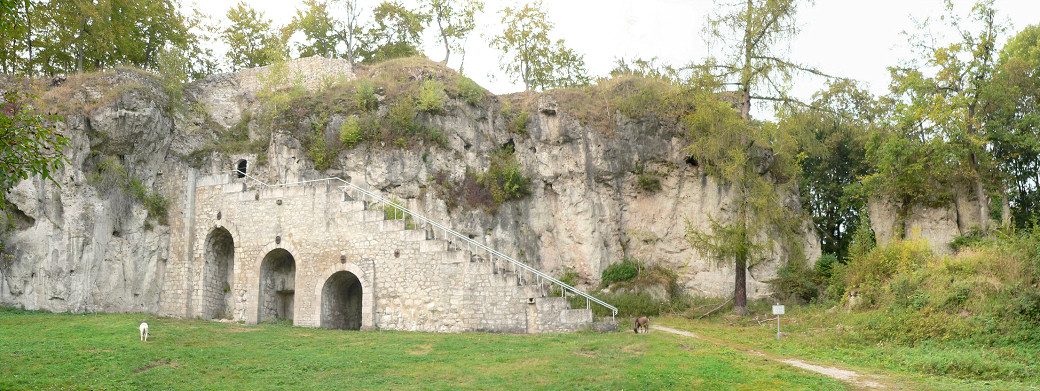
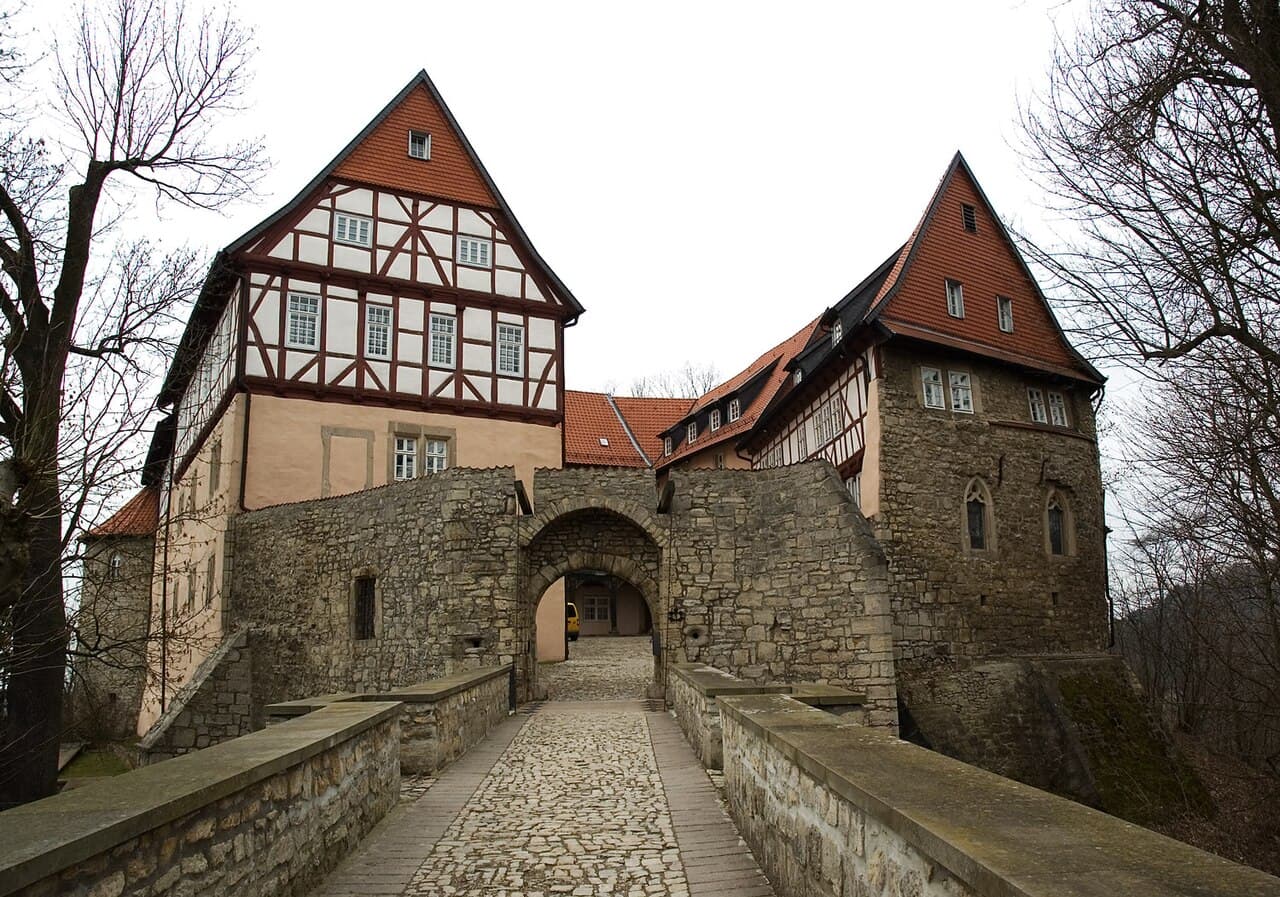
Burg Bodenstein is a well-preserved example of a hill castle primarily constructed from natural stone, reflecting the building techniques typical of its significant reconstruction after the Peasants’ War. The castle complex is organized around a central courtyard, or burghof, which forms the heart of the site.
The chapel added in 1668 serves as a key architectural and cultural feature. It includes a Herrenempore, a noble family gallery, and is adorned with stained-glass windows created around 1835 by the renowned glass artist Heinrich Friedrich Wedemeyer from Göttingen. Inside the chapel, visitors can find a unique baptismal angel, a symbolic figure representing protection during baptism ceremonies.
The interior spaces historically housed an impressive collection of artworks, porcelain, finely crafted furniture, and miniature portraits. These treasures originated from the Brandenburg-Schwedt inheritance and were augmented by gifts linked to the Napoleonic era, including items once owned by Queen Marie-Antoinette.
Family crypt and cemetery
Below the castle lies the von Wintzingerode family crypt, established in 1823 by Georg Ernst Levin von Wintzingerode. Despite suffering damage from vandalism and storms, restoration efforts have preserved this small cemetery, maintaining a tangible connection to the castle's long-standing noble lineage.
Religious and cultural significance
Burg Bodenstein holds a significant place in religious history, particularly as a center for Protestant Evangelicalism in the region. Its adoption of the Reformation in 1530 marked a turning point, leading to conflicts but also establishing the castle as a spiritual hub. During the Nazi period, the castle was notable for its association with the Confessing Church, a resistance movement opposing Nazi interference in church affairs.
After World War II, stewardship of Burg Bodenstein passed to the Evangelical Church of Central Germany, which repurposed the castle as a retreat and cultural venue. This transition preserved the castle's historical and religious heritage while adapting it for contemporary use.
Political context and ownership changes
The castle's political affiliations shifted over the centuries, reflecting broader European changes. In 1803, Burg Bodenstein came under Prussian control. It was incorporated into the Kingdom of Westphalia between 1807 and 1813 before returning to Prussian rule following the Congress of Vienna. The von Wintzingerode family retained ownership until 1945, when post-war land reforms led to their expulsion.
During the late 18th century, Philippine of Hesse-Kassel resided at the castle and entered a morganatic marriage with Georg Ernst Levin von Wintzingerode in 1794. This period saw the accumulation of a significant collection of art and cultural artifacts, enhancing the castle's status as a cultural landmark.
Current status and preservation
Today, Burg Bodenstein is well-preserved and maintained by the Evangelical Church, which uses the castle for cultural events, retreats, and family gatherings. The castle's architectural fabric, including its courtyard, chapel, and family crypt, remains intact, offering visitors a vivid glimpse into its layered history from a medieval stronghold to a modern cultural venue.
Frequently asked questions (FAQ)
- How do I get to Burg Bodenstein?
- Burg Bodenstein is located near the village of Wintzingerode in Leinefelde-Worbis, Thuringia, Germany. Visitors can reach the castle by regional roads, with the nearest larger towns providing public transport connections.
- What is the historical significance of Burg Bodenstein?
- Burg Bodenstein has a rich history dating back to the 10th century, serving as a strategic military site and noble residence. It played a key role during the Peasants' War and the Protestant Reformation, reflecting the region's religious and political changes.
- Can I visit the chapel at Burg Bodenstein?
- Yes, the castle chapel built in 1668 is accessible to visitors. It features a noble family gallery and stained-glass windows by Heinrich Friedrich Wedemeyer, offering insight into the castle's religious heritage.
- Is Burg Bodenstein accessible for visitors with mobility issues?
- Due to its hilltop location and historic architecture, some areas of Burg Bodenstein may be challenging for visitors with mobility impairments. It is advisable to contact the managing entity for detailed accessibility information before planning a visit.
- When is the best time to visit Burg Bodenstein?
- The castle is best visited during the warmer months, from late spring to early autumn, when the surrounding landscape is most inviting and cultural events are often held.
Photo gallery

Information
Sources & official resources
Verify the information above using these authoritative references.
Loading map...
Visitor reviews
No reviews yet. Been here? Write the first review and help other travelers!
Write the first reviewVisited this castle? Share your experience
Your review helps other travelers and adds first-hand knowledge to our encyclopedia.