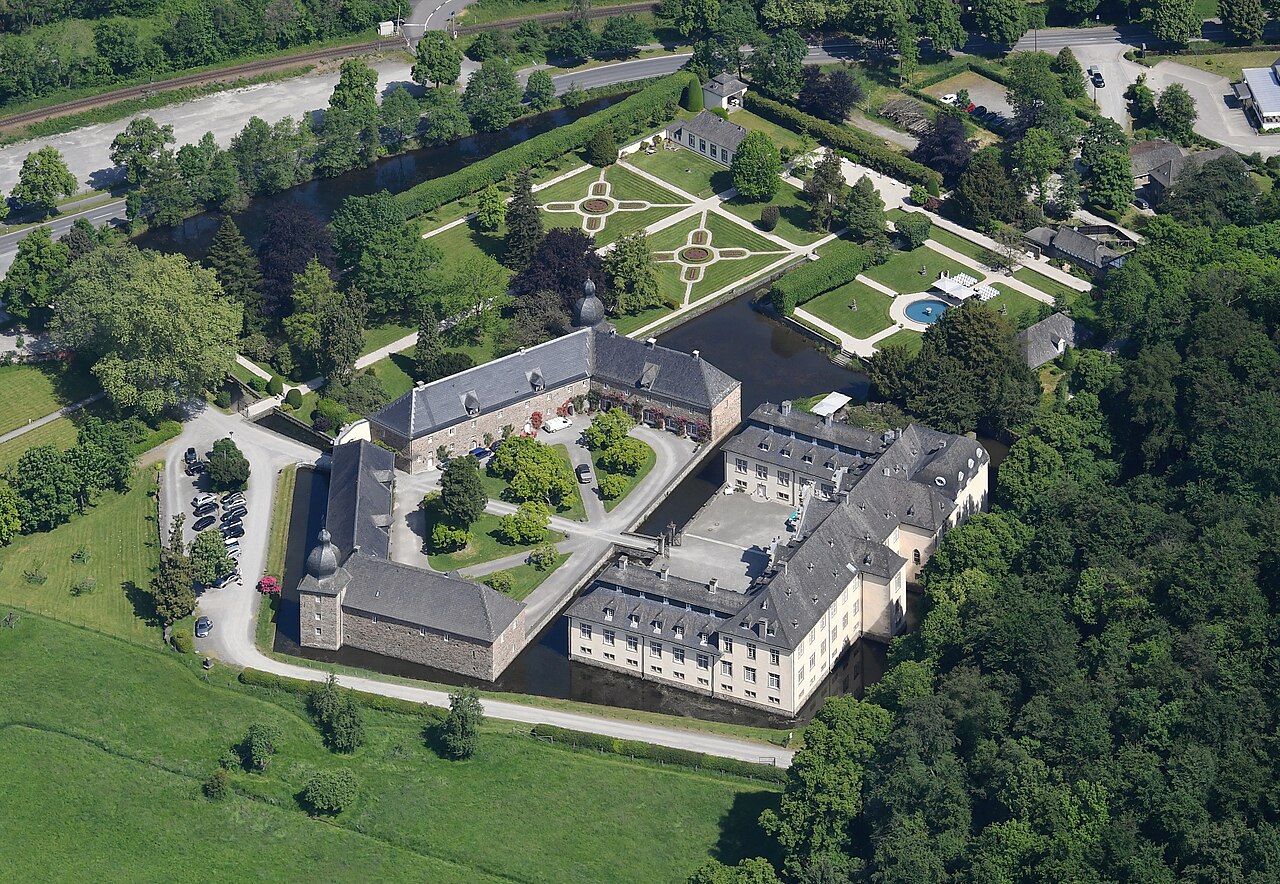
Burg Honrath
Burg Honrath is a remarkable example of a hill castle located in the village of Honrath, within the city of Lohmar, Germany. Its origins trace back to the early 12th century, making it a significant medieval stronghold in the region. The castle stands prominently on a gently sloping ridge at approximately 162 meters above sea level, offering strategic views over the Aggertal valley. This advantageous position was crucial for defense and surveillance during its active use in the Middle Ages.
Early history and noble ownership
The earliest documented mention of Burg Honrath dates to 1117, when a noble named God(e)fried donated his allodium, known as "Hagenroth," to the Siegburg monastery. This donation marks the castle's first appearance in surviving historical records and suggests the site's importance as a landed estate even at that time. Throughout the high medieval period, the castle passed through the hands of several noble families, including Theoderich von Hengebach and Arnold von Hückeswagen, reflecting the complex feudal landscape of the region.
From 1259, the castle was under the possession of the Counts of Sayn zu Blankenberg, followed by the Lords of Loen-Heinsberg and the Counts of Berg in 1363. This sequence of ownership illustrates the castle's continued strategic and residential value among the regional aristocracy. By 1393, the property was transferred to the Collegiate Church of Düsseldorf, indicating a shift towards ecclesiastical control during the late medieval period.
16th-century developments and notable figures
During the 16th century, Burg Honrath came under the control of Joist Lüninck, a figure remembered in local lore for his indulgent lifestyle. A popular anecdote recounts how a local woman cleverly secured marriage to Lüninck by offering him Malvasier wine from the castle's cellar, a beverage that subsequently gained renown as a prized cellar reserve. This story highlights the castle's role not only as a military and residential site but also as a center of local culture and tradition.
The castle's ownership continued to evolve, passing to the Lords of Proff zu Menden in the early 1700s and later to the Barons of La Valette St. George in 1825. Since 1930, Burg Honrath has been privately owned by non-noble proprietors, reflecting broader societal changes in property ownership and aristocratic influence in Germany.
Architectural features and preservation
Burg Honrath today is primarily recognized for its well-preserved castle house dating from the 16th century, constructed atop much older Romanesque foundations. The castle's robust rubble stone masonry imparts a fortified appearance, particularly evident in its surviving towers. Key remnants of the earlier Romanesque structure include barrel-vaulted cellars and sections of the eastern wall of the estate's economic buildings, showcasing medieval construction techniques that have endured through centuries.
Adjacent to the castle stands the original Romanesque church tower, which historically served dual purposes as a residential space and a defensive stronghold. This tower was later adapted into a freestanding bergfried, a main fortified tower characteristic of medieval castles. The bergfried was connected to the main residential building by an upper-level arched gallery, integrating defensive and domestic functions seamlessly.
The castle's layout emphasizes defense with its sturdy walls and strategically placed towers, designed to maximize protection against potential attackers. Despite its fortified nature, Burg Honrath has remained habitable and continues to be a private residence. Public access is limited, but the castle can be viewed from nearby roads, and its grounds include a garden and agricultural buildings where local products are sold, allowing some interaction with visitors.
Religious heritage and local significance
Close to Burg Honrath is the village church of St. Margaretha, one of the oldest structures in Honrath. Originally a Catholic church, it converted to Protestantism in the 17th century, mirroring the religious transformations occurring throughout Germany during the Reformation. The church's patronage was assigned in 1209 to a Benedictine nunnery in Gräfrath near Solingen, linking the site to important regional religious institutions.
Together, Burg Honrath and St. Margaretha church form the oldest architectural complex in the village, embodying both the secular and spiritual history of the area. The castle's endurance as a fortified residence and the church's evolving religious role highlight the intertwined nature of medieval nobility and ecclesiastical power in shaping local communities.
Cultural legacy and modern status
Today, Burg Honrath stands as a testament to centuries of German medieval and early modern history. Its preservation offers valuable insights into castle architecture, feudal society, and regional developments in North Rhine-Westphalia. The castle's blend of Romanesque foundations and 16th-century Renaissance-era structures illustrates the architectural evolution typical of many German castles adapting to changing defensive needs and residential comforts.
Although privately owned and not generally open to the public, Burg Honrath remains an important cultural monument. Its presence enriches the historical landscape of Lohmar and serves as a focal point for local heritage. Visitors to the area can appreciate the castle's exterior views and explore the surrounding village, which retains elements of its medieval past.
Frequently asked questions (FAQ)
- How do I visit Burg Honrath?
- Burg Honrath is privately owned and not generally open to the public. Visitors can view the castle from nearby public roads and explore the surrounding village of Honrath.
- What is the historical significance of Burg Honrath?
- Burg Honrath is significant for its early medieval origins, continuous noble ownership, and well-preserved Romanesque and 16th-century architecture, reflecting regional history.
- When was Burg Honrath built?
- The castle dates back to the early 12th century, with its first documented mention in 1117.
- Can I visit the adjacent St. Margaretha church?
- Yes, the St. Margaretha church near Burg Honrath is one of the oldest buildings in the village and may be accessible to visitors depending on local parish schedules.
- Why is the bergfried important?
- The bergfried is a key defensive tower typical of medieval castles, serving as a last refuge and symbol of feudal authority. Burg Honrath's bergfried uniquely connects to the main building via an arched gallery.
Information
Sources & official resources
Verify the information above using these authoritative references.
Loading map...
Visitor reviews
No reviews yet. Been here? Write the first review and help other travelers!
Write the first reviewVisited this castle? Share your experience
Your review helps other travelers and adds first-hand knowledge to our encyclopedia.