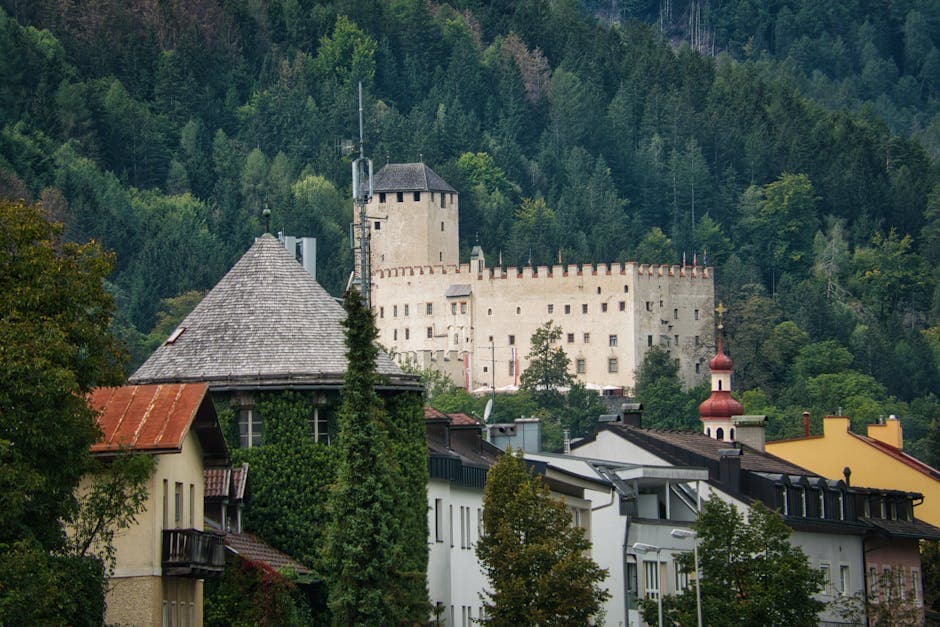
Burg Heidenreichstein
Burg Heidenreichstein stands as a remarkable example of a high medieval hill castle in Lower Austria, perched at an elevation of 556 metres above sea level. Its origins trace back to the 12th century, making it one of the region's enduring medieval fortifications. The castle's strategic location on a rocky rise was chosen to oversee and protect two vital trade routes leading to Bohemia, underscoring its importance in medieval commerce and defense.
The founding and early history
The castle was founded circa 1180–1190 by the burgrave Heidenreich, a vassal of the Counts of Raabs and related to the influential Kuenring family. The earliest documented mention dates to 1205, when Heidenreich's brother, Otto, adopted the name Otto von Heidenreichstein. Initially, the castle belonged to the Counts of Raabs before passing to the Hirschberg family and later to the Kuenring brothers as vassals. This succession of ownership reflects the complex feudal relationships of the period.
Medieval conflicts and expansions
During the turbulent Hussite Wars (1425–1431), Burg Heidenreichstein was besieged by Hussite forces and rebellious peasants but withstood capture, demonstrating its robust fortifications. From the 15th century onward, the castle functioned as a seat of the regional court, emphasizing its administrative significance.
In the early 16th century, under the stewardship of Wilhelm von Puchheim, who served as Landmarschall of Austria and distinguished himself in the 1532 wars against the Turks, the castle saw notable enhancements. His son, Friedrich Christoph von Puchheim, added the Renaissance-style outer bailey and gatehouse around 1540, reflecting the period's architectural shift towards greater residential comfort and representational grandeur.

Photo by Regan Dsouza
Ownership changes and renovations
The Puchheim family retained possession until 1636, when financial difficulties necessitated the sale to Siegmund Adam von Traun. Subsequent owners included the Zinzendorf, Khuen von Belasy, and Volkra families. In the mid-17th century, Margaretha Marchesa degli Obbizzi, née Countess Pálffy, incorporated the castle into a fideicommissum for the Pálffy family, who maintained ownership until 1947.
At the turn of the 20th century, the Pálffy family undertook extensive renovations, introducing historicist interior elements that harmonized contemporary tastes with the castle's medieval heritage. After the Pálffy line ended, the castle passed to Count Rudolf van der Straten-Ponthoz, notable as an adjutant to Archduke Franz Ferdinand and director of Vienna's Spanish Riding School. Through marriage, the property came under the ownership of the Kinsky family in 1961, who continue to hold it.
Architectural features and defensive elements
Burg Heidenreichstein is strategically situated on a rocky outcrop, naturally fortified by water on three sides. The castle is surrounded by a defensive pond to the south, the Romau stream to the east, and moats to the north and west, some partially filled today. This integration of natural and man-made defenses exemplifies medieval military architecture.
Access is granted through two drawbridges leading to gates designed in the Renaissance style. The castle's perimeter is reinforced by round corner towers topped with pointed conical roofs. The largest tower features a projecting roof that shelters the battlement walkway, providing defenders with a commanding vantage point.
The centerpiece is the central bergfried, the oldest part of the castle, dating from circa 1160. This imposing tower stands 42 meters tall with walls up to 4.5 meters thick, serving as a formidable stronghold and lookout. Its substantial construction predates much of the surrounding complex.
The castle's exterior walls are notably austere above the waterline, with very few windows to enhance defense. Inside, the great hall on the first floor measures approximately 27 meters in length and originally soared to 12 meters in height. Its shape resembles a ship's hull, a distinctive architectural feature.
The roof structure is predominantly Gothic, constructed from hewn beams joined by intricately carved wooden pegs and covered with wooden shingles. The interior furnishings span several periods, including Gothic tables and chests. A particularly notable artifact is a table crafted from a single piece of maple wood estimated to be about a thousand years old. The castle also houses Austria's oldest wooden cabinet, a testament to its rich heritage.
Baroque polychrome tiled stoves from the mid-17th century remain in situ, alongside preserved armor and weapons. Remnants of a chapel survive within the complex, and a secret passage is built into the bergfried's wall, hinting at concealed movement within the castle.
Renaissance additions and residential comfort
The Renaissance outer bailey and gatehouse, constructed in the mid-16th century, signify a transition toward greater residential comfort and aesthetic refinement. Defensive walls were strengthened with additional towers, and an arcaded gallery with cross-rib vaulting was built near the medieval smoke kitchen in the courtyard, blending functionality with architectural elegance.
Legacy and preservation
Remarkably, Burg Heidenreichstein escaped plunder and destruction during the upheavals of 1945, remaining one of the few noble residences in the Waldviertel region continuously inhabited. Its historical and architectural significance was nationally recognized in 1957 when it featured on an Austrian postage stamp celebrating architectural monuments.
Today, the castle offers a well-preserved glimpse into centuries of medieval and Renaissance architecture, combining formidable defensive structures with refined residential spaces. Its enduring presence and continuous habitation make it a vital cultural heritage site in Austria.
Frequently asked questions (FAQ)
- How do I get to Burg Heidenreichstein?
- Burg Heidenreichstein is easily accessible by car and public transport. If you're traveling by car, you can follow the A22 motorway and take the exit for Heidenreichstein. Public transport options include local buses that connect to nearby train stations.
- What is the historical significance of Burg Heidenreichstein?
- Burg Heidenreichstein dates back to the 12th century and is notable for its well-preserved medieval architecture. It served as a strategic fortress and residence for various noble families throughout the centuries. The castle is a testament to the region's rich history and has been an important landmark in Austrian heritage.
- When was Burg Heidenreichstein built?
- Construction of Burg Heidenreichstein began in the 12th century, with significant expansions and renovations occurring over the following centuries. The castle's architecture reflects various styles due to the periods of construction and modification. Today, it showcases a blend of medieval and Renaissance elements.
- Can I visit Burg Heidenreichstein year-round?
- Yes, Burg Heidenreichstein is open to visitors throughout the year, although some areas may have limited access during the winter months. It's advisable to check the official website for specific seasonal opening hours and any special events that may be taking place. Guided tours are available and provide a deeper insight into the castle's history.
- Why is Burg Heidenreichstein a popular tourist attraction?
- Burg Heidenreichstein is popular for its stunning architecture, historical significance, and picturesque surroundings. Visitors are drawn to the castle's rich history and the opportunity to explore its beautifully restored rooms. Additionally, the scenic views from the castle provide excellent photo opportunities and a chance to appreciate the beauty of the Austrian countryside.
- Is it possible to host events at Burg Heidenreichstein?
- Yes, Burg Heidenreichstein offers facilities for hosting various events, including weddings, corporate gatherings, and cultural activities. The castle's unique ambiance and historical charm make it an ideal venue. Interested parties should contact the castle management for more information on availability and booking.
- What are the ticket prices for visiting Burg Heidenreichstein?
- Ticket prices for Burg Heidenreichstein vary depending on the type of tour and whether you are an adult, child, or senior. Generally, adult tickets are reasonably priced, while discounts are often available for families and groups. It is recommended to check the official website for the most current pricing and any special promotions.
- What are the opening hours for Burg Heidenreichstein?
- Burg Heidenreichstein typically opens to visitors from 10 AM to 5 PM, though these hours may vary seasonally. During peak tourist season, the castle may offer extended hours to accommodate more visitors. Always check the castle’s official website or contact them directly for the most accurate and up-to-date information regarding opening hours.
- Are there any nearby attractions to visit while at Burg Heidenreichstein?
- Yes, there are several nearby attractions worth exploring, including scenic hiking trails and picturesque villages in the surrounding area. The nearby town of Heidenreichstein offers charming shops and local cuisine. Additionally, other historical sites and natural parks can be easily accessed for a full day of exploration.
Photo gallery

Photo by Joerg Hartmann


Information
Sources & official resources
Verify the information above using these authoritative references.
Loading map...
Visitor reviews
No reviews yet. Been here? Write the first review and help other travelers!
Write the first reviewVisited this castle? Share your experience
Your review helps other travelers and adds first-hand knowledge to our encyclopedia.


