Burg Freundsberg
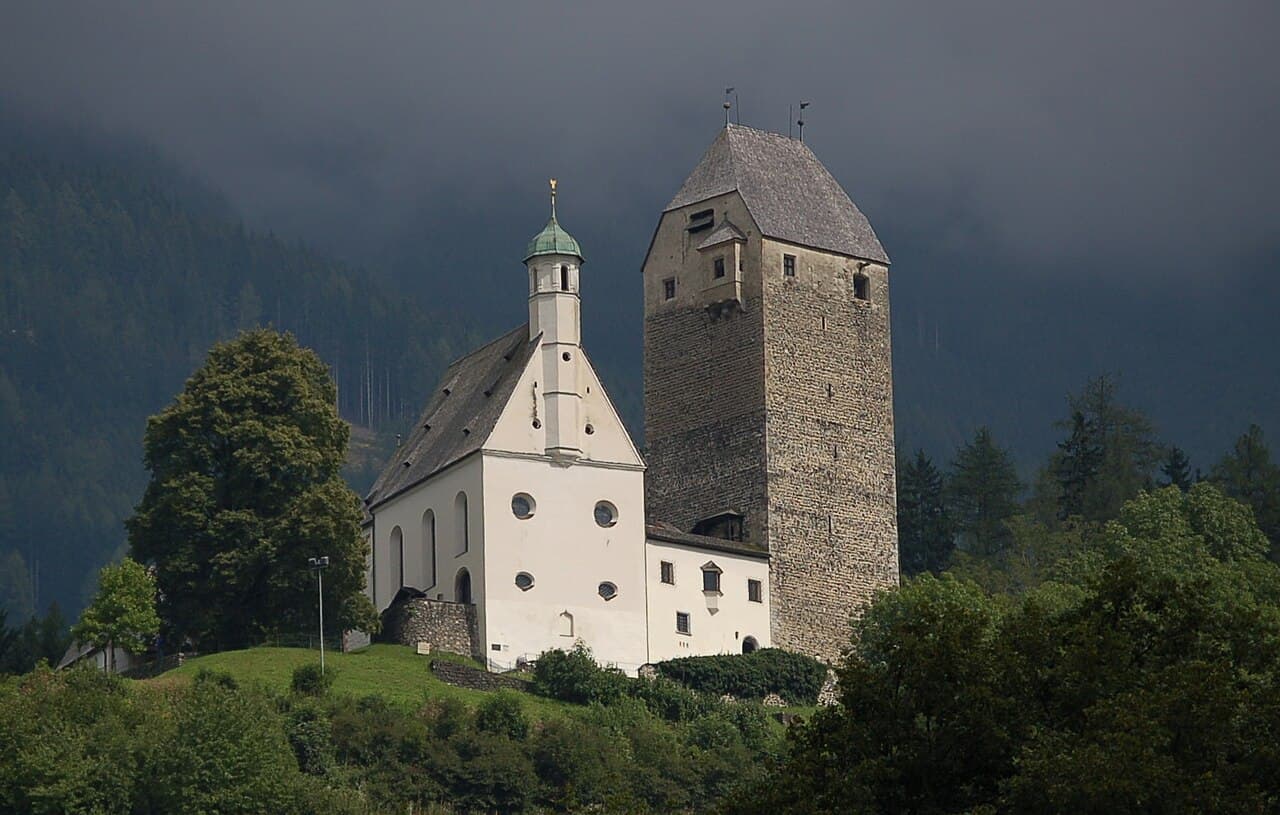
Burg Freundsberg is a remarkable high medieval hill castle located in Schwaz, Tirol, Austria. Built around 1150 by the aristocratic Freundsberg family, it stands prominently on a steep hill approximately 170 meters above the Inn valley. This strategic location allowed the castle to serve as a defensive stronghold and a symbol of noble authority in the region. The castle originally consisted of a single five-story residential tower or keep, which remains well preserved today and forms the heart of the complex.
The initial construction phase included the erection of the keep, rising to about 28 meters in height, showcasing robust medieval masonry typical of the 12th century. Shortly after, in 1176, the castle chapel dedicated to the Holy Cross and Saint Mary was consecrated by Archbishop Conrad of Mainz, a papal legate. This chapel is among the earliest religious structures within the castle grounds, reflecting the importance of faith and the church's influence during the high medieval period.
Architectural features and structural evolution
The original keep and residential tower
The castle's central feature is its original five-story keep, which was designed as a fortified residence rather than purely a military fortification. The tower's thick walls and height provided defense and surveillance over the surrounding valley. Inside, fragments of original frescoes remain on the interior walls, offering valuable insights into medieval artistic decoration and the lifestyle of the noble inhabitants. The keep's robust construction has allowed it to survive centuries of change and conflict.
Chapels and religious buildings
The 1176 chapel dedicated to the Holy Cross and Saint Mary was a key religious space within the castle. It was later complemented by the construction of a late Renaissance court church between 1634 and 1637, which introduced Renaissance architectural elements to the castle complex. This addition reflects the evolving religious practices and aesthetic preferences of the castle's owners over time.
Fortifications and defensive structures
While the original keep was the primary defensive structure, the castle's position on a steep hill naturally enhanced its defensibility. The surrounding walls, gates, and battlements were adapted and rebuilt in various phases, especially during the ownership of Archduke Sigismund of Austria in the late 15th century. His renovations, including renaming the castle Sigmundsruh, signified a shift in the castle's role from a purely military fortress to a more residential and administrative center.
Historical significance and ownership changes
The freundsberg family and early history
The Freundsberg family established the castle in the mid-12th century, using it as their noble seat. The castle's strategic placement allowed control over the important trade routes and the rich silver mining region around Schwaz, which was one of the most significant mining centers in Europe during the Middle Ages. The family's influence is evident in the castle's original design and the early chapel's consecration.
Archduke sigismund's renovations
In 1467, the castle was sold to Archduke Sigismund of Austria, a prominent ruler of the Tyrol region. He undertook substantial rebuilding efforts, modernizing the castle and temporarily renaming it Sigmundsruh or Siegmundsfried. These renovations included enhancements to the living quarters and fortifications, reflecting Renaissance influences beginning to permeate the region. Sigismund's ownership marked a crucial transformation in the castle's function and architectural style.
Later ownership and municipal stewardship
Following Sigismund's tenure, the castle passed through various noble hands until the early 19th century. In 1812, the municipality of Schwaz acquired Burg Freundsberg, recognizing its cultural and historical value. Restoration efforts began in earnest in 1966 to preserve the castle's structural integrity and historical features. Today, the castle is owned by the municipality and serves as a cultural landmark.
Museum and cultural heritage
Since 1948, the castle's keep has housed a local history museum that documents the development of Schwaz and the vital role of the silver mining industry in the region. The museum's exhibits provide visitors with a comprehensive understanding of the town's economic and social history, linking the castle's past to the broader narrative of Tyrol's mining heritage.
Before relocating to Burg Freundsberg, Schwaz's first city museum opened in 1930 on Innsbrucker Straße. The move to the castle allowed for a more atmospheric setting, combining historical architecture with educational displays. The museum also highlights the noble families associated with the castle, including heraldic symbols such as the coat of arms of Joseph Anton Ignaz Graf von Tannenberg and his wife Maria Anna Leopoldine Josepha Theresia Gräfin von Starhemberg, displayed above the entrance to the Holy Sepulchre Chapel.
Preservation and visitor experience
Restoration efforts have preserved many of Burg Freundsberg's architectural and decorative elements. Visitors can explore the imposing keep, admire the surviving frescoes, and visit the chapels showcasing different architectural styles from the high medieval to the late Renaissance. The castle's elevated position offers panoramic views of the Inn valley and surrounding mountains, enhancing its appeal as a tourist destination.
Today, Burg Freundsberg stands as a testament to the region's rich history, architectural evolution, and cultural heritage. Its combination of medieval fortifications, Renaissance religious architecture, and museum exhibits make it a significant site for both history enthusiasts and casual visitors alike.
Frequently asked questions (FAQ)
- How do I get to Burg Freundsberg?
- Burg Freundsberg is located in Schwaz, Austria, and is easily accessible by car or public transport. If you are traveling by train, you can take a short bus ride from Schwaz train station to reach the castle.
- What are the opening hours of Burg Freundsberg?
- Burg Freundsberg is open to visitors from April to October, typically from 10 AM to 6 PM. It is advisable to check the official website for any seasonal changes or special events that may affect opening hours.
- Can I take a guided tour of the castle?
- Yes, guided tours are available at Burg Freundsberg, offering insights into its rich history and architecture. Tours are often available in multiple languages, so be sure to inquire when purchasing tickets.
- When was Burg Freundsberg built?
- Burg Freundsberg was constructed in the late 13th century, primarily as a defensive fortress. Over the centuries, it has undergone several renovations, reflecting different architectural styles and historical periods.
- Is it possible to hold events at Burg Freundsberg?
- Yes, Burg Freundsberg offers facilities for private events and weddings, providing a unique historical backdrop. Interested parties should contact the castle administration for more details on available services and planning.
- Why is Burg Freundsberg historically significant?
- Burg Freundsberg is historically significant as it played a crucial role in the defense of the region during the Middle Ages. It also served as the residence for important local nobility, contributing to its rich cultural heritage.
- What is the ticket price for visiting Burg Freundsberg?
- Ticket prices for Burg Freundsberg are generally around €8 for adults, with discounts available for students and seniors. Children under a certain age may enter for free, making it a family-friendly destination.
- What nearby attractions can I visit while at Burg Freundsberg?
- While visiting Burg Freundsberg, you can explore nearby attractions such as the Silberbergwerk Schwaz (silver mine) and the town's historic center. These sites offer additional insights into the region's mining history and cultural significance.
- Is the castle accessible for visitors with disabilities?
- Burg Freundsberg has limited accessibility for visitors with disabilities due to its historical architecture. However, staff are available to assist and provide information on the best routes for those with mobility challenges.
Photo gallery

Information
Website
Visit websiteSources & official resources
Verify the information above using these authoritative references.
Loading map...
Visitor reviews
No reviews yet. Been here? Write the first review and help other travelers!
Write the first reviewVisited this castle? Share your experience
Your review helps other travelers and adds first-hand knowledge to our encyclopedia.