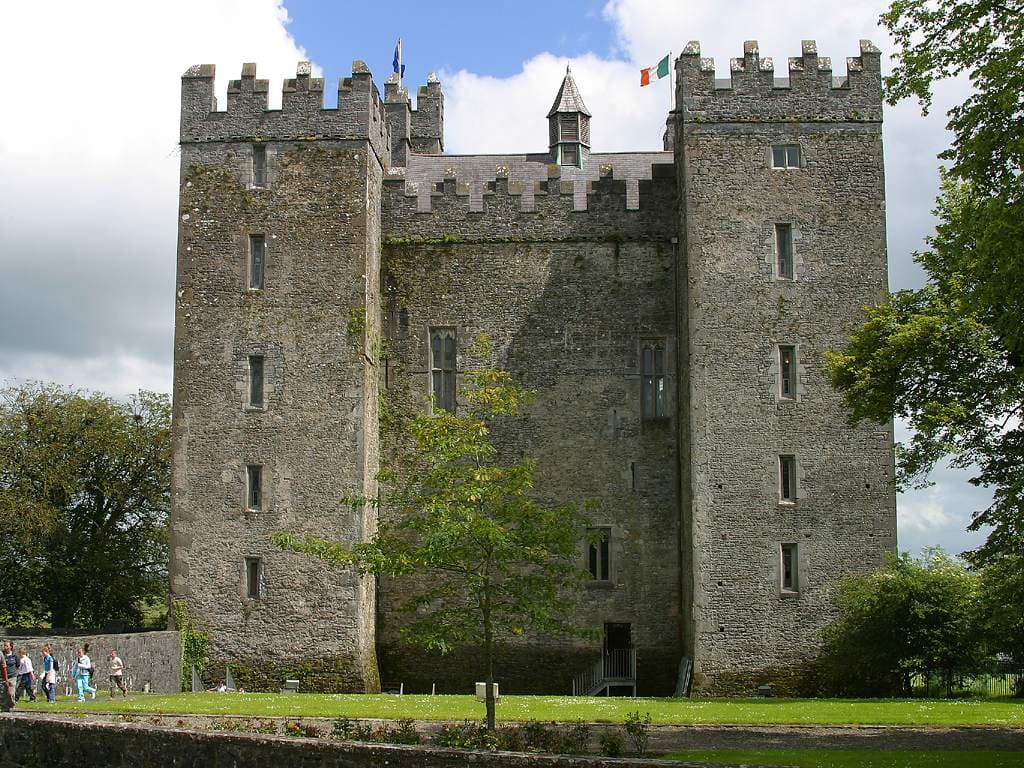
Bunratty Castle — Ireland castle

Bunratty Castle

Bunratty Castle: 15th-century tower house in County Clare, Ireland
Bunratty, Ireland
Late Medieval (14th–15th c.)
Well Preserved

Bunratty Castle (Irish: Caisleán Bhun Raithe) stands as one of the most complete and authentic examples of a 15th-century tower house in Ireland. Located in the heart of Bunratty village in County Clare, this imposing hill castle lies strategically near the N18 road connecting Limerick and Ennis, and close to Shannon Town and its airport. Its position made it a significant stronghold during the late medieval period, controlling access to important trade routes and local territories.

Architectural features and layout

The castle is a classic example of a late medieval Irish tower house, featuring a large rectangular keep with thick stone walls rising to four stories. The structure is surrounded by a curtain wall that encloses a courtyard, which historically contained various outbuildings and stables. The walls are punctuated by narrow slit windows and crenellated battlements designed for defense.

The main entrance is fortified with a heavy wooden door reinforced by iron, and protected by a murder hole and portcullis within the gatehouse. Inside, the castle contains a great hall on the first floor, used for receptions and banquets, with a large fireplace and intricately carved stonework. Above are private chambers and storage rooms, accessible via a narrow spiral staircase embedded within the thick walls.

Defensive elements

Bunratty Castle's design emphasizes defense against sieges and attacks common in the turbulent late medieval period. The curtain walls and battlements provided vantage points for archers and lookouts. The castle's elevated position on a slight hill enhanced visibility over the surrounding plains. The moat that once surrounded the castle has largely been filled in, but historical records confirm its presence as a deterrent to attackers.

Historical context and ownership

The castle was originally built in the early 15th century by the MacNamara family, a powerful Gaelic clan in the region. It later passed into the hands of the O'Briens, Earls of Thomond, who expanded and fortified the structure. Throughout its history, Bunratty Castle played a role in various conflicts, including local clan disputes and the wider English conquest of Ireland.

In the 17th century, the castle was involved in the Cromwellian conquest and changed hands multiple times. By the 18th century, it fell into disrepair and was abandoned as a residence. The castle's strategic importance diminished with changes in military technology and political stability.

Restoration and modern significance

In the mid-20th century, Bunratty Castle underwent extensive restoration to preserve its medieval character. The restoration aimed to maintain the authenticity of the stonework, interior chambers, and defensive features. Today, it is managed as a heritage site and tourist attraction, offering visitors a glimpse into medieval Irish life.

The castle hosts medieval banquets and cultural events that recreate the atmosphere of the late medieval period. Its well-preserved state and rich history make it one of Ireland's most visited castles, contributing to the understanding of late medieval architecture and society.

Surrounding area and visitor experience

Bunratty Castle is situated within a village that retains a traditional Irish character, with nearby attractions including the Bunratty Folk Park, an open-air museum showcasing rural Irish life from the past centuries. Visitors can explore the castle's courtyards, dungeons, and towers, with informative displays explaining its history and architecture.

The castle's proximity to major roads and Shannon Airport makes it accessible for tourists. Guided tours are available, offering detailed insights into the castle's construction, historical events, and the lives of its former inhabitants.

Frequently asked questions (FAQ)

How do I get to Bunratty Castle?
Bunratty Castle is located just off the N18 road, approximately 20 minutes from Shannon Airport. Visitors can reach the castle by car, public transport, or taxi services available in the area.
What is the historical significance of Bunratty Castle?
Bunratty Castle, dating back to the 15th century, is one of Ireland's most important medieval structures. It has played a significant role in Irish history, serving as a stronghold and a symbol of power during the tumultuous times of the past.
When was Bunratty Castle built?
Bunratty Castle was originally built in 1250 and has undergone several renovations throughout the centuries. The current structure was completed in 1425, showcasing impressive medieval architecture and historical artifacts.
Can I take guided tours of Bunratty Castle?
Yes, Bunratty Castle offers guided tours that provide visitors with an in-depth understanding of its history and architecture. Tours are available throughout the day and are led by knowledgeable guides who share fascinating stories about the castle.
Why is Bunratty Castle considered an architectural masterpiece?
Bunratty Castle is renowned for its well-preserved structure, intricate stonework, and stunning interiors. The castle's design reflects the typical characteristics of medieval fortifications, making it a prime example of 15th-century architecture.
Is it possible to visit Bunratty Castle year-round?
Yes, Bunratty Castle is open year-round, although opening hours may vary seasonally. It is advisable to check the official website for the most current hours and any potential closures due to events or maintenance.
What are the ticket prices for Bunratty Castle?
Ticket prices for Bunratty Castle vary based on age and group size, with discounts available for children, seniors, and families. It's best to purchase tickets in advance online to secure the best rates and avoid long lines at the entrance.
What is the best time to visit Bunratty Castle?
The best time to visit Bunratty Castle is during the spring and summer months when the weather is pleasant and the gardens are in full bloom. Additionally, special events and festivals often take place during this time, enriching the visitor experience.
What nearby attractions can I explore while visiting Bunratty Castle?
While visiting Bunratty Castle, you can also explore the Bunratty Folk Park, which showcases traditional Irish life and culture. Other nearby attractions include the scenic River Shannon and the charming village of Bunratty, making it an ideal spot for a full day of exploration.

Photo gallery

Bunratty Castle
Click to view

Photo by Jon Sullivan•Public domain

1 photo • Click any image to view in full screen

Information

Hill Castle

Loading map...

Visitor reviews

No reviews yet. Been here? Write the first review and help other travelers!

Write the first review

Visited this castle? Share your experience

Your review helps other travelers and adds first-hand knowledge to our encyclopedia.

Write a review

(5/5)

0/2000 characters

Your review will be visible after admin approval

Nearby castles

0.3 km

Bunratty Castle

Bunratty, United Kingdom

Bunratty Castle stands as one of Ireland's most iconic and well-preserved medieval fortresses, located in the village of Bunratty in County Clare. This large 15th-century stone tower house is a National Monument of Ireland and a major tourist attraction, celebrated for its authentic medieval architecture, rich history, and cultural significance. The castle's imposing structure, original defensive features, and extensive collection of period furnishings and artworks offer visitors a vivid glimpse into Ireland's late medieval period. The current castle, the fourth to be built on the site, was constructed around 1425 by the MacNamara family. It was later acquired and expanded by the powerful O'Brien clan, Earls of Thomond, who made Bunratty their principal seat by the early 16th century. The castle's history reflects the turbulent political and military landscape of medieval Ireland, including sieges, clan rivalries, and English colonial efforts. Medieval origins and early castles The site of Bunratty Castle has a history dating back to the 9th and 10th centuries when it was a Viking settlement and trading camp. Although no archaeological evidence pinpoints the exact location, historical records suggest that the area was destroyed by the High King Brian Boru in 977. In the mid-13th century, King Henry III granted the district to Robert de Muscegros, who likely constructed the first fortification, a wooden motte-and-bailey castle using local timber. This early castle served as a strategic center for Anglo-Norman control and was accompanied by market rights granted in 1253, marking the beginnings of organized settlement in Bunratty. The second castle was a stone fortress built by Thomas de Clare around 1276. This large lime-washed white tower was occupied until its destruction in 1318 during the Irish Bruce Wars. The castle was surrounded by a substantial ditch about 130 meters long. Unfortunately, no physical remains survive today as the stones were repurposed locally. A third castle was constructed in the 1350s as part of English efforts to secure the Shannon estuary. Led by Sir Thomas de Rokeby, this castle's exact location is uncertain but is traditionally thought to be near the site of the modern Bunratty Castle Hotel. It was soon destroyed by Irish clans, marking the end of its brief existence. The current castle: architecture and expansions The present Bunratty Castle was begun around 1425 by the MacNamara clan and completed by Sean Finn MacNamara. This large stone tower house exemplifies the defensive and residential architecture of the late medieval period in Ireland. It features thick stone walls, narrow windows for defense, and originally was surrounded by a ditch or fosse for protection. By around 1500, the castle came under the control of the O'Brien family, who expanded the structure and made it their chief residence, moving their seat from Ennis. The O'Briens added significant enhancements, including improved living quarters and defensive modifications, reflecting their status as the most powerful clan in Munster. The castle's interior today contains a remarkable collection of furnishings, tapestries, and works of art dating primarily from the 17th and 18th centuries, reflecting the castle's use and restoration over time. The Great Hall, chambers, and other rooms showcase medieval and post-medieval domestic life with authentic period decor. Architectural features Thick defensive walls designed to withstand sieges and attacks. Arrow slits and narrow windows for archers and defense. Large gatehouse controlling access to the courtyard. Ditch or fosse surrounding the castle as a defensive moat-like feature. Spacious great hall used for gatherings and feasts. Multiple towers providing vantage points and defense. Historical events and ownership changes Throughout its history, Bunratty Castle witnessed significant events reflecting Ireland's complex medieval and early modern periods. In 1558, Lord Lieutenant Thomas Radclyffe seized the castle from Donal O'Brien and granted it to his nephew Connor O'Brien. Connor's son, Donogh O'Brien, made improvements including installing a new lead roof, enhancing the castle's durability. During the Irish Confederate Wars of the 1640s, the castle played a strategic role. In 1646, English Parliamentary forces under Lord Forbes occupied the castle with the support of Barnabas O'Brien. The castle was defended by Rear-Admiral Penn but eventually surrendered after a siege to Confederate forces. Ownership remained with the O'Briens into the late 17th century. In 1712, Henry O'Brien, 8th Earl of Thomond, sold the castle and lands to Thomas Amory, who sold it to Thomas Studdert around 1720. The Studdert family abandoned the castle in favor of a more modern residence built in 1804, leading to the castle's decline. In the 19th century, the castle served as a Royal Irish Constabulary barracks, but by the late 1800s, the Great Hall roof had collapsed, and the castle was in serious disrepair. Restoration and modern use In 1956, the castle was purchased by the 7th Viscount Gort, who, with government support, undertook an extensive restoration project. The restoration stabilized the structure, reroofed the Great Hall, and preserved the castle from further decay. Since opening to the public in 1960, Bunratty Castle has operated as a museum showcasing its extensive collection of medieval furniture, tapestries, and artifacts. It is internationally renowned for its medieval banquets, which have been held regularly since 1963. These banquets feature traditional Irish food, music, and performances by the Bunratty Castle Entertainers, offering visitors an immersive historical experience. Adjacent to the castle is the Bunratty Folk Park, a 26-acre open-air museum recreating 19th-century rural Irish life. The park includes around 30 buildings such as farmhouses, a church, shops, and a walled garden, providing cultural context to the castle's history and the region's heritage. In 2023, ownership of Bunratty Castle transferred from Shannon Heritage to Clare County Council, ensuring continued preservation and public access as part of Ireland's rich cultural legacy. Visitor experience and significance Today, Bunratty Castle offers visitors a comprehensive historical experience combining architectural grandeur, authentic medieval atmosphere, and cultural entertainment. The castle's well-preserved interiors and extensive collections provide insight into the lifestyle of Irish nobility during the late medieval and early modern periods. The medieval banquets are a highlight for many visitors, featuring period costumes, music, and traditional cuisine served in the castle's atmospheric Great Hall. The adjoining Bunratty Folk Park complements the castle visit by showcasing rural Irish life, crafts, and traditions from the 19th century, making the site a unique cultural destination. As one of Ireland's most complete and authentic medieval castles, Bunratty Castle holds a significant place in Irish heritage and attracts visitors from around the world interested in history, architecture, and traditional Irish culture.

Late Medieval (14th–15th c.)
Details
7.3 km

Carrigogunnell Castle

, United Kingdom

Carrigogunnell Castle stands as a remarkable example of a medieval hill castle strategically perched on a volcanic rock outcrop near Clarina village in Ballybrown, Ireland. Its commanding position overlooking the River Shannon afforded it significant defensive advantages and a sweeping view of the surrounding landscape. The castle’s origins date back to at least the early 13th century, with the first historical mention in 1209 when King John of England acknowledged it as part of the lands held by Donnchad Cairbreach O’Brien, the King of Thomond. This early association with the powerful O’Brien dynasty highlights the castle’s importance as a regional stronghold during the High medieval period. The castle’s initial construction likely involved Gaelic Irish builders under O’Brien influence, combining native defensive techniques with emerging medieval fortification concepts. Over the centuries, Carrigogunnell evolved architecturally and politically, reflecting the turbulent history of Ireland through the late medieval and early modern eras. Significant building phases occurred around the mid-15th century and again during the 16th century, coinciding with the castle’s transition through various noble families, including the O’Connells and the Fitzgeralds. Historical context and ownership transitions Carrigogunnell Castle played a notable role in the shifting power dynamics of medieval Ireland. Initially under the control of the O’Brien family, it symbolized Gaelic authority in the region. The castle’s strategic location made it a coveted asset during the Tudor conquest of Ireland. In 1536, it was captured by Leonard Grey, the Lord Deputy of Ireland, during a campaign to assert English dominance. This seizure was marked by a brutal massacre of the garrison and local inhabitants, a grim event documented in contemporary accounts sent to London. During the mid-17th century, the castle saw relative quietude amid the Wars of the Three Kingdoms (1640–1651). It was controlled by a soldier named Captain Wilson, who implemented some modifications before selling it to Michael Boyle, later Archbishop of Dublin. The castle’s military significance resurfaced during the Williamite War in Ireland. In 1691, it was garrisoned by forces loyal to King James II during the second siege of Limerick but was captured by troops under Dutch General Godert de Ginckell. Subsequently, the castle was deliberately damaged to prevent further military use. Architectural features and layout Outer ward and defensive structures The castle’s layout is characterized by a roughly harp-shaped outer ward covering about one acre (0.40 hectares). This area includes a tower in the southwest corner and a large two-story building in the northeast corner, possibly a chapel, though its exact function remains uncertain. The outer walls, constructed from finely cut local limestone, demonstrate skilled masonry and contrast with the volcanic rock of the hill itself. The main southern gateway, serving as the primary entrance, is accessed via a gentle slope. It was modestly fortified, lacking flanking towers and featuring walls less than 1.5 meters thick. A smaller sally port on the western side provided quick access to the steep crags below. Defensive towers were strategically placed at wall junctions, though the overall fortifications suggest the castle was designed more as a fortified residence than a purely military fortress. Inner ward and keep The inner or upper ward is situated in the northwest corner of the site and contains a two-story range of buildings approximately 30 meters long along the west wall. These structures exhibit at least two phases of construction, indicating ongoing development over centuries. The most prominent feature is the five-story keep at the northwestmost point, rising over 15 meters tall. This keep includes a spiral staircase providing vertical access between floors and dates architecturally to the 14th or 15th century. By the early 20th century, only the outer walls and parts of the southern wall of the keep remained intact, reflecting considerable deterioration. Adjacent to the keep is a three-story residential building likely constructed in the 16th century, evidencing continuous habitation and adaptation of the castle complex over time. Cultural significance and local legends Carrigogunnell Castle is enveloped in local folklore, adding a rich mythic dimension to its historical narrative. The castle’s name, meaning "rock of the candle," is linked to a legend about a supernatural hag named Grana who is said to have lit an enchanted candle on the rock before the castle’s construction, casting a fatal spell over the site. This tale underscores the castle’s deep-rooted presence in the cultural imagination of the region. Beyond legend, the castle remains a powerful symbol of the medieval Gaelic aristocracy and the complex history of Ireland’s interactions with English rule. Its ruins continue to attract interest for their historical, architectural, and cultural value. Preservation and current condition Today, Carrigogunnell Castle stands as a partially preserved ruin. The volcanic rock outcrop and remaining structures provide a dramatic silhouette against the landscape. While some walls have collapsed, substantial portions of the outer ward, inner ward, and keep remain visible. The use of finely cut limestone in construction highlights the quality craftsmanship of its builders. The castle’s irregular internal layout reflects its dual role as a fortified residence rather than a fortress built solely for defense. This characteristic, combined with its historical significance and scenic location, makes Carrigogunnell a fascinating site for visitors and scholars interested in medieval Irish castles.

High Medieval (11th–13th c.)
Details
9.1 km

Dromoland Castle

Newmarket-on-Fergus, United Kingdom

Dromoland Castle stands as a quintessential example of an Irish castle that has gracefully transitioned from a historic fortress to a luxurious modern hotel. Located near Newmarket-on-Fergus in County Clare, Ireland, this castle is renowned not only for its rich heritage but also for its exceptional hospitality and cultural significance. The castle's origins trace back to a 15th or early 16th-century tower house, which served as the ancestral home of the O'Brien family, descendants of the High King of Ireland. The current structure, completed in 1835, is a grand example of 19th-century Gothic Revival architecture, characterized by its imposing battlements, turrets, and ornamental stonework. This architectural style sought to evoke the medieval past while incorporating modern comforts and aesthetics of the time. The castle's design reflects the romanticism of the era, blending defensive features with elegant residential quarters. Historical origins and architectural evolution The site of Dromoland Castle has been occupied since the late medieval period, initially featuring a tower house typical of Irish noble residences during the late medieval period. These tower houses were fortified stone structures designed for both defense and domestic living. Over the centuries, the castle underwent significant transformations, especially in the 19th century when the present mansion was constructed, replacing the earlier medieval buildings. The castle was historically the seat of the O'Brien clan, an influential Gaelic family with deep roots in Irish history. Their lineage includes the High Kings of Ireland, and Dromoland was a symbol of their power and prestige. The 19th-century reconstruction was commissioned by Sir Edward O'Brien, 4th Baronet, who sought to create a residence that combined the grandeur of a noble estate with the comforts of a modern mansion. Architectural features and grounds Dromoland Castle boasts a striking façade with , turrets, and pointed arch windows that emphasize its Gothic Revival style. The interior includes lavishly decorated rooms, grand halls, and period furnishings that reflect the castle's aristocratic heritage. The castle is surrounded by extensive parklands and gardens, which include a renowned golf course that complements the estate's luxury offerings. The castle's layout integrates traditional defensive elements such as thick stone walls and a gatehouse, though these features are largely symbolic in the current era of hospitality. The grounds offer scenic views of the Irish countryside, enhancing the visitor experience with natural beauty and historical ambiance. Transition to luxury hospitality In the late 20th century, Dromoland Castle was transformed into a 5-star luxury hotel, preserving its historic character while adapting to contemporary standards of comfort and service. The hotel features elegantly appointed guest rooms, fine dining options, and amenities such as a spa and conference facilities. The castle's restaurant, the Earl of Thomond, achieved a prestigious Michelin star in 1995 under the leadership of head chef Jean Baptiste Molinari. This accolade highlights the castle's commitment to culinary excellence and enhances its reputation as a premier destination. Notable guests and cultural significance Dromoland Castle has hosted a distinguished roster of guests, including United States Presidents George W. Bush and Bill Clinton, King Juan Carlos I of Spain, Nelson Mandela, Muhammad Ali, and numerous celebrities such as Richard Branson, Jack Nicholson, Johnny Cash, Michael Flatley, Bono, and John Travolta. Their visits underscore the castle's status as a symbol of luxury and historical prestige. As a member of Historic Hotels Worldwide, Dromoland Castle plays a vital role in preserving Ireland's cultural heritage while offering guests a unique experience that blends history, architecture, and modern luxury. Visitor experience and amenities Guests at Dromoland Castle enjoy a range of amenities including a championship golf course, spa services, and beautifully maintained gardens. The castle's interiors feature period furnishings, antique collections, and grand reception rooms that evoke the aristocratic lifestyle of its former inhabitants. The hotel also serves as a venue for weddings, conferences, and special events, making it a versatile destination that appeals to a broad audience. Its location in County Clare provides convenient access to other Irish landmarks and natural attractions, enhancing its appeal for tourists.

Modern (19th–20th c.)
Details
