Budapeszt
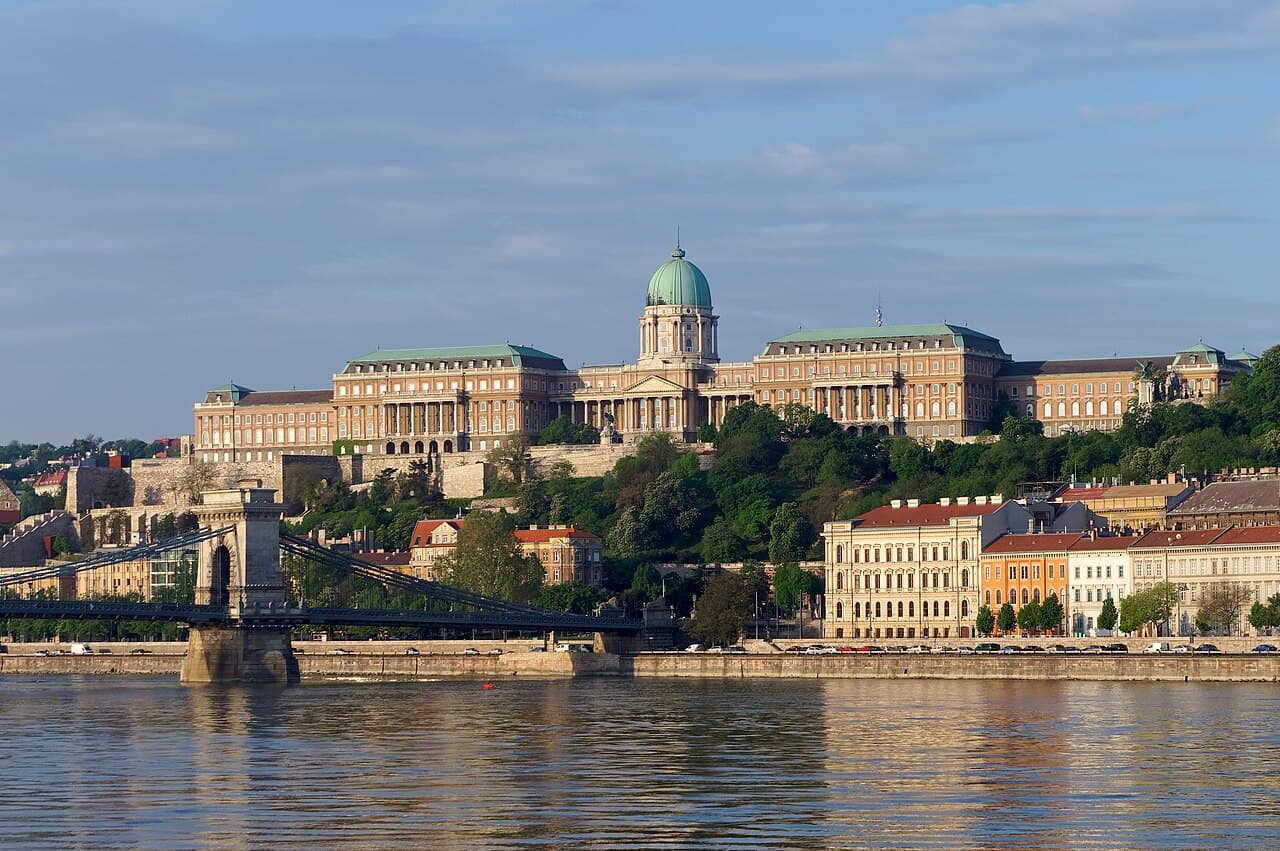
Buda Castle, located on the historic Castle Hill in Budapest, Hungary, stands as a monumental symbol of the city's rich royal heritage and architectural evolution. This palace castle complex, part of the Budapest UNESCO World Heritage Site, has origins dating back to the 13th century when the first royal fortress was constructed between 1247 and 1265 under the reign of King Béla IV. Although no physical traces of this initial structure remain, archaeological excavations have uncovered foundational elements such as the Stefan Tower, the oldest surviving part of the royal residence, built in the mid-14th century by Prince Stephen of Slavonia.
Medieval foundations and early expansions
The original royal castle was modest in scale but underwent significant expansions throughout the 14th century. In the 1380s, two rectangular wings were erected: the eastern wing, which housed the two-story castle chapel dedicated to the Virgin Mary, and the western wing, designed for residential purposes with a series of interconnected chambers. These expansions created a trapezoidal courtyard enclosed by a curtain wall and a prominent gate tower, with a deep moat separating the castle from the city below.
Gothic transformation under sigismund of luxembourg
The castle's most notable medieval transformation occurred between 1410 and 1419 under the auspices of Sigismund of Luxembourg, who ruled as King of Hungary, Germany, Bohemia, Italy, and Holy Roman Emperor. Sigismund commissioned the construction of the Friss-palota, a monumental third section of the castle between the city and the moat. The northern wing of this addition featured vast, three-story halls with impressive architectural details such as star-shaped vaulting supported by eight pillars in the lower hall and a rib-vaulted upper knights' hall adorned with richly carved wooden panels. The façade was enhanced by large six-part windows framed with tracery and pinnacles, demonstrating the castle's blend of defensive and representational functions.
Renaissance influences and the reign of matthias corvinus
The castle saw a renaissance makeover during the late 15th century under King Matthias Corvinus, who introduced Italian Renaissance elements brought by artists and craftsmen from Naples, accompanying his queen, Beatrix of Naples. This period saw the addition of an elegant Italian loggia to the courtyard and the creation of opulent royal chambers with gold-decorated vaults. The renowned Corvinian Library, one of Europe's richest Renaissance collections, was housed here. Matthias also initiated construction of a grand Renaissance palace on the eastern side of the complex, which remained unfinished due to his untimely death.
Turkish occupation and decline
The devastating Battle of Mohács in 1526 resulted in a crushing defeat for Hungary and ushered in nearly 150 years of Ottoman rule. The castle was captured by Ottoman forces in 1526 and suffered significant damage during the 1529 siege. The Ottoman administration used the castle primarily for military purposes, converting parts of it into barracks, stables, and storage, while neglecting the residential and ceremonial quarters. The construction of the Great Bastion on the southern tip of Castle Hill by Italian architects during the early period of Ottoman control is one of the few surviving elements from this era.
Habsburg era and baroque reconstruction
The castle was reclaimed from Ottoman control in 1686 after a prolonged siege that left much of the city and castle in ruins. An explosion in the Stefan Tower powder magazine during the siege caused extensive destruction to the medieval structures. The Habsburg rulers initially planned to rebuild the castle but eventually demolished the ruins in the early 18th century, filling in moats and leveling the terrain for new construction. In 1715, a new Baroque palace was built on the site, which unfortunately burned down in 1723. Later, in 1748, Count Antal Grassalkovich spearheaded a national fundraising campaign to rebuild the castle hill, resulting in a U-shaped Baroque palace with the consecration of the St. Sigismund Chapel in 1769.
19th-century expansions and the role of miklós ybl
Following a devastating fire in 1810 and political upheavals including the 1848 Hungarian Revolution, the castle underwent several restorations and changes in function. By the late 19th century, the Hungarian Parliament authorized a major expansion overseen by renowned architect Miklós Ybl, later continued by Alajos Hauszmann. The Baroque palace was almost doubled in size with a new western wing integrated into the hillside and additional floors added to harmonize the structure’s height. A new northern wing crowned with a dome bearing a replica of the Holy Crown of Hungary was constructed, culminating in the palace's grand inauguration in 1912. During the interwar period, the castle served as the residence of Regent Miklós Horthy.
World war ii destruction and postwar restoration
The castle suffered near-total destruction during the Siege of Budapest in World War II, when it was heavily bombarded by Soviet and German forces. Paradoxically, the devastation led to the discovery of significant medieval Gothic walls and foundations from the reigns of Sigismund and Matthias Corvinus. Between 1958 and 1962, under the direction of architect László Gerő, partial reconstruction efforts focused on the oldest Gothic sections, including the restoration of the ground and first floors of Sigismund’s palace, the Gothic Hall, the royal chapel with its rib-vaulted ceilings, the Great Rondella bastion, and the main gate. The reconstruction of the southern tower of the eastern wing sparked debate due to its full-height restoration, which some historians considered historically inaccurate.
Modern use and cultural significance
Today, Buda Castle is a vibrant cultural hub housing the Budapest History Museum, the Hungarian National Gallery, and the Széchényi National Library. Its historic courtyards, reconstructed Gothic elements, and Baroque palace interiors attract millions of visitors annually. The castle hill remains a lively district with museums, restaurants, shops, and residential areas, preserving the medieval street layout and architectural heritage. The extensive cellar network beneath the hill, formed by natural thermal caves and man-made tunnels, adds to the site's unique character and historical depth.
Access and visitor experience
Visitors can reach the castle via the historic Sikló funicular, a charming cable railway dating from 1870, or by ascending the grand Steps Reali staircase. The castle district offers a blend of medieval ambiance and modern amenities, making it a must-see destination for tourists exploring Budapest.
Frequently asked questions (FAQ)
- How do I get to Budapeszt Castle?
- Budapeszt Castle is conveniently located in the heart of Budapest, easily accessible by public transportation. You can take the metro to the Széll Kálmán tér station and then a short bus or tram ride will take you directly to the castle.
- What is the historical significance of Budapeszt Castle?
- Budapeszt Castle has a rich history, dating back to the 13th century when it served as a royal residence. It has witnessed numerous historical events and transformations, reflecting the changing tides of Hungarian and European history.
- When was Budapeszt Castle built?
- Construction of Budapeszt Castle began in the 13th century, although it has undergone various renovations and expansions over the centuries. The castle complex we see today features architectural styles from Gothic to Baroque, showcasing its evolution over time.
- Can I visit Budapeszt Castle year-round?
- Yes, Budapeszt Castle is open to visitors throughout the year, although certain areas may have seasonal hours. It’s advisable to check the official website for specific opening times and any special events that may affect access.
- Why is Budapeszt Castle a popular tourist attraction?
- Budapeszt Castle attracts visitors for its stunning architecture, breathtaking views of the Danube River, and its rich history. The castle is also home to several museums, making it an educational and cultural destination for travelers.
- Is it possible to take guided tours of Budapeszt Castle?
- Absolutely! Guided tours are available and can enhance your experience by providing in-depth historical context and insights into the castle’s architecture. Check in advance for tour schedules and availability.
- What are the ticket prices for Budapeszt Castle?
- Ticket prices for Budapeszt Castle vary depending on the areas you wish to visit and whether you opt for a guided tour. Discounts are often available for students and groups, so be sure to inquire when purchasing your tickets.
- What are the best times to visit Budapeszt Castle?
- The best times to visit Budapeszt Castle are in the spring and fall when the weather is mild, and the crowds are smaller. Early mornings or late afternoons are also ideal for enjoying the castle’s beauty with fewer tourists around.
- Are there any nearby attractions to Budapeszt Castle?
- Yes, there are several nearby attractions, including the Fisherman's Bastion and Matthias Church, both of which are within walking distance. Additionally, the charming streets of the Buda Castle District offer a variety of cafes, shops, and stunning views.
Photo gallery

Information
Website
Visit websiteSources & official resources
Verify the information above using these authoritative references.
Loading map...
Visitor reviews
No reviews yet. Been here? Write the first review and help other travelers!
Write the first reviewVisited this castle? Share your experience
Your review helps other travelers and adds first-hand knowledge to our encyclopedia.