Broughty Castle
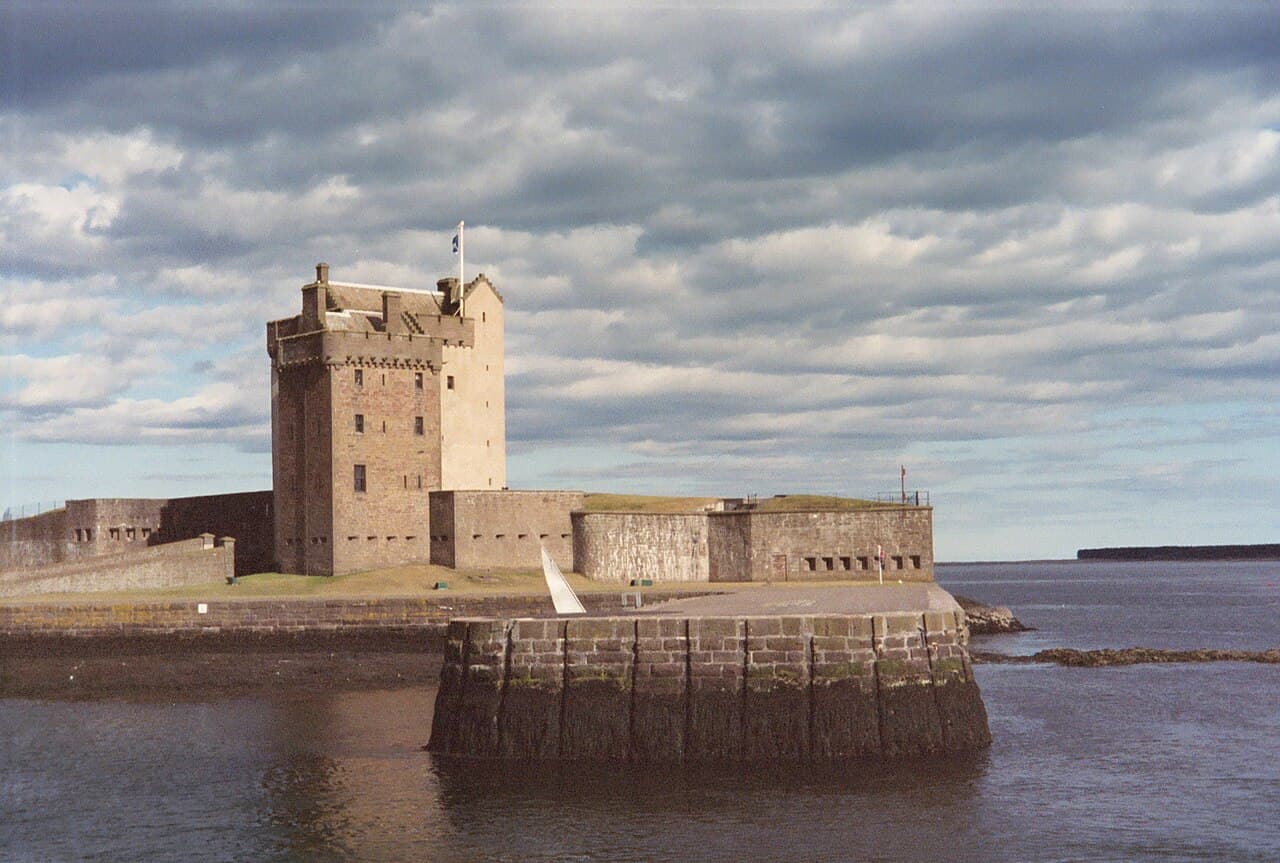
Broughty Castle stands as a significant late-medieval fortress on the banks of the River Tay in Broughty Ferry, Scotland. Completed around 1495, its origins trace back to earlier fortifications authorized in 1454. The castle's strategic location at the river mouth allowed it to control maritime access to the important cities of Dundee and Perth, making it a key military asset over several centuries.
Constructed initially under the direction of Andrew, 2nd Lord Gray, following a royal charter from King James IV, the castle was built in response to increasing threats from English naval forces. Its core is a robust four-story tower house that exemplifies the defensive architecture of the 15th century. Over time, Broughty Castle evolved through numerous phases of military enhancement, reflecting changing warfare technologies and geopolitical tensions.
Early history and medieval significance
The earliest fortifications on the site were established in 1454 when George Douglas, 4th Earl of Angus, received permission to build defenses. However, it was the construction initiated by Lord Gray in the 1490s that created the enduring structure that defines the castle today. The castle's design focused on a strong central tower with thick stone walls, battlements, and limited access points, typical of hill castles built to withstand sieges and artillery bombardment.
During the turbulent period known as the War of the Rough Wooing (1543–1551), Broughty Castle played a pivotal role. Following the Battle of Pinkie in 1547, the castle was captured by English forces without resistance, marking a strategic loss for Scotland. The English garrison enhanced the castle's defenses by adding a ditch on the landward side and fortifying a nearby hill, addressing vulnerabilities in the original medieval design.
In 1550, a combined French and Scottish force led by Paul de Thermes recaptured the castle after a six-day siege. This event underscored the castle's military importance and the broader Franco-Scottish alliance during this period. The castle later changed hands again during the Wars of the Three Kingdoms, with Parliamentary forces under General Monck taking it in 1651 without battle.
Architectural evolution and military enhancements
Following its military significance in the medieval period, Broughty Castle experienced phases of decline and renewal. After being sold by the Gray family in 1666, the castle gradually fell into disrepair. However, the 19th century brought renewed strategic interest due to changing geopolitical threats.
In 1846, the castle was acquired by the Edinburgh and Northern Railway Company to develop a harbor for their railway ferry. Later, the War Office took ownership in 1855 to protect the harbor from potential Russian naval attacks amid European tensions. This led to extensive rebuilding and modernization of the castle's defenses starting in 1860, under the guidance of architect Robert Rowand Anderson.
The 19th-century renovations transformed Broughty Castle into a modern artillery fortification. New walls and defensive structures were constructed around the original tower house, including a caponier for enfilading fire along the ditch, and emplacements for large artillery guns. The castle's courtyard was expanded, and additional buildings were erected to support the garrison, including accommodations for submarine miners who laid underwater mines in the Tay Estuary.
Between 1886 and 1891, further additions included a magazine for ammunition storage and remodeling of gun emplacements to accommodate evolving artillery technology. These enhancements reflected the castle's continued role as a coastal defense installation well into the 20th century.
20th-century military use and preservation
Broughty Castle remained an active military site until 1932. It was reactivated during both World Wars, underscoring its enduring strategic value. During World War I, the castle mounted two 4.7-inch Quick Firing naval guns, serving as a coastal defense post against potential naval threats.
In World War II, the castle's defenses were further updated, including the addition of a defense post atop the main tower to enhance observation and command capabilities. After the war, parts of the outer battery were demolished in 1967 to create recreational space, marking a shift from military to public use.
Since 1969, Broughty Castle has operated as a public museum managed by Dundee City Council and Leisure & Culture Dundee. The museum offers visitors insights into the castle's military history, the life and times of Broughty Ferry, and the local natural environment. It features exhibits on the castle's architectural evolution, its role in regional conflicts, and the wildlife of the Tay Estuary.
Despite proposals to close the museum in 2024 due to budget constraints, community efforts have emphasized the castle's cultural and heritage importance, advocating for its continued preservation and public access.
Architectural features and layout
The castle's layout centers on the four-story tower house built around 1495. This tower remains the heart of the site, strategically positioned on a promontory with natural water defenses on several sides. Its thick stone walls and narrow windows exemplify defensive design principles of the late medieval period.
The English garrison's enhancements during the Rough Wooing included a defensive ditch and fortifications on a nearby hill, addressing the castle's landward vulnerabilities. These earthworks remain visible and contribute to understanding the site's military adaptations.
The 19th-century additions significantly expanded the castle's defensive capacity. The reconstructed courtyard walls and new wings incorporated artillery emplacements and living quarters. The caponier on the southeast side allowed defenders to fire along the ditch, a key innovation in fortification design.
Additional structures include a small enclosure on the west side and buildings east of the castle built for submarine miners. The ammunition magazine constructed within the western enclosure reflects the logistical needs of a modern artillery fort. These features illustrate the castle's transformation from a medieval fortress to a complex coastal defense system.
Current status and heritage significance
Today, Broughty Castle is a scheduled monument, recognized for its architectural and historical significance. Its well-preserved core and extensive military adaptations provide a tangible record of Scotland's defensive strategies from the 15th century through the 20th century.
The castle's museum function allows public engagement with this rich heritage, offering educational programs and exhibitions. Its location near Dundee makes it accessible to visitors interested in Scottish history, military architecture, and coastal ecosystems.
Broughty Castle exemplifies the layering of historical periods and architectural styles, from its late medieval tower house origins to its 19th-century artillery fortifications and 20th-century military modifications. This continuity of use and adaptation highlights its enduring strategic importance and cultural value.
Frequently asked questions (FAQ)
- How do I get to Broughty Castle?
- Broughty Castle is easily accessible by public transport, with regular bus services operating from Dundee city center. If you are driving, there is parking available nearby, making it convenient for visitors to explore the castle and its surroundings.
- What is the historical significance of Broughty Castle?
- Broughty Castle, built in the 15th century, played a crucial role in defending the Firth of Tay against invasions. Its strategic location and well-preserved architecture provide insight into Scotland's military history and the turbulent times of the past.
- When was Broughty Castle last renovated?
- Broughty Castle underwent a significant restoration in the mid-20th century, which helped preserve its structure and historical features. The castle is now maintained by Historic Scotland, ensuring its longevity for future generations to enjoy.
- Can I take photographs inside Broughty Castle?
- Yes, photography is allowed inside Broughty Castle, making it a great opportunity to capture the stunning architecture and exhibits. However, please be respectful of other visitors and follow any specific guidelines provided by the staff.
- Why is Broughty Castle a popular tourist attraction?
- Broughty Castle is popular due to its fascinating history, stunning coastal views, and engaging exhibitions. Visitors enjoy exploring the castle's interior and learning about its role in Scotland's defense, making it a must-see for history enthusiasts.
- Is it possible to access Broughty Castle with a wheelchair?
- Yes, Broughty Castle is accessible for visitors with mobility challenges. The site offers wheelchair ramps and assistance, ensuring that everyone can enjoy the historical experience it offers.
- What are the opening hours for Broughty Castle?
- Broughty Castle is typically open daily from 10 AM to 5 PM, though hours may vary seasonally. It is advisable to check the official website for the most up-to-date information before planning your visit.
- Are there any nearby attractions to visit along with Broughty Castle?
- Yes, nearby attractions include the beautiful Broughty Ferry beach and the charming village with its shops and cafes. The area offers a pleasant combination of natural scenery and local culture, perfect for a full day of exploration.
- What are the ticket prices for Broughty Castle?
- Admission to Broughty Castle is usually free for all visitors, making it an affordable destination for families and tourists. Special exhibitions or events may have separate charges, so it's wise to check in advance for any upcoming activities.
Photo gallery

Photo by TimVickers•Public domain
Information
Website
Visit websiteSources & official resources
Verify the information above using these authoritative references.
Loading map...
Visitor reviews
No reviews yet. Been here? Write the first review and help other travelers!
Write the first reviewVisited this castle? Share your experience
Your review helps other travelers and adds first-hand knowledge to our encyclopedia.